Introduction
The Green Thorntail (Discosura conversii) is a small, forest-dwelling hummingbird of Central and north-western South America. It is known for the male’s brilliant green plumage, white rump band and unusually elongated, pointed tail feathers. The species is generally resident rather than migratory, although local movements may occur in response to food availability.
Physical Description
The Green Thorntail is a very small hummingbird. Adult males measure about 9.5 cm in length, largely because of their extended tail feathers, while females are shorter, at about 6.6 cm. Recorded body mass is approximately 3 g.
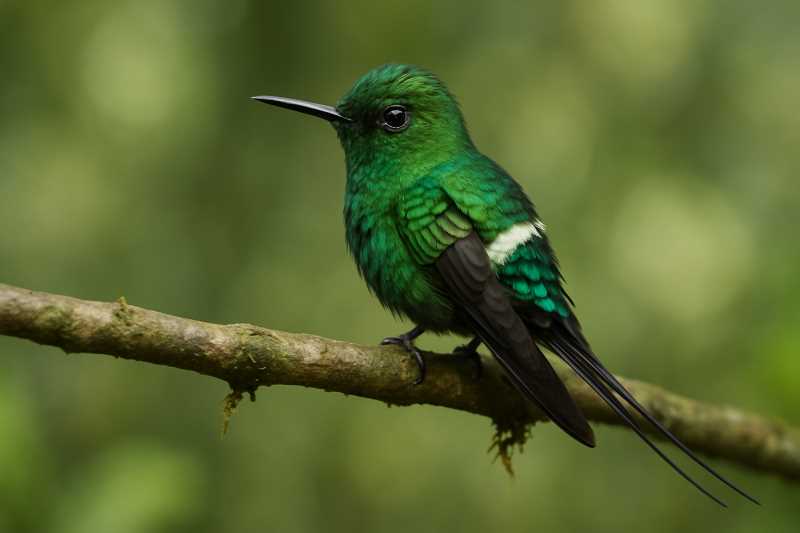
Males are predominantly shimmering green, with a darker green crown, metallic green throat and breast, and a coppery-bronze rump marked by a white band. The tail is blue-black, deeply forked and formed by narrow, pointed outer feathers that give the species its common name.
Females are less conspicuous. They have green upperparts, a darker rump, a shorter, notched tail and a distinctive white moustache-like malar stripe. The outer tail feathers have contrasting white areas, while the underparts are generally less intensely coloured than those of the male. Juveniles are expected to resemble females more closely than adult males, although detailed age-related information is limited.
Range and Habitat
The Green Thorntail occurs from Costa Rica through western Panama, western Colombia and western Ecuador. It is associated mainly with humid lowland and foothill forest, forest edges, clearings and gardens with flowering plants. It may occur in both primary and secondary forest, particularly where flowering shrubs, vines and trees provide feeding opportunities.
Most records are from elevations of roughly 700 to 1,400 metres, although the species can occur at lower elevations, especially during periods of increased flowering. It is usually encountered in the canopy and along forest edges, but may visit flowering plants and feeders at eye level.
Where to See This Species
Tapantí-Macizo de la Muerte National Park, Cartago Province, Costa Rica
Green Thorntail is included on bird checklists for Tapantí, a very wet protected area containing foothill and montane forest on the Talamanca range. Look along forest edges, flowering vegetation and suitable trails, particularly where the canopy is close to the road or path. The species is local and may require patient observation.
Nearby accommodation: The practical bases are Orosí and Cartago, where visitors can find guest houses, hotels and self-catering accommodation.
San Jorge de Milpe Bird Reserve, Pichincha Province, Ecuador
San Jorge de Milpe is a publicly accessible birding reserve in the Chocó foothills west of Quito, with humid forest, flowering plants and established birdwatching trails. Green Thorntails have been recorded at the reserve and are known to visit its hummingbird-feeding areas.
Nearby accommodation: Mindo is the main gateway settlement, with lodges, guest houses and small hotels suited to birdwatchers.
La Paz Waterfall Gardens, Alajuela Province, Costa Rica
This publicly accessible wildlife and forest-viewing venue lies in humid foothill habitat north of San José. Green Thorntails have been recorded at the site, including around flowering areas and hummingbird-feeding stations. The species may be easier to observe here than in dense forest, although sightings remain dependent on local conditions.
Nearby accommodation: Vara Blanca and the Poás area provide lodges, small hotels, guest houses and cabins.
Behaviour and Diet
The Green Thorntail is an agile, fast-flying hummingbird that can hover, dart between flowers and change direction rapidly. Males may defend feeding areas or display their plumage and tail during courtship, but detailed information about territorial behaviour is limited.
Its diet consists primarily of nectar from a range of forest and garden flowers. It also takes small insects and other arthropods, which provide protein and other nutrients. By transferring pollen between flowers while feeding, the species contributes to pollination, although its importance varies according to the plants available in each habitat.
Breeding biology is not well documented. The female builds a compact, deep open-cup nest using plant fibres and spider webs. Known nests have been placed on slender branches, plant stems or leaf petioles, sometimes several metres above the ground. Two white eggs have been recorded, but the duration of incubation and the timing of fledging are not sufficiently documented to state precise species-specific averages. The female is responsible for nest construction, incubation and care of the young, as in other hummingbirds.
Identification Tips
- Look for a tiny hummingbird with a conspicuous white band across the rump.
- The adult male is entirely green overall, with a metallic throat and a long, narrow, deeply forked blue-black tail.
- The female has a much shorter tail and a clear white moustache-like stripe on the face.
- The male’s elongated tail distinguishes it from most other small green hummingbirds in the same forests.
- Female coquettes may appear similar, but they generally lack the Green Thorntail’s distinctive white malar stripe.
- The species is often detected first by its rapid movement between flowers or by a brief, hovering visit to a feeder.
Conservation Status
The Green Thorntail is assessed as Least Concern on the IUCN Red List. It has a broad distribution and occurs in a number of protected areas, but it remains dependent on humid forest and flowering habitat.
The principal long-term concerns are deforestation, agricultural expansion, development and the gradual fragmentation of forest. Changes in flowering patterns caused by climate change may also affect local food availability, although the scale of this impact is not well established. Maintaining connected forest, protecting foothill and montane reserves, retaining native flowering plants and improving knowledge of the species’ breeding biology are important conservation measures.
Frequently Asked Questions
Where is the Green Thorntail found?
It occurs from Costa Rica through western Panama, western Colombia and western Ecuador, mainly in humid lowland, foothill and montane forest.
What does a male Green Thorntail look like?
The male is a tiny, shimmering green hummingbird with a white rump band and a long, narrow, deeply forked blue-black tail.
How can a female Green Thorntail be identified?
The female has a shorter, notched tail, green upperparts, contrasting white areas in the tail and a distinctive white moustache-like stripe on the face.
What does the Green Thorntail eat?
It feeds mainly on nectar from flowering plants and supplements its diet with small insects and other arthropods.
Is the Green Thorntail migratory?
It is generally regarded as a resident species rather than a long-distance migrant. Local movements may occur when flowering conditions change.
Is the Green Thorntail threatened?
The species is currently listed as Least Concern, but habitat loss and forest fragmentation remain important potential threats, particularly in areas undergoing agricultural or urban development.
References
- BirdLife International
- Cornell Lab of Ornithology, eBird
- Ornitología Neotropical
Related posts