Introduction
The Broad-tailed Hummingbird (Selasphorus platycercus) is a small, migratory hummingbird of mountain habitats in western North America. It is recognised for the male’s brilliant rose-magenta throat, green upperparts and distinctive wing trill. The species breeds in montane meadows and open woodlands, where it feeds on nectar and small invertebrates and contributes to the pollination of flowering plants.
Physical Description
The Broad-tailed Hummingbird measures approximately 9–10 cm in length and has a wingspan of about 13 cm. It weighs roughly 3–4 g, although mass varies with sex, season and condition.
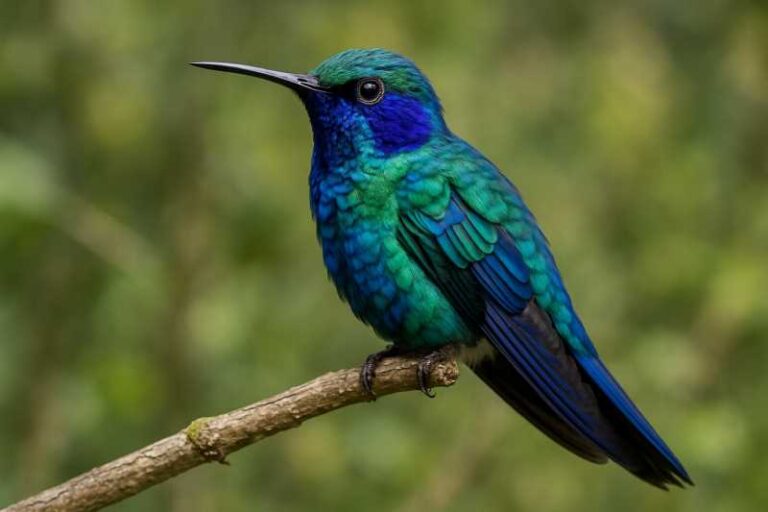
Both sexes have iridescent green upperparts, a pale eye-ring, a white breast and a rounded, dark tail. Adult males are readily recognised by their rose-magenta gorget, which can appear dark or brilliant depending on the light, and their green crown. Females lack the adult male’s bright throat patch and have a pale throat marked with fine dusky or bronzy speckles. Their flanks are often washed with cinnamon or buff.
Juveniles resemble females. Young males gradually develop scattered colour in the throat before acquiring the full adult gorget. The species’ relatively broad, rounded tail helps distinguish it from some other small western hummingbirds, although size and plumage can overlap between species.
Range and Habitat
The Broad-tailed Hummingbird occurs from western parts of Canada and the United States south through Mexico to the highlands of Guatemala. Northern populations are migratory, breeding in western mountain ranges during spring and summer before moving south for winter. Some populations in Mexico and Central America are more resident or make shorter seasonal movements.
During the breeding season, it favours montane meadows, forest openings, thickets and open woodland, including pine-oak, pinyon-juniper, evergreen and aspen habitats. It commonly breeds at elevations of approximately 1,500–3,200 metres, although local records vary. In winter, it uses flowering habitats in Mexican highlands and other suitable wooded or scrubby areas.
The species is often associated with flower-rich areas containing plants such as larkspur, red columbine, paintbrush, sage and scarlet gilia. It may also visit gardens and feeders where suitable habitat remains nearby.
Where to See This Species
Rocky Mountain National Park, Colorado, United States
Rocky Mountain National Park provides documented summer habitat for Broad-tailed Hummingbirds. They arrive in spring, often from April to early May, and can be found around montane meadows, forest openings and flowering shrubs. The park has also supported hummingbird surveys and banding work, making it a well-established location for observing the species during the breeding season.
Nearby accommodation: Estes Park is the main gateway settlement, with hotels, lodges, cabins, guest houses and campsites.
Bandelier National Monument, New Mexico, United States
The National Park Service reports Broad-tailed Hummingbirds as common through the summer at Bandelier National Monument, where they nest and raise young. Riparian areas, flowering vegetation and woodland edges are useful places to search from late spring through early autumn.
Nearby accommodation: Los Alamos is the nearest practical town for hotels, guest houses and self-catering accommodation, while Santa Fe offers a wider range of accommodation options.
Mesa Verde National Park, Colorado, United States
Broad-tailed Hummingbirds breed in Mesa Verde National Park, and long-term monitoring has documented the species among the park’s breeding hummingbirds. Look in woodland edges, shrub-rich areas and flower-filled openings during the warmer months.
Nearby accommodation: Cortez is the principal gateway town, with hotels, motels, guest houses and self-catering accommodation. Mancos also provides a smaller range of local accommodation.
Behaviour and Diet
Broad-tailed Hummingbirds are active during daylight and spend much of their time hovering, feeding and defending flower patches or feeders. Their wings beat rapidly during flight, producing the characteristic humming sound. Males are strongly territorial during the breeding season and chase intruders from productive feeding areas.
The male’s courtship display includes a steep climb followed by a rapid dive towards the female. The wings produce a loud, metallic trill during these flights. Males may also use similar aerial manoeuvres when challenging rivals.
Nectar provides energy and is taken from a wide range of flowers. The birds also eat small insects and spiders, which supply protein and other nutrients. They capture insects in the air, glean them from foliage or collect them from webs. Nesting females and growing young require particularly large amounts of animal protein.
The female alone builds the nest, incubates the eggs and feeds the young. The small cup-shaped nest is made from spider silk and other fine fibres, then camouflaged with moss, lichen, bark and plant material. It is commonly placed on a sheltered branch or in a shrub or thicket, often close to the ground.
A typical clutch contains two white eggs. Incubation lasts approximately 16–19 days, and the young generally remain in the nest for about 21–26 days. Adults may enter a state of torpor on cold nights, lowering their body temperature and conserving energy.
Identification Tips
- Look for a small hummingbird with a green back, pale eye-ring, white breast and rounded dark tail.
- Adult males have a vivid rose-magenta throat and a green crown. The throat may look black or dull when it is not catching the light.
- Females and juveniles have a pale, finely spotted throat and buff or cinnamon-coloured flanks.
- Listen for the male’s loud, metallic wing trill, especially around flowering meadows and forest openings.
- The Broad-tailed Hummingbird can resemble the Rufous Hummingbird, but Broad-tailed Hummingbirds usually show more extensive green on the back and lack the Rufous Hummingbird’s strongly rufous sides and back. The female Broad-tailed also tends to show a paler, more neutral appearance.
- It can also be confused with the Black-chinned Hummingbird. The Broad-tailed male has a rose-magenta gorget and a green crown, whereas the Black-chinned male has a dark throat with a narrow violet lower edge.
Conservation Status
The Broad-tailed Hummingbird is currently assessed as Least Concern by the IUCN Red List. Its broad distribution and use of a range of montane habitats mean that it is not presently considered globally threatened.
Local pressures may include the loss or alteration of mountain meadows, woodland edges and migration stopover habitat. Changes in flowering times, drought, severe weather and shifting temperature patterns may also affect nectar availability and breeding conditions. Protecting native vegetation, maintaining flowering habitat and limiting disturbance around active nests can support local populations.
Frequently Asked Questions
Where does the Broad-tailed Hummingbird live?
It lives in mountain meadows, forest openings, thickets and open woodland from western North America through Mexico to the highlands of Guatemala. Northern populations breed in the mountains and migrate south for winter.
When is the best time to see a Broad-tailed Hummingbird?
In the United States, the best period is generally late spring through summer, when the species is breeding in mountain habitats. Local timing varies with elevation and weather, but many birds can be seen from April or May into August or September.
What does the Broad-tailed Hummingbird eat?
It feeds mainly on flower nectar, supplemented by insects and spiders. Animal prey is especially important for females during nesting and for developing young.
How can you identify a male Broad-tailed Hummingbird?
The adult male has an iridescent green crown and back, a rose-magenta throat, a pale eye-ring and a rounded dark tail. Its loud metallic wing trill is also a useful identification clue.
Do Broad-tailed Hummingbirds migrate?
Many northern populations migrate between breeding grounds in the western United States and Canada and wintering areas in Mexico. Populations farther south may be resident or make shorter seasonal movements.
Do Broad-tailed Hummingbirds use feeders?
They may visit hummingbird feeders within their range, particularly where feeders are near suitable flowering habitat. Clean feeders regularly and use plain sugar water without colouring or other additives.
References
- Cornell Lab of Ornithology
- National Park Service
- IUCN Red List of Threatened Species
Related posts