Introduction
The Little Woodstar (Chaetocercus bombus) is a very small hummingbird in the family Trochilidae. It occurs locally in western South America, where it uses forest edges, clearings, scrub and seasonally moist or semi-deciduous woodland. Although easily overlooked because of its size and unobtrusive behaviour, it is recognised as a distinct, monotypic species. (ww.worldbirdnames.org)
Physical Description
The Little Woodstar measures approximately 6 to 7 centimetres in length. It has a short, straight black bill and marked sexual dimorphism.
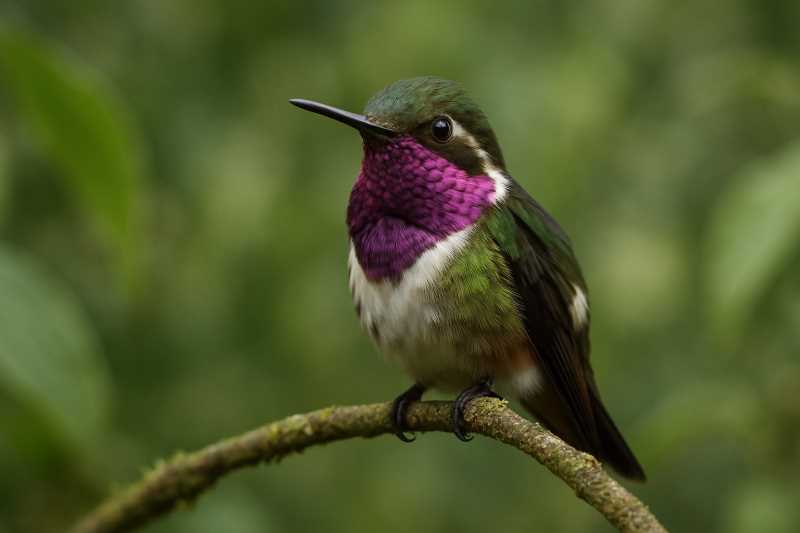
The adult male is mainly dark bronzy green or blue-green above and below. A buffy or whitish line behind the eye curves towards the upper breast, while the throat bears a small, brilliant rosy to magenta gorget. The tail is short and forked, with unusually narrow outer feathers that can give the bird a fine, wire-like appearance in flight.
The female lacks the bright gorget. She is bronzy green above and cinnamon or rufous-buff below, with tawny flanks and vent. Her tail is shorter and rounded, with warm rufous or cinnamon colouring and a dark subterminal band. Immature birds resemble females, and young males may not show the full adult throat colour immediately. Reliable published measurements for body mass vary, so a precise weight is not given here. (birdsofcolombia.com)
Range and Habitat
The Little Woodstar has a patchy distribution from south-western Colombia through western and, locally, eastern Ecuador to north-western and central Peru. It is not known to be a long-distance migrant, although local or seasonal movements may occur in response to flowering conditions.
It is associated with humid and semi-deciduous forest, forest margins, shrubby clearings, secondary growth and other transitional habitats where flowering plants are available. The species is often recorded at lower elevations and foothills, but it can occur higher in the Andes in suitable habitat. Records from Ecuador include the Yunguilla area at about 1,700 to 1,850 metres, illustrating that elevation can vary considerably between localities. (birdlifedata.blob.core.windows.net)
Where to See This Species
Yunguilla Reserve, Azuay, Ecuador
Yunguilla Reserve, near Girón in Azuay Province, is one of the better-documented places to look for the Little Woodstar. Museum records confirm the species there, and a published nesting record was obtained in the reserve. The bird has been associated with shrubby vegetation, bamboo patches, flowering edges and vegetation beside quebradas. Sightings are likely to be local and unpredictable, so quiet observation around flowering shrubs and forest margins is more useful than relying on hummingbird feeders alone. (asociacioncolombianadeornitologia.org)
Nearby accommodation: Girón is the nearest practical gateway town, with small hotels, guesthouses and self-catering accommodation suitable for visiting the reserve.
Behaviour and Diet
The Little Woodstar is a rapid, agile flier that can hover while taking nectar from flowers. It often works low to mid-level vegetation and may move through forest edges, scrub and clearings rather than remaining in dense forest. Its small size and relatively inconspicuous habits make it easy to miss, even where it is present.
Its diet consists mainly of nectar from flowering plants, supplemented by small insects and other arthropods that provide protein. Individuals may visit a succession of scattered flowers, and their movements between blossoms can contribute to pollination.
Breeding information is limited. The female builds a small cup-shaped nest, and available observations indicate that she undertakes incubation. A documented nest at Yunguilla was lined with pale plant fibres and camouflaged externally with lichens. It contained two white eggs. The precise incubation period and fledging period are not sufficiently documented for this species, so the commonly repeated figures of 15 to 18 days of incubation and three weeks to fledging should not be treated as confirmed. (asociacioncolombianadeornitologia.org)
Identification Tips
- Look for a very small hummingbird, about 6 to 7 centimetres long, with a short straight black bill.
- An adult male shows a rosy or magenta throat patch, a pale buffy line behind the eye and a forked tail with narrow outer feathers.
- A female or immature bird is greener above and cinnamon-buff below, with a short rounded tail marked by a dark band near the tip.
- The species is often seen near forest edges, scrub and flowering clearings rather than in the upper canopy.
- The female can be confused with other small woodstars. Check the warm cinnamon underparts and the rufous tail with a dark subterminal band. The White-bellied Woodstar generally appears paler below, although individual variation means that several features should be assessed together.
Conservation Status
The Little Woodstar is currently assessed as Near Threatened. Its range is fragmented, and the principal concern is the continuing loss and degradation of suitable forest, woodland and edge habitat through agricultural expansion, deforestation, development and other land-use changes. The species appears to be uncommon and local across much of its distribution, but a precise global population estimate should not be assumed from the available information.
Conservation priorities include protecting remaining forest fragments, maintaining flowering habitat and improving the management of reserves within its range. Sites such as Yunguilla demonstrate the value of protected areas and habitat-focused conservation for this poorly known hummingbird. (datazone.birdlife.org)
Frequently Asked Questions
Where can the Little Woodstar be found?
It occurs from south-western Colombia through Ecuador to north-western and central Peru. Its distribution is patchy, and it is usually encountered locally rather than evenly throughout the region.
What does the Little Woodstar look like?
It is a tiny hummingbird with a short black bill. Males have dark bronzy green plumage, a rosy or magenta throat patch and a forked tail. Females are bronzy green above and cinnamon-buff below, with a rounded tail.
What does the Little Woodstar eat?
It feeds mainly on nectar from flowering plants and also takes small insects and other arthropods.
Is the Little Woodstar migratory?
It is not generally regarded as a long-distance migrant. Local movements may occur when birds follow changing supplies of flowers.
Where is the best documented place to see this species?
Yunguilla Reserve in Azuay, Ecuador, is a well-documented locality with museum records, field observations and a published nesting record. The species remains difficult to find and sightings are not guaranteed.
What is the conservation status of the Little Woodstar?
The Little Woodstar is assessed as Near Threatened. Habitat loss and fragmentation are the main conservation concerns.
References
- BirdLife International
- IUCN Red List of Threatened Species
- Ornitología Colombiana
Related posts