Hudson’s Black Tyrant: A Comprehensive Overview
Hudson’s Black Tyrant (Knipolegus hudsoni) is a fascinating bird species belonging to the family Tyrannidae, which encompasses tyrant flycatchers. This bird is primarily found in South America, with its range extending across countries like Argentina, Bolivia, Brazil, and Paraguay. Known for its striking appearance and intriguing behaviors, the Hudson’s Black Tyrant is a subject of interest for ornithologists and birdwatchers alike.
Taxonomy and Nomenclature
The bird’s scientific name, Knipolegus hudsoni, is a tribute to the English naturalist and ornithologist William Henry Hudson, who made significant contributions to the study of South American avifauna. The genus name, Knipolegus, is derived from Greek, meaning ‘to cut’ and ‘to leap,’ which reflects the bird’s agile flight and foraging behavior.
Physical Description
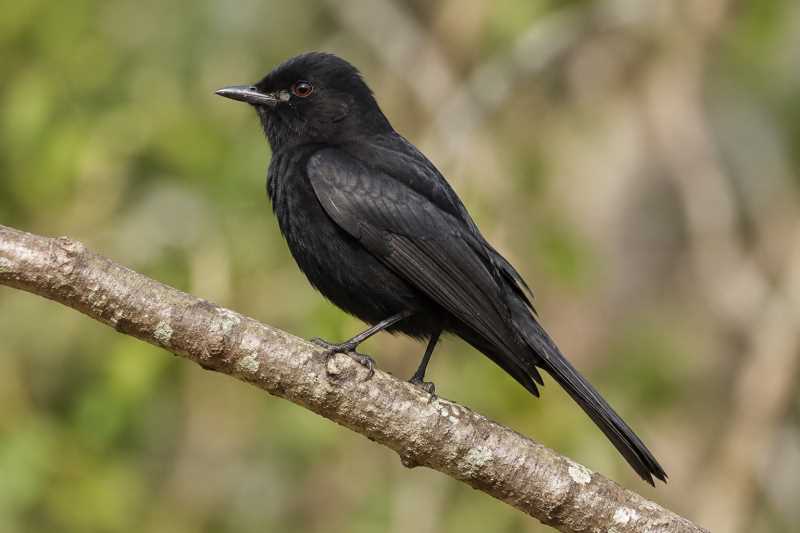
The Hudson’s Black Tyrant is a small to medium-sized bird, measuring approximately 15 to 16 centimeters in length. The male is predominantly black, featuring a glossy sheen that becomes particularly noticeable in bright sunlight. In contrast, the female is less vividly colored, with dark gray plumage that offers excellent camouflage against predators. Both genders have a slight crest on their heads, which can be raised or lowered depending on their mood or during courtship displays.
One of the distinguishing features of this species is its deeply forked tail, which aids in their agile flight. Their wings are also adapted for quick, darting movements, enabling them to catch insects mid-air with remarkable precision.
Habitat and Distribution
Hudson’s Black Tyrant inhabits a variety of ecosystems, ranging from subtropical or tropical dry forests to moist lowland forests and shrublands. They are also found in human-altered landscapes such as gardens and parks, demonstrating a degree of adaptability to changing environments. Their preference for open areas with scattered trees or shrubs makes them a common sight in savannas and grasslands as well.
This species is primarily sedentary, with some populations undertaking short-distance movements in response to seasonal changes in food availability. In regions with harsh winters or dry seasons, these birds may migrate to more hospitable areas, returning when conditions improve.
Diet and Foraging Behavior
As insectivores, Hudson’s Black Tyrants primarily feed on a wide variety of arthropods, including beetles, flies, and moths. They are adept at aerial hawking, a foraging technique where they catch insects in flight. This behavior is facilitated by their agile flight and sharp vision, allowing them to spot and capture prey effectively.
In addition to insects, these birds occasionally consume fruits and seeds, especially when insect populations dwindle. This dietary flexibility is crucial for survival in habitats where food resources can be unpredictable.
Breeding and Reproduction
The breeding season for Hudson’s Black Tyrant typically occurs during the spring and summer months, although this can vary slightly depending on geographical location. During this time, males engage in elaborate courtship displays to attract females. These displays often involve vocalizations, aerial acrobatics, and the presentation of their glossy plumage.
Once a pair bond is established, the female is responsible for building the nest, which is usually situated in a tree or shrub. The nest is cup-shaped and constructed from twigs, grass, and other plant materials, providing a secure environment for the eggs.
The female typically lays two to three eggs, which are incubated for about two weeks. Both parents participate in feeding and caring for the chicks once they hatch. The young birds fledge after approximately two to three weeks but remain dependent on their parents for food and protection for some time thereafter.
Conservation Status
Currently, Hudson’s Black Tyrant is listed as a species of Least Concern by the International Union for Conservation of Nature (IUCN). This status is attributed to their wide distribution and stable population numbers. However, like many bird species, they face potential threats from habitat destruction and climate change, which could impact their survival in the long term.
Conservation efforts aimed at preserving natural habitats and promoting sustainable land use practices are essential to ensuring the continued survival of this species. Additionally, further research into their ecology and behavior can provide valuable insights for conservation planning.
Observational Opportunities
For bird enthusiasts interested in observing Hudson’s Black Tyrant, the best opportunities arise in regions where they are known to inhabit. National parks and protected areas in South America are often ideal locations, as these environments offer the necessary conditions for the birds to thrive.
Equipped with a pair of binoculars and a field guide, birdwatchers can enjoy the challenge of spotting these elusive birds. Patience and a keen eye are essential, as their dark plumage can blend seamlessly into the shadows of their surroundings.
In conclusion, Hudson’s Black Tyrant is a remarkable species that contributes to the rich biodiversity of South America. Its adaptability, striking appearance, and engaging behaviors make it a captivating subject for study and observation. By understanding and appreciating this species, we can contribute to its conservation and ensure that future generations can continue to marvel at its beauty.
Related posts