Introduction
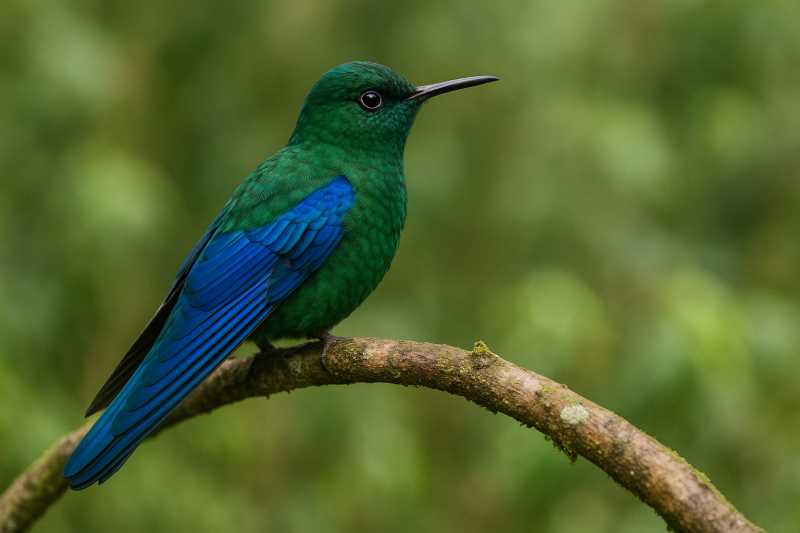
The Great Sapphirewing (Pterophanes cyanopterus) is a large Andean hummingbird found in high-elevation habitats from Colombia south through Ecuador and Peru to Bolivia. Its iridescent blue wings, green body and powerful flight make it one of the most distinctive hummingbirds of the páramo and upper montane zone.
Physical Description
The Great Sapphirewing is one of the largest hummingbirds, measuring about 15.5 cm from bill tip to tail. Its long, straight bill is approximately 3.6 cm long. Males weigh roughly 9.6–12 g, while females are slightly lighter at about 8.4–10 g.
Adult males have dark, shining blue-green upperparts and blue-green underparts, with strongly iridescent sapphire-blue wings. The tail is greenish black, and both sexes show a small white spot behind the eye. Females are duller overall, with dark green upperparts, a greyer crown, dusky wings and rufous or cinnamon-brown underparts. Their outer tail feathers usually show more white than those of males.
Young birds and females can appear less vividly coloured than adult males, but the species’ large size, long bill and blue wing panels remain useful identification features.
Range and Habitat
The Great Sapphirewing occurs in the Andes of Colombia, Ecuador, Peru and Bolivia. It is associated with humid montane forest edges, páramo, elfin woodland, Polylepis woodland, shrubby slopes and flowering clearings. It generally occurs at about 2,600–3,700 metres, although local records may extend beyond this range.
The species is not regarded as a long-distance migrant. Some individuals may make seasonal movements to lower elevations, particularly when food becomes less available at higher elevations. Regional variation is recognised, including the subspecies P. c. cyanopterus, P. c. caeruleus and P. c. peruvianus.
Where to See This Species
Yanacocha Reserve, Pichincha, Ecuador
Yanacocha Reserve protects high-elevation Andean forest and páramo habitat west of Quito. The reserve’s bird checklist documents the Great Sapphirewing, and the species may be looked for around flowering plants, forest edges and open montane vegetation.
Nearby accommodation: Quito is the nearest practical base, with hotels, guest houses and self-catering accommodation. Visitors may also find rural lodging in surrounding mountain communities.
Cajas National Park, Azuay, Ecuador
Cajas National Park contains high-elevation páramo, wetlands, Polylepis woodland and montane habitats where the Great Sapphirewing has been recorded. The Llaviuco area and other sheltered forest-edge sites are suitable places to search, although sightings may require patience.
Nearby accommodation: Cuenca is the main gateway, offering hotels, guest houses and self-catering accommodation. Rural lodging is also available in communities and accommodation areas near the park.
Behaviour and Diet
The Great Sapphirewing is active during the day and is usually seen flying rapidly between feeding areas, hovering at flowers or perching briefly in shrubs and trees. It may defend rich flower patches from other hummingbirds, but it can also use trap-line feeding, visiting a regular circuit of flowering plants.
Its diet consists mainly of nectar from shrubs, herbs and other flowering plants. It also captures small arthropods, either by gleaning them from foliage or by making short flights to catch flying insects. This animal protein is particularly important for growth and reproduction.
Breeding information remains limited. The breeding season is not precisely defined across the entire range, but records indicate activity during at least part of the wet season. The female is responsible for nest building, incubation and care of the young. A documented nest was made from moss and soft fibres and was suspended several metres above the ground. Detailed information on incubation and fledging periods is still scarce.
Identification Tips
- Look for a very large hummingbird with a long, straight bill and relatively slow, powerful wingbeats.
- In males, the deep sapphire-blue wings are the most striking feature, contrasting with dark green or blue-green body plumage.
- Both sexes usually show a small white spot behind the eye.
- Females are greener above and rufous or cinnamon below, with more white in the outer tail feathers.
- The female can resemble a Giant Hummingbird, but the Great Sapphirewing has green upperparts, lacks the Giant Hummingbird’s conspicuous white rump and is more closely associated with humid montane forest edges and páramo vegetation.
Conservation Status
The Great Sapphirewing is currently classified as Least Concern on the IUCN Red List. Its population size has not been reliably quantified, but it has a broad Andean distribution and is considered locally uncommon to locally common in different parts of its range.
Forest clearance, habitat fragmentation and changes to high-elevation flowering communities may affect local populations. The species tolerates some forest-edge habitat, but the protection of montane forest, páramo, Polylepis woodland and connected highland reserves remains important. Conservation measures include maintaining protected areas, safeguarding native vegetation and preserving flowering plants used by hummingbirds.
Frequently Asked Questions
Where is the Great Sapphirewing found?
It is found in the Andes of Colombia, Ecuador, Peru and Bolivia, mainly in high-elevation montane forest, páramo, elfin woodland and shrubby clearings.
How large is the Great Sapphirewing?
It measures about 15.5 cm long, including its bill and tail, making it one of the largest hummingbirds.
What does the Great Sapphirewing eat?
It feeds mainly on nectar from flowering plants and supplements its diet with small insects and other arthropods.
How can the Great Sapphirewing be identified?
The species is recognised by its large size, long straight bill, iridescent blue wings, green body plumage and small white spot behind the eye. Females have rufous underparts and more subdued colours.
Is the Great Sapphirewing migratory?
It is not considered a long-distance migrant, although some individuals may move to lower elevations seasonally in response to food availability.
Is the Great Sapphirewing endangered?
No. The species is currently assessed as Least Concern, although habitat loss and degradation may threaten local populations.
References
- IUCN Red List of Threatened Species
- Birds of the World
- Fundación Jocotoco
Related posts