Introduction
The Grey-tailed Mountaingem (Lampornis cinereicauda) is a small hummingbird endemic to Costa Rica. It belongs to the hummingbird family Trochilidae and is associated chiefly with the cool, forested mountains of the Talamanca Range. The species is recognised by BirdLife International and the IOC, although some taxonomic authorities have treated it as the grey-tailed form of the White-throated Mountaingem.
Physical Description
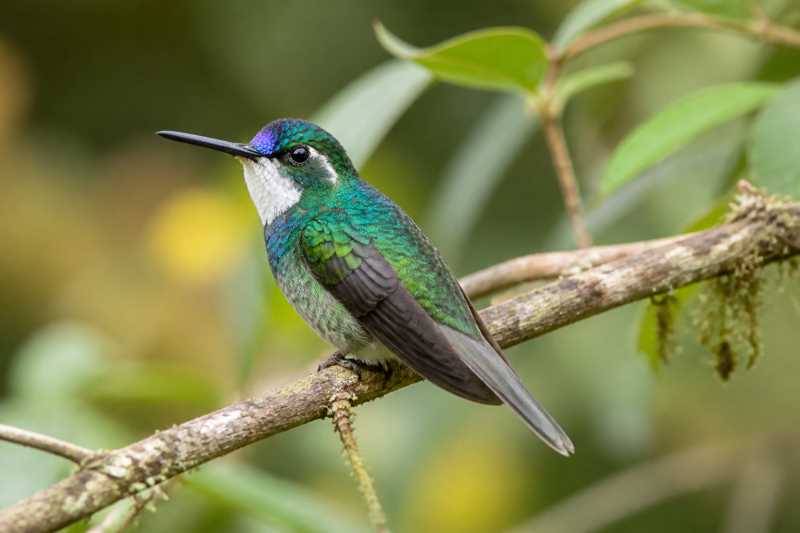
The Grey-tailed Mountaingem is a medium-sized hummingbird, measuring about 12 cm in length and weighing approximately 5 g. It has a straight, medium-length black bill, dark cheeks and a conspicuous pale stripe behind the eye.
Adult males have dark bronzy-green upperparts, a brighter emerald-green crown, a white chin and throat, green sides to the neck and upper breast, and darker greyish lower underparts. The tail is dark, with the grey or relatively pale outer feathers providing the feature reflected in the common name.
Females are less contrasting. They have mainly green upperparts, a less brightly marked head and throat, and paler, greyer-edged tail feathers. Juveniles are generally duller than adults, although detailed age-related plumage information is limited. As with other hummingbirds, the wings are adapted for sustained hovering and rapid manoeuvring while feeding.
Range and Habitat
The Grey-tailed Mountaingem is endemic to Costa Rica, where it occurs in the Talamanca mountain region, particularly in the highlands of the south-central part of the country. It is associated with humid montane and cloud forest, especially oak-dominated forest, forest edges, shrubby clearings and gardens close to remaining forest.
Records come from a broad elevational belt that includes middle and high mountain sites, with observations extending to approximately 2,700 to 3,300 metres in the Talamanca highlands. It may also move to different elevations in response to flowering conditions, and BirdLife International classifies it as an altitudinal migrant.
The species has a restricted distribution and is not a long-distance migrant. Its range lies within one of Costa Rica’s most important mountain regions for endemic birds. Taxonomic treatment has varied, and some checklists have included cinereicauda within Lampornis castaneoventris, but BirdLife International and the IOC list it as Lampornis cinereicauda.
Where to See This Species
Tapantí-Macizo de la Muerte National Park, Cartago, Costa Rica
A documented bird count in Tapantí-Macizo de la Muerte National Park and the adjoining Río Macho Forest Reserve recorded Grey-tailed Mountaingems on several routes. The park contains humid montane forest across a wide elevation range, making its forest trails and higher-elevation routes suitable places to search for the species. Look for hummingbirds along flowering plants, forest margins and clearings, particularly during periods of strong flowering activity.
Nearby accommodation: The towns of Orosi and Paraíso provide the most practical bases, with hotels, guest houses, lodges and self-catering accommodation available in the surrounding area.
Cloudbridge Nature Reserve, San José Province, Costa Rica
The Grey-tailed Mountaingem is included in the reserve’s montane cloud-forest bird records. Cloudbridge protects high-elevation forest and trails in the Talamanca region, with suitable habitat including forest interior, edges and flowering areas. The bird may be encountered while quietly watching flowering shrubs and canopy-level activity along the reserve trails.
Nearby accommodation: San Gerardo de Dota is the nearest established gateway area, offering lodges, guest houses, cabins and small hotels suited to birdwatchers.
Los Quetzales National Park, San José Province, Costa Rica
Grey-tailed Mountaingem records have been documented from Los Quetzales National Park, where high-elevation cloud forest and oak woodland provide appropriate habitat. The species is likely to be most rewarding during patient searches of forest edges, flowering vegetation and quieter trail sections rather than in open farmland.
Nearby accommodation: San Gerardo de Dota and the wider Dota Valley provide practical accommodation, including lodges, guest houses, cabins and small hotels.
Behaviour and Diet
The Grey-tailed Mountaingem is active during the day and is usually encountered alone. Like other mountaingems, it may defend productive feeding areas from other hummingbirds, particularly where flowering plants or feeders provide a concentrated food source.
Its diet consists mainly of nectar from a variety of flowering plants, including montane shrubs, epiphytes and other cloud-forest plants. It also captures small insects and spiders, which provide protein and other nutrients. It may forage within forest, along edges and in gardens near suitable mountain habitat.
Detailed species-specific information about courtship, nesting dates and parental care is limited. As in other hummingbirds, the female is expected to undertake nest construction, incubation and most care of the young, but exact breeding measurements and timing should not be assumed without site-specific evidence.
Identification Tips
- Look for a small, compact hummingbird with a straight black bill and a pale stripe behind the eye.
- Adult males show a green crown, green sides to the upper breast, a white throat and darker lower underparts.
- The greyish tail, especially the paler outer tail feathers, is an important feature when the bird is seen from behind or in flight.
- Females are less strongly marked and can be difficult to separate from other female Lampornis hummingbirds.
- In Costa Rica, compare it carefully with the Purple-throated Mountaingem. Male Grey-tailed Mountaingems have a white rather than purple throat, while females of the two forms can be considerably more difficult to distinguish.
- Plumage, location and elevation should be considered together because the Lampornis castaneoventris group has a history of differing taxonomic treatments.
Conservation Status
BirdLife International assesses the Grey-tailed Mountaingem as Least Concern. Its population size and current population trend are not reliably quantified in the available assessment.
The species has a restricted Costa Rican range and depends largely on humid montane and cloud-forest habitats. Forest clearance, agricultural expansion and changes to mountain rainfall and flowering patterns may reduce habitat quality or affect food availability. Maintaining connected high-elevation forest, protecting forest edges and supporting sustainable land use around protected areas are important conservation measures.
Frequently Asked Questions
Where is the Grey-tailed Mountaingem found?
It is endemic to Costa Rica and occurs mainly in the Talamanca mountain region, especially in humid montane and cloud forests of the south-central highlands.
Is the Grey-tailed Mountaingem migratory?
It is not a long-distance migrant. BirdLife International classifies it as an altitudinal migrant, meaning that it may move between elevations as conditions and food resources change.
What does the Grey-tailed Mountaingem eat?
It feeds mainly on nectar from flowering plants and supplements this diet with small insects and spiders.
How can it be identified?
Look for a small hummingbird with a straight black bill, a pale stripe behind the eye and a greyish tail. Males have a white throat, a green crown and dark lower underparts.
Where is the best place to look for this hummingbird?
Good documented locations include Tapantí-Macizo de la Muerte National Park, Cloudbridge Nature Reserve and Los Quetzales National Park. Forest edges, flowering plants and quiet cloud-forest trails are particularly worth checking.
Is the Grey-tailed Mountaingem threatened?
It is currently assessed as Least Concern, but its restricted range and dependence on mountain forest make habitat protection important. The available assessment does not provide a reliable population estimate or confirmed population trend.
References
- BirdLife International
- IOC World Bird List
- Cloudbridge Nature Reserve
Related posts