Introduction
The Tapajós Hermit (Phaethornis aethopygus) is a small hummingbird endemic to Brazil. It occurs in the southern and eastern Amazon, mainly in the forested region between the Tapajós, Teles Pires and Xingu rivers. Although it is not brightly coloured by hummingbird standards, its restricted range and specialised forest habitat make it an important species for Amazonian conservation.
Physical Description
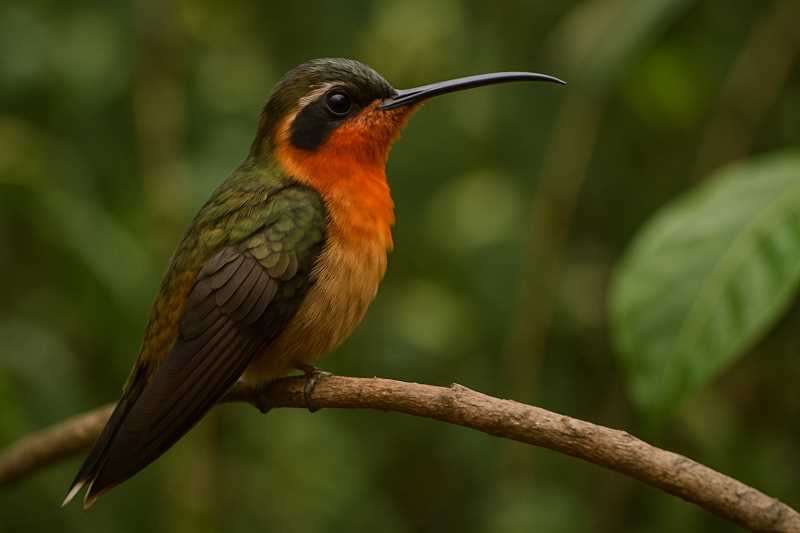
The Tapajós Hermit is a small to medium-sized hermit hummingbird, measuring about 9–10 centimetres in length. It has a slender, slightly curved bill suited to feeding from tubular flowers.
The upperparts are mainly metallic olive-green or bronze-green, with warmer reddish-brown tones on the rump and feather edges. The face is dark, with a pale supercilium and a contrasting pale malar or cheek stripe. The chin is whitish, while the throat is dark and the lower underparts are generally rufous or buffy. The wings and tail are dark, and the tail has elongated central feathers with conspicuous pale markings at the bases of several feathers.
Males and females are broadly similar, but females are usually paler, particularly on the underparts and rump. The male’s throat may appear darker, although the species does not show the strong sexual contrast seen in many other hummingbirds. Reliable information on juvenile plumage is limited.
Range and Habitat
The Tapajós Hermit is endemic to Brazil. Its distribution is centred on the Tapajós Endemism Centre, south of the Amazon River and between the Tapajós or Teles Pires and Xingu river systems. Records extend from the Tapajós region in Pará southwards towards northern Mato Grosso.
It is primarily associated with humid lowland terra firme forest, especially relatively intact primary forest and forest near streams or other moist areas. The species has also been recorded in selectively logged, burned or otherwise disturbed forest, but available assessments indicate that it remains dependent on forest habitat and is uncommon in heavily altered secondary vegetation.
The Tapajós Hermit is a resident species rather than a long-distance migrant. Its restricted distribution overlaps areas affected by deforestation, agricultural expansion, road construction and other development pressures.
Where to See This Species
Floresta Nacional do Tapajós, Pará, Brazil
The Floresta Nacional do Tapajós is one of the most reliable publicly accessible places to search for the species. The Tapajós Hermit has been documented in the reserve’s forest, including primary lowland forest, and the area supports important populations of range-restricted birds. Look along forest trails and in shaded understorey, particularly near flowering plants and streams. Visitor access and local guiding arrangements should be confirmed before travelling.
Nearby accommodation: Santarém and Belterra provide the main practical bases, with hotels, guest houses, lodges and other visitor accommodation.
Cristalino Reserve and Cristalino Lodge, Mato Grosso, Brazil
The private Cristalino Reserve near Alta Floresta lies within the species’ southern range and has documented Tapajós Hermit records. Guided forest trails, river margins and flowering areas provide suitable opportunities to search for this uncommon hummingbird. Access is generally arranged through the lodge, which offers guided wildlife and birdwatching activities.
Nearby accommodation: Accommodation is available at Cristalino Lodge, with additional hotels and guest houses in Alta Floresta.
Rio Azul Jungle Lodge, Novo Progresso, Pará, Brazil
Rio Azul Jungle Lodge is a recognised birdwatching venue in the Tapajós region where the Tapajós Hermit has been reported around flowering plants near the lodge and along forest trails. The surrounding forest and riverine landscape provide suitable habitat, although sightings are not guaranteed because the species is locally uncommon.
Nearby accommodation: The lodge itself provides accommodation, while Novo Progresso has additional hotels, guest houses and practical visitor services.
Behaviour and Diet
The Tapajós Hermit is generally found alone or in loose association with other forest birds. Like other hermits, it can hover while taking nectar and often moves through shaded understorey rather than remaining in exposed clearings. Its long, curved bill allows it to exploit tubular flowers that are inaccessible to many shorter-billed birds.
Nectar is an important food source, and the species is also thought to take small insects and other arthropods. These animal foods are especially valuable as sources of protein and may be important when feeding young.
Males have been observed displaying at leks, where several individuals sing and perform short flights from traditional perches. Details of the breeding season, nest construction and parental care remain poorly documented, so generalisations based on better-known hermit species should be treated cautiously.
By visiting flowers, the Tapajós Hermit may contribute to pollination within the forest, although the species-specific importance of this role has not been quantified.
Identification Tips
- Look for a small hermit with a dark face, pale eyebrow, dark throat and warm rufous or buffy underparts.
- The olive-green or bronze-green back contrasts with the reddish rump and darker wings.
- The tail is relatively rounded, with elongated central feathers and pale markings that can flash during flight.
- Search in shaded terra firme forest, especially along narrow trails, stream margins and flowering plants rather than in open gardens.
- The species is most likely to be confused with other small Phaethornis hermits in its range. Careful attention to the combination of dark throat, pale facial markings, rufous underparts and range is more reliable than any single feature.
- Vocalisations and habitat can be useful when the bird remains concealed, but visual separation from similar hermits may still be difficult without a good view.
Conservation Status
The Tapajós Hermit is classified as Vulnerable on the IUCN Red List. Its population size has not been reliably quantified, but the population is considered to be declining because of continuing habitat loss and degradation.
The main threats are deforestation, forest fragmentation, fires, agricultural expansion, infrastructure development and road-associated settlement. The paving and increased use of major transport routes through the species’ range may accelerate habitat conversion.
Protecting large, connected areas of Amazonian forest is central to the species’ conservation. Important measures also include effective management of protected areas, limiting forest fires, maintaining habitat along rivers and streams, improving knowledge of the species’ distribution and breeding biology, and monitoring populations in areas affected by development.
Frequently Asked Questions
Where does the Tapajós Hermit live?
The species is endemic to Brazil and occurs mainly in the southern and eastern Amazon between the Tapajós, Teles Pires and Xingu river systems. It is most closely associated with humid lowland forest.
Is the Tapajós Hermit a migratory bird?
No. It is regarded as a resident species and is not known to undertake regular long-distance migration.
What does the Tapajós Hermit eat?
It feeds mainly on nectar from flowers and is also believed to take small insects and other arthropods. The animal component of its diet probably provides important protein.
How can the Tapajós Hermit be identified?
Useful field marks include the small size, bronze-green upperparts, dark face and throat, pale eyebrow and warm rufous or buffy underparts. Its restricted range and preference for shaded forest also help with identification.
Is the Tapajós Hermit threatened?
Yes. The species is classified as Vulnerable because its restricted forest range is being affected by deforestation, fires, fragmentation, roads and other development.
Where is the best place to look for this hummingbird?
The Floresta Nacional do Tapajós, Cristalino Reserve and Rio Azul Jungle Lodge are documented wildlife-viewing locations within its range. Local guides and recent bird records can improve the chances of finding this uncommon species.
References
- BirdLife International
- Birds of the World
- Instituto Chico Mendes de Conservação da Biodiversidade
Related posts