Introduction
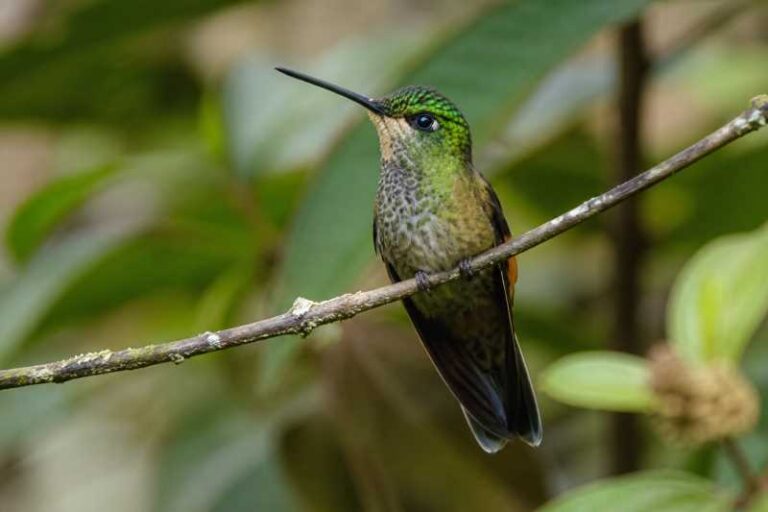
The Green Mango (Anthracothorax viridis) is a large hummingbird endemic to Puerto Rico. It is chiefly associated with humid mountain forests, forest edges and shaded coffee plantations, particularly in the island’s central and western highlands. Its deep green plumage, bluish tail and long, curved bill distinguish it from several other Puerto Rican hummingbirds.
Physical Description
The Green Mango measures approximately 11 to 14 centimetres in length. Adults are predominantly emerald green above and below, with metallic blue-green tones on the throat and underparts. The tail is dark blue to blue-black, often with pale or white tips on some feathers.
The bill is long and slightly decurved, an adaptation for reaching nectar in tubular flowers. Both sexes are very similar in appearance. Females may show a small pale spot behind the eye, but this feature can be difficult to see in the field. Reliable descriptions of juvenile plumage are limited, so young birds are best identified by their overall structure, bill shape, habitat and association with adults.
As in other hummingbirds, the wings produce a humming sound during rapid flight. Wingbeat speed varies with flight behaviour and should not be treated as a fixed field character.
Range and Habitat
The Green Mango is endemic to Puerto Rico and is a resident species rather than a long-distance migrant. It is most strongly associated with humid forests in the central and western mountains, including lower montane forest, forest edges and shaded coffee plantations. It also occurs locally in suitable forest in eastern Puerto Rico.
The species has been recorded mainly between about 800 and 1,200 metres above sea level, although it can occur at lower elevations where appropriate forest habitat and flowering plants are available. It is generally less typical of exposed coastal habitats and dry lowlands than the Puerto Rican Mango and some other hummingbirds.
Where to See This Species
Maricao State Forest, Maricao, Puerto Rico
Maricao State Forest is one of the most reliable public sites for Green Mango because it protects humid mountain forest and forest-edge habitat in the western highlands. The species is documented from the forest, and flowering vegetation along roads and trails can provide feeding opportunities. Early morning is generally the most productive time for observing hummingbirds.
Nearby accommodation: The town of Maricao and nearby western mountain communities provide guest houses, small inns and self-catering accommodation.
Río Abajo State Forest, Arecibo and Utuado, Puerto Rico
Río Abajo State Forest contains extensive forest and karst habitat in north-central Puerto Rico, and Green Mango has been documented there. Look along forest roads, clearings and edges with flowering plants, while also allowing time to observe other Puerto Rican endemic birds.
Nearby accommodation: Arecibo and Utuado are the nearest practical service towns, with hotels, guest houses and self-catering accommodation.
El Yunque National Forest, Río Grande and surrounding municipalities, Puerto Rico
El Yunque provides publicly accessible humid montane and rainforest habitat in eastern Puerto Rico. Green Mango is associated with the forest’s interior and mid- to higher-elevation zones, although it may be less conspicuous there than in parts of the western mountains. Visitors should check current Forest Service access information before travelling because conditions and access arrangements can change.
Nearby accommodation: Río Grande, Luquillo and surrounding communities offer hotels, guest houses, cabins and holiday rentals.
Behaviour and Diet
The Green Mango is diurnal and usually forages alone. Males can be strongly territorial, defending flowering trees and feeding areas from other hummingbirds. Individuals may move between elevations or forest zones as flowering conditions change, but the species is not considered migratory in the usual long-distance sense.
Nectar from trees, shrubs, vines and other flowering plants provides most of its energy. The bird also takes small arthropods, including insects and spiders, which supply protein. It may catch insects in flight or pick spiders and other small prey from vegetation and bark. By visiting flowers, it can contribute to pollination within Puerto Rico’s forest ecosystems.
Breeding has been recorded in several months, and atlas data indicate that breeding may occur throughout the year rather than being restricted to the March-to-July period sometimes reported in older summaries. The female builds a small cup-shaped nest from plant fibres and spider silk, often decorating the outside with lichens. A normal clutch consists of two eggs. The female alone is responsible for nest construction and incubation, while the young are dependent on her after hatching.
Identification Tips
- Look for a relatively large hummingbird with an overall green appearance and a long, slightly curved bill.
- Note the bluish-green throat and underparts, together with the dark blue or blue-black tail.
- Search humid mountain forest, shaded coffee plantations and forest edges, especially at middle and higher elevations.
- The sexes are alike, so sex is usually not a useful field distinction.
- The Green Mango may be confused with the Puerto Rican Mango or Green-throated Carib. Green Mango is most closely associated with humid upland forest, while the other species are often more typical of lower, more open or drier habitats. Habitat should support, not replace, careful attention to plumage and bill shape.
- Because hummingbirds can change appearance with angle and light, do not rely on the apparent brightness of the green plumage alone.
Conservation Status
The Green Mango is currently assessed as Least Concern on the IUCN Red List. Its population size and long-term population trend have not been quantified, but the available assessment does not indicate a decline severe enough to meet the thresholds for a threatened category.
The species nevertheless depends on the continued protection of humid mountain forests, forest edges and shaded agricultural landscapes. Habitat conversion, degradation of flowering plant communities and the effects of severe storms or other environmental changes may reduce local feeding and nesting opportunities. Maintaining connected forest, protecting mature vegetation and retaining shade trees in coffee-growing areas are important conservation measures.
Frequently Asked Questions
Where is the Green Mango found?
The Green Mango is endemic to Puerto Rico. It is most frequent in humid mountain forests and shaded coffee plantations, particularly in the central and western highlands, with local records in the east.
Is the Green Mango migratory?
No. It is considered a resident species. Individuals may make local or altitudinal movements in response to flowering conditions, but it does not undertake regular long-distance migration.
What does the Green Mango eat?
It feeds mainly on flower nectar and supplements its diet with small insects, other arthropods and spiders. Animal prey is particularly important as a source of protein.
How can the Green Mango be identified?
Look for a large, mostly green hummingbird with a long, slightly decurved bill, bluish-green underparts and a dark blue or blue-black tail. It is most likely to be encountered in humid upland forest.
Where is the best place to see a Green Mango in Puerto Rico?
Maricao State Forest is widely regarded as one of the more reliable public locations. Río Abajo State Forest and suitable parts of El Yunque National Forest are also documented sites, although sightings are never guaranteed.
Is the Green Mango endangered?
No. The species is currently listed as Least Concern by the IUCN. Its population is not well quantified, so continued protection of mountain forest and flowering habitat remains important.
References
- IUCN Red List of Threatened Species
- The Puerto Rico Breeding Bird Atlas
- United States Department of Agriculture Forest Service
Related posts