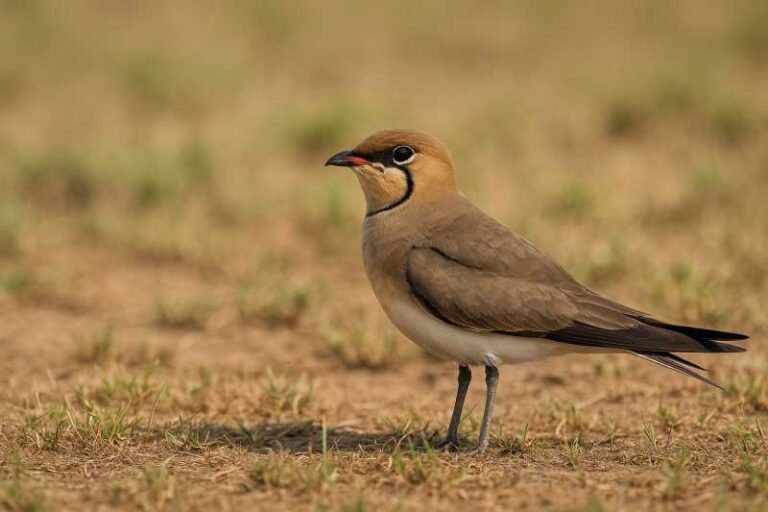
Introduction
The Stripe-faced Wood Quail (Odontophorus balliviani) is a secretive New World quail of the eastern Andes. It occurs in montane forest in south-eastern Peru and western Bolivia, where it usually remains hidden in dense vegetation and is more often heard than seen. The species is also known as the Stripe-faced Wood-quail in some taxonomic and conservation sources. [1][2]
Physical Description
The Stripe-faced Wood Quail is a compact, medium-sized ground bird measuring approximately 23–24 cm in length. Its plumage is predominantly brown and rufous, with darker vermiculation on the upperparts and contrasting pale markings on the throat, breast and belly.
The face has distinctive black and buff striping, together with a patch of bare reddish skin around the eye. The crown and crest are chestnut, and the underparts bear pale streaks or diamond-shaped markings. These features are more useful for identification than the bird’s generally cryptic brown body colour.
Males and females are similar, although females are generally paler brown above and more rufous below. Regional variation has been reported, with birds from Cochabamba appearing more rufous than those from La Paz. Reliable information on juvenile plumage and age-related differences is limited. [3][4]
Range and Habitat
The species is restricted to the eastern slopes of the Andes in south-eastern Peru and western Bolivia. Its recorded range includes parts of the Peruvian departments of Cusco and Puno and the Bolivian departments of La Paz and Cochabamba, with records extending through humid Andean forest farther south and east in Bolivia.
It inhabits humid and seasonally dry montane forest, including upper Yungas forest, cloud forest, stunted forest near the tree line and areas with dense undergrowth. Tree ferns, bamboo and epiphytes are characteristic elements of suitable habitat. It may also use young second growth, forest clearings and, near timberline, adjacent puna grassland.
Reported elevations range broadly from about 1,000 to 3,050 metres, although local records and habitat descriptions vary. The Stripe-faced Wood Quail is considered resident rather than migratory, and no regular long-distance migration is known. [3][4][5]
Behaviour and Diet
This wood quail is secretive and predominantly terrestrial. It moves through leaf litter and dense undergrowth, where its rounded body and brown plumage provide effective camouflage. Individuals are often detected by their calls, particularly in the early morning or late afternoon, rather than by direct observation.
The species may occur in pairs or small groups, and vocal communication is likely important for maintaining contact in thick forest. Its diet is not well documented, but available accounts describe ground foraging for seeds, fallen fruit and small invertebrates. Scratching through leaf litter is an important part of its feeding behaviour.
Breeding information is scarce. Ground nesting has been reported for wood quails, but the breeding season, nest construction, clutch size, incubation and parental care of the Stripe-faced Wood Quail have not been sufficiently documented to support confident species-specific detail. [3][4]
Identification Tips
Look for the following combination of features:
- A compact, short-tailed quail moving on the forest floor.
- Strong black-and-buff facial striping.
- Bare reddish skin around the eye.
- Chestnut crown and crest.
- Brown upperparts with darker markings.
- Pale streaking or diamond-shaped spots on the throat, breast and belly.
- A preference for dense montane forest, where it may be heard before it is seen.
The facial pattern is the most useful field mark. The species can be confused with other wood quails in overlapping Andean forests, especially the Rufous-breasted Wood Quail (Odontophorus speciosus). Habitat, range and the Stripe-faced Wood Quail’s sharply marked face should be considered together when identification is uncertain. [3][4]
Conservation Status
The Stripe-faced Wood Quail is currently assessed as Least Concern on the IUCN Red List. This category reflects its present global assessment and does not indicate that the species is common or well studied. Population size and population trend are poorly documented because the bird is difficult to detect and survey.
The principal conservation concern is the loss and degradation of montane forest through agricultural expansion, logging, road development and other forms of human encroachment. Protecting humid Andean forest, maintaining habitat connectivity and improving field surveys would assist long-term conservation of the species. [1][5]
Frequently Asked Questions
Where does the Stripe-faced Wood Quail live?
It lives on the eastern slopes of the Andes in south-eastern Peru and western Bolivia, mainly in humid montane and Yungas forests.
What does the Stripe-faced Wood Quail look like?
It is a 23–24 cm brown and rufous quail with prominent black-and-buff facial stripes, a chestnut crown and crest, and pale markings on the underparts.
Is the Stripe-faced Wood Quail migratory?
It is regarded as a resident species. No regular long-distance migration has been documented.
What does the Stripe-faced Wood Quail eat?
Its diet is not fully documented, but it is reported to forage on the forest floor for seeds, fallen fruit and small invertebrates.
Why is the Stripe-faced Wood Quail difficult to see?
It moves quietly through dense undergrowth and leaf litter, and its brown plumage provides strong camouflage. Observers often hear its calls without seeing the bird.
Is the Stripe-faced Wood Quail endangered?
It is currently assessed as Least Concern, although habitat loss and the lack of reliable population data remain important conservation concerns.
References
- BirdLife International. 2026. Stripe-faced Wood-quail Odontophorus balliviani Species Factsheet. BirdLife DataZone. Available at: https://datazone.birdlife.org/species/factsheet/stripe-faced-wood-quail-odontophorus-balliviani (accessed 8 September 2026).
- Carroll, J. P. and Kirwan, G. M. 2020. Stripe-faced Wood-Quail (Odontophorus balliviani). In Birds of the World. Cornell Lab of Ornithology, Ithaca, New York. https://doi.org/10.2173/bow.sfwqua1.01 (accessed 8 September 2026).
- Gill, F., Donsker, D. and Rasmussen, P., eds. 2026. IOC World Bird List, version 15.2. International Ornithologists’ Union. Available at: https://www.worldbirdnames.org/ (accessed 8 September 2026).
- Birds of Bolivia. 2019. Odontophorus balliviani, Stripe-faced Wood-Quail. Species fact sheet. Available at: https://birdsofbolivia.org/species-fact-sheets-2/tinamous-perdices/odontophorus-balliviani/ (accessed 8 September 2026).
- International Union for Conservation of Nature. 2026. The IUCN Red List of Threatened Species. Species assessments and Red List categories. Available at: https://www.iucnredlist.org/ (accessed 8 September 2026).
- International Union for Conservation of Nature. 2024. IUCN Red List version 2024-1: Table 7, Species changing IUCN Red List Status. IUCN, Gland, Switzerland. Available at: https://nc.iucnredlist.org/redlist/content/attachment_files/2024-1_RL_Table_7_corrected_20240916.pdf (accessed 8 September 2026).
Related posts