Introduction
The Coral-billed Ground Cuckoo (Carpococcyx renauldi) is a large, elusive, ground-dwelling cuckoo of mainland South-east Asia. It occurs in Cambodia, Laos, Thailand and Viet Nam, where it inhabits forest with dense undergrowth. The species is resident rather than migratory, although its distribution is now highly localised in parts of its range. (worldbirdnames.org)
Physical Description
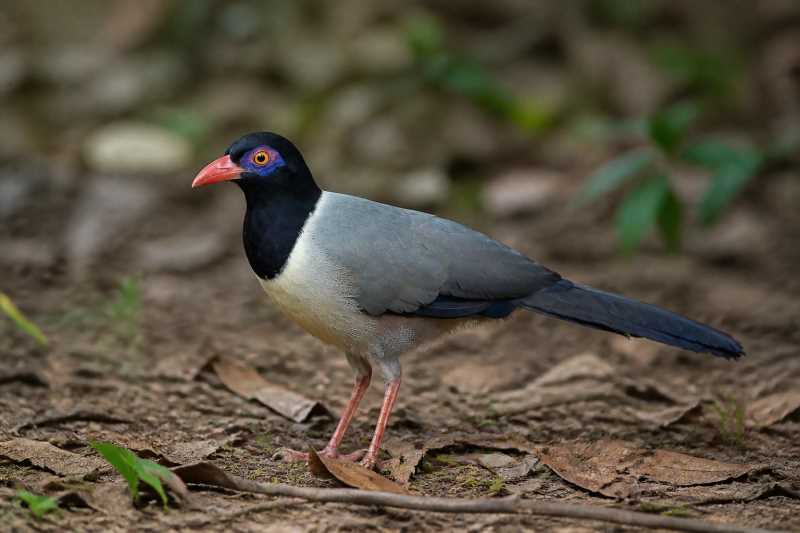
The Coral-billed Ground Cuckoo is a large, pheasant-like bird reaching approximately 70 centimetres in length. It has a bluish-grey back and wings, pale grey to whitish underparts, and a dark hood, neck, upper breast and long tail with blue or violet gloss. The bill and legs are bright coral-red, while the eye is surrounded by a conspicuous area of bare blue and reddish skin. (ebird.org)
The sexes are difficult to distinguish in the field because males and females are similar in appearance. Its long tail, strong legs, vivid red bill and combination of dark glossy upperparts with pale underparts are the most useful identification features.
Range and Habitat
The species is endemic to mainland South-east Asia and is recorded in Cambodia, Laos, Thailand and Viet Nam. It is associated mainly with semi-evergreen, dry evergreen and moist lowland forests, but it also uses foothill and montane forest, regenerating woodland and some degraded forest with dense bamboo or undergrowth.
The Coral-billed Ground Cuckoo occurs from sea level to at least 900 metres in the current IUCN assessment. Historical and regional records extend higher in some areas, including the Cardamom Mountains and parts of Indochina. In Thailand, recent records are concentrated mainly in the eastern and north-eastern parts of the country. (doi.org)
It is a resident species and is not considered migratory. Its apparent absence from some suitable-looking areas may reflect both genuine population declines and the difficulty of detecting a secretive bird that spends most of its time in dense cover.
Where to See This Species
The Coral-billed Ground Cuckoo is difficult to observe even where it is known to occur. Quiet early-morning searches along forest tracks, especially in areas with dense ground cover, may be more productive than open viewpoints. Local guides and park staff are particularly valuable because many records are based on repeated observations or local knowledge.
Khao Yai National Park, Nakhon Ratchasima and adjacent provinces, Thailand
Khao Yai National Park is one of the more reliable places in Thailand to look for the species. It supports suitable forest habitat and is among the Thai localities with recent records. The bird is most likely to be encountered on or near the forest floor in quiet, densely vegetated areas, although sightings remain uncommon. (datazone.birdlife.org)
Nearby accommodation: Pak Chong and the Khao Yai gateway area offer hotels, guest houses, lodges, campsites and self-catering accommodation.
Phu Khieo Wildlife Sanctuary, Chaiyaphum Province, Thailand
Phu Khieo Wildlife Sanctuary is recognised as an important Thai site for the Coral-billed Ground Cuckoo and contains suitable dry evergreen and mixed forest habitat. The sanctuary is also noted as one of the few known breeding areas for the species, although the bird remains secretive and is not guaranteed on a short visit. (datazone.birdlife.org)
Nearby accommodation: Chum Phae and nearby settlements provide practical guest houses, small hotels and other basic accommodation for visitors arranging access to the sanctuary.
Khao Khitchakut National Park, Chanthaburi Province, Thailand
Khao Khitchakut National Park has recorded the Coral-billed Ground Cuckoo among its notable bird species. Its forested landscape and dense undergrowth provide appropriate habitat, but visitors should expect a patient search rather than a routine sighting. (datazone.birdlife.org)
Nearby accommodation: Pluang village and Khao Khitchakut town provide guest houses, small hotels and other accommodation outside the park.
Behaviour and Diet
The Coral-billed Ground Cuckoo is primarily terrestrial and spends much of its time walking through leaf litter and dense undergrowth. It is generally shy and difficult to approach, often remaining hidden despite its large size. It is usually encountered alone or in pairs rather than in large groups.
Its diet includes insects and other invertebrates, as well as small reptiles, small mammals and small birds. It forages on or close to the ground, using its strong legs and bill to search through leaf litter and low vegetation. (doi.org)
Breeding behaviour is poorly documented. Available information indicates that the species nests on the ground, but details of nest construction, clutch size, incubation and parental care remain limited. Observations from Thailand have included ground nests, supporting the view that breeding takes place close to the forest floor. (researchgate.net)
Identification Tips
- Look for a large, long-tailed bird moving quietly through dense forest undergrowth rather than flying through the canopy.
- The combination of a bright coral-red bill and legs, pale grey underparts, bluish-grey back and dark glossy head and tail is distinctive.
- Bare blue and reddish skin around the eye can be conspicuous at close range.
- The species may resemble a pheasant or large forest rail in behaviour because of its terrestrial habits, but its red bill, long tail and cuckoo-like structure help separate it from those birds.
- Do not rely on calls alone. The species is secretive, and vocal activity or detectability may vary between sites and seasons.
Conservation Status
The Coral-billed Ground Cuckoo is listed as Endangered on the IUCN Red List, following a 2024 assessment. The population trend is decreasing, although a precise global population estimate is unavailable. (doi.org)
The principal threats are intensive snaring for bushmeat, including accidental capture in snares set for other wildlife, forest loss, habitat conversion, logging and the increasing accessibility of remote forests. Because the species is strictly terrestrial, it is particularly vulnerable to ground-level snares.
Protected areas provide important refuges, especially in Thailand, but protection is uneven across the range. Priority conservation measures include removing and preventing snares, improving enforcement, protecting remaining lowland and foothill forests, involving local communities and conducting targeted surveys using camera traps and autonomous sound recorders. (doi.org)
Frequently Asked Questions
Where is the Coral-billed Ground Cuckoo found?
It is found in Cambodia, Laos, Thailand and Viet Nam, although recent records are localised and the species has declined in several parts of its former range.
Is the Coral-billed Ground Cuckoo migratory?
No. It is considered a resident species and is not classified as migratory.
What does the Coral-billed Ground Cuckoo eat?
Its diet includes insects and other invertebrates, small reptiles, small mammals and small birds. It searches for food mainly on the forest floor.
How can the Coral-billed Ground Cuckoo be identified?
Look for a large terrestrial cuckoo with a bright coral-red bill and legs, pale grey underparts, bluish-grey upperparts, a dark glossy head and tail, and bare coloured skin around the eye.
Is the Coral-billed Ground Cuckoo endangered?
Yes. The species is currently listed as Endangered on the IUCN Red List, with snaring, hunting pressure and forest loss identified as major threats.
Where is the best place to look for this bird?
In Thailand, Khao Yai National Park, Phu Khieo Wildlife Sanctuary and Khao Khitchakut National Park are documented sites. Even at these locations, sightings are difficult and usually require quiet searching in dense forest undergrowth.
References
- IUCN Red List of Threatened Species
- BirdLife International
- IOC World Bird List
Related posts