Camiguin Boobook: A Jewel of Avian Diversity in the Philippines
The Philippines, an archipelago renowned for its rich biodiversity and unique ecosystems, is home to a myriad of endemic species. Among these, the Camiguin Boobook (Ninox leventisi) stands out as a testament to the country’s avian diversity. This small, elusive owl, found only on the island of Camiguin, is not only an emblem of natural beauty but also a symbol of conservation challenges and triumphs in the region.
Discovery and Classification
The Camiguin Boobook was formally described in 2002, a relatively recent discovery in the ornithological world. Prior to its classification, the owl was often overlooked, confused with other Ninox species due to its subtle distinctions. Named after its native island, the specific epithet ‘leventisi’ honors Dr. Tim Leventis, a notable figure in ornithological research. This discovery highlighted the unexplored biodiversity of the Philippines, encouraging further scientific exploration in the region.
Physical Characteristics and Behavior
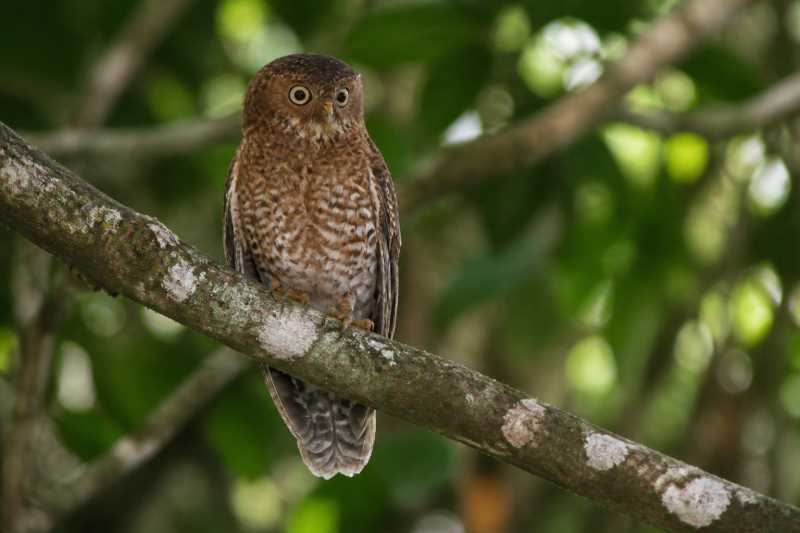
The Camiguin Boobook is a small owl, measuring about 20-25 centimeters in length. Its plumage is primarily brown with streaks of white and buff, providing excellent camouflage against the forest canopy. The bird’s eyes are strikingly large and yellow, adapted for its nocturnal lifestyle. Unlike many owl species, the Camiguin Boobook exhibits a distinctive call, a series of hoots that resonate through the dense forests at night.
Behaviorally, this species is a solitary hunter, preying on insects and small vertebrates. Its diet reflects its adaptation to the island’s ecosystem, and its hunting techniques are optimized for the dense foliage of its habitat. The Camiguin Boobook plays a crucial role in controlling insect populations, thus maintaining ecological balance.
Habitat and Distribution
Restricted to the small island of Camiguin in the southern Philippines, the Camiguin Boobook’s habitat is limited to the island’s remaining lowland and montane forests. These forests, characterized by high humidity and dense vegetation, provide the perfect environment for this nocturnal bird. Unfortunately, the island’s unique habitat is under threat from human activities such as agriculture, logging, and urban development, leading to habitat fragmentation and degradation.
Conservation Status and Efforts
The Camiguin Boobook is currently classified as Vulnerable by the International Union for Conservation of Nature (IUCN). The primary threat to its survival is habitat loss, exacerbated by the island’s limited area and increasing human population. Conservation efforts are focused on habitat protection and restoration, alongside research initiatives to better understand the species’ ecology and population dynamics.
Local and international conservation organizations have been instrumental in raising awareness about the Camiguin Boobook. Community-based programs aim to educate local residents about the importance of preserving their unique wildlife. Additionally, ecotourism is being promoted as a sustainable alternative to more destructive land-use practices. These efforts not only contribute to the conservation of the Camiguin Boobook but also benefit the island’s biodiversity as a whole.
The Importance of Continued Research
Further research is essential to ensure the survival of the Camiguin Boobook. Detailed studies on its breeding patterns, feeding ecology, and habitat requirements are needed to develop effective conservation strategies. Moreover, understanding how climate change might affect its habitat and food sources is crucial for long-term conservation planning.
Collaborations between local researchers and international conservation bodies can provide the resources and expertise necessary to carry out comprehensive studies. Citizen science initiatives, where locals participate in monitoring bird populations, can also play a significant role in data collection and fostering a culture of conservation.
Conclusion
The Camiguin Boobook is more than just an avian species; it is a symbol of the rich biodiversity of the Philippines and a reminder of the delicate balance that exists within island ecosystems. Protecting this unique owl requires a concerted effort from scientists, conservationists, local communities, and policymakers. By prioritizing habitat conservation, promoting sustainable development, and fostering a deeper understanding of the island’s natural heritage, we can ensure that the Camiguin Boobook continues to thrive in its natural habitat, serving as a beacon of biodiversity for generations to come.
Related posts