Introduction
The Blue Korhaan (Eupodotis caerulescens) is a ground-dwelling bustard of the high-altitude grasslands and grassy Karoo of southern Africa. It is a regional endemic, occurring mainly in South Africa with a marginal range in western Lesotho. Although it is often difficult to see, its blue-grey plumage and distinctive calls make it an important species of open grassland habitats.
Physical Description
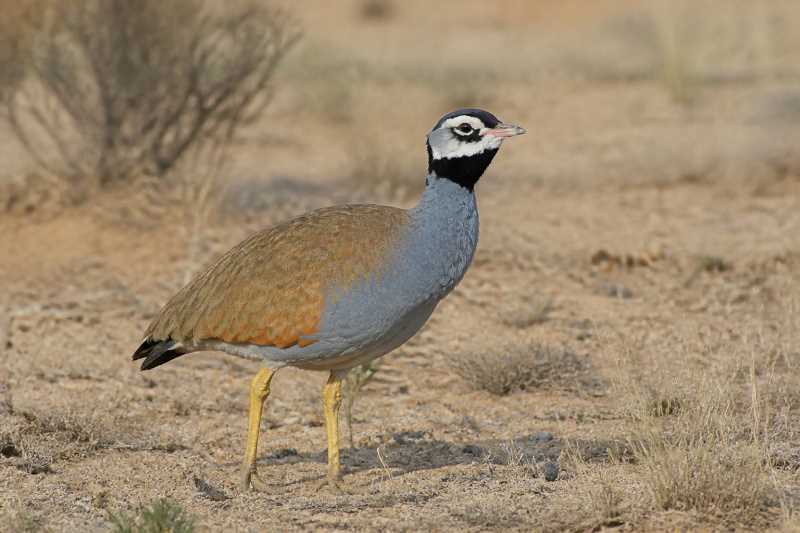
The Blue Korhaan is a medium-sized, long-legged bird with a sturdy body, large head and relatively short toes adapted for walking and running. Adults are mainly blue-grey, including the neck and underparts, with contrasting black markings on the crown and nape. The wings show blue tones in flight, which can be useful for identification at a distance.
The sexes are broadly similar in appearance. Juvenile and immature birds are generally duller and less clearly marked than adults. The species usually relies on running and remaining concealed in grass, but it can fly strongly and rapidly when disturbed.
Range and Habitat
The Blue Korhaan occurs mainly in South Africa, particularly across the Free State, Eastern Cape, Mpumalanga, north-western KwaZulu-Natal and parts of the Northern Cape. It extends marginally into western Lesotho. It is considered sedentary rather than migratory, although local movements may occur in response to conditions.
It favours high-altitude grassveld, often above 1,500 metres, as well as open grassy Karoo. Suitable areas usually have short or lightly grazed grass, a flat or gently undulating landscape, few trees and access to water. It may also use open pasture and some cultivated landscapes where suitable grassland remains, but extensive habitat transformation reduces the quality and continuity of its range.
Where to See This Species
Golden Gate Highlands National Park, Free State, South Africa
Blue Korhaans are recorded in the park’s open montane grasslands. The grasslands along the access road to the Basotho Cultural Village are recognised as a particularly useful area to search, especially where short grass and open views make a ground-dwelling bird easier to detect.
Nearby accommodation: The park provides rest-camp accommodation, while the nearby town of Clarens offers guest houses, lodges, hotels and self-catering accommodation.
Mountain Zebra National Park, Eastern Cape, South Africa
The species is included on the park’s official bird checklist. The park’s broad grassland plains and open valleys provide suitable habitat, and early morning or late afternoon searches along quiet roads and open slopes offer the best chance of detection.
Nearby accommodation: Mountain Zebra National Park has a rest camp and camping facilities. The nearest practical town is Cradock, which offers hotels, guest houses and self-catering accommodation.
Seekoeivlei Nature Reserve, Free State, South Africa
Blue Korhaans are documented on the reserve’s open grassy plains and in surrounding highveld grasslands. The reserve lies at approximately 1,700 metres and combines wetland, pasture and open grassland habitats. The species is most likely to be found away from dense wetland vegetation, where the surrounding short grassland can be scanned from roads and tracks.
Nearby accommodation: The nearest gateway settlement is Memel, with guest houses, small lodges and self-catering options in the town and surrounding area. Access tracks can become muddy during wet weather, so visitors should check local conditions before travelling.
Behaviour and Diet
The Blue Korhaan is primarily terrestrial and spends most of its time walking through grassland. It is usually seen alone, in pairs or in small family groups. Activity is often most noticeable during the cooler parts of the day, particularly in the early morning and late afternoon.
Its diet is varied and includes grasshoppers, beetles, termites, scorpions, lizards and other small animals, together with seeds, grass and other plant material. The species forages by walking slowly through short vegetation and probing or picking food from the ground.
Breeding generally takes place from September to February. The female lays one or two eggs, occasionally three, in a shallow scrape on the ground. Incubation lasts approximately 24 to 28 days and is carried out by the female. The chicks are precocial and can leave the nest soon after hatching, while both parents may contribute to their care. Young birds remain dependent for some time before becoming fully independent.
The call is a distinctive series of deep, frog-like croaks, often given during territorial or breeding activity. Displays may include wing movements and short flights, with the blue tones of the wings becoming more visible when the bird is airborne.
Identification Tips
Look for a large, long-legged bird walking through short highveld grassland rather than perching or moving through dense vegetation. The overall blue-grey colour, dark crown and nape, sturdy shape and upright posture are the most useful features.
In flight, the blue tones in the wings can be conspicuous. The species may be confused with the White-bellied Korhaan, but the latter has a tawny hind neck and a white belly. The Karoo Korhaan is browner and lacks the Blue Korhaan’s contrasting facial markings and blue-grey appearance. These species also differ in flight, with the Blue Korhaan showing blue-toned outer wing panels rather than the creamy-buff panels of the other species.
Conservation Status
The Blue Korhaan is currently assessed as Near Threatened globally on the IUCN Red List. In South Africa, its 2025 regional assessment is Vulnerable, reflecting evidence of a declining population and a relatively small number of mature individuals.
The principal concerns are the loss and degradation of high-altitude grassland through intensive agriculture, afforestation, mining, settlement and other development. Much of the species’ distribution lies outside protected areas, and the effects of habitat transformation are compounded by limited knowledge of its movements, population size and breeding success. Climate change may add further pressure by altering grassland condition and the availability of suitable habitat.
Protecting remaining natural grasslands, maintaining appropriate grazing regimes, retaining open areas near water and improving monitoring are important conservation priorities. Research into movement patterns and population trends is also needed to guide effective management.
Frequently Asked Questions
Where does the Blue Korhaan live?
The species lives mainly in South African highveld grasslands and grassy Karoo, with a marginal occurrence in western Lesotho. It favours open, short-grass habitats, often at elevations above 1,500 metres.
Is the Blue Korhaan migratory?
No. It is generally regarded as sedentary, although individuals may make local movements when habitat conditions, food availability or water supplies change.
What does the Blue Korhaan eat?
Its diet includes insects such as grasshoppers, beetles and termites, as well as scorpions, lizards, seeds, grass and other plant material.
How does the Blue Korhaan breed?
Breeding usually occurs from September to February. The female lays one or two eggs in a shallow ground scrape and incubates them for about 24 to 28 days. The chicks leave the nest soon after hatching.
How can the Blue Korhaan be identified?
The combination of blue-grey plumage, a dark crown and nape, long legs, a sturdy body and open-grassland habitat is distinctive. Blue tones may also be visible in the wings during flight.
Is the Blue Korhaan endangered?
It is not currently classified as globally threatened, but it is listed as Near Threatened worldwide and Vulnerable in South Africa. Its population is declining, largely because of grassland loss and degradation.
References
- BirdLife South Africa
- IUCN Red List of Threatened Species
- South African National Parks
Related posts