Introduction
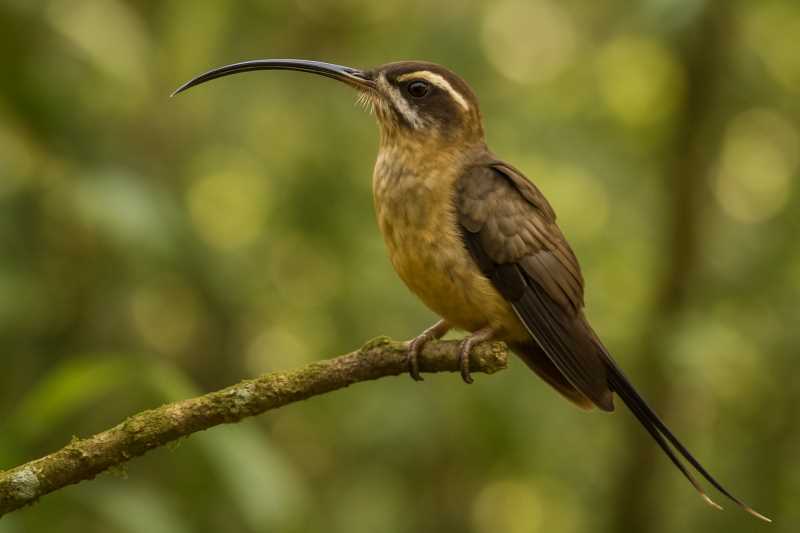
The Long-tailed Hermit (Phaethornis superciliosus) is a resident hummingbird of northern South America. It is recognised by its elongated bill, brown plumage, pale facial markings and especially long tail feathers with contrasting pale tips. Like other hermits, it is adapted to feeding along regular routes through forest and woodland habitats.
Physical Description
The Long-tailed Hermit is a medium-sized hummingbird, measuring about 13 to 15 centimetres in length. Its long, slightly decurved bill is suited to feeding from tubular flowers. The upperparts are mainly bronzy or brown, while the underparts are generally buff to warm brown. Pale stripes around the face, including a noticeable supercilium, contrast with the darker head.
The tail is a key identification feature. The central tail feathers are elongated, and the tail shows pale or whitish tips that are especially noticeable in flight or when the bird is perched. The sexes are broadly similar in colour, although females are typically slightly smaller. Juveniles and recently fledged birds may appear duller and show less sharply defined facial and tail markings.
Range and Habitat
The Long-tailed Hermit is distributed in Venezuela, Guyana, Suriname, French Guiana and northern Brazil, mainly north of the Amazon River. It is a resident species rather than a long-distance migrant, although local movements may occur in response to food availability and seasonal conditions.
It occupies humid lowland forest, forest edges, clearings, river margins, secondary growth and other shaded habitats with suitable flowering plants. The species may also occur in plantations, gardens and lodge grounds where forest cover and nectar resources remain available. It is generally associated with low elevations, although the precise upper limit varies across its range.
Where to See This Species
Atta Rainforest Lodge, Upper Demerara-Berbice Region, Guyana
The Long-tailed Hermit is regularly recorded at the feeders and forest surroundings of Atta Rainforest Lodge. The lodge lies within the Iwokrama region, where humid rainforest, forest edges and flowering plants provide suitable habitat. Guided visits offer a practical opportunity to observe the species at close range while also looking for it along shaded forest trails.
Nearby accommodation: Atta Rainforest Lodge itself provides rainforest accommodation. Additional guest houses and eco-lodges are available in the wider Iwokrama and Mabura area.
Iwokrama Forest, Guyana
The species is included on bird checklists for the Iwokrama Forest. Look for it in lowland rainforest, along forest tracks, near clearings and around flowering plants. Sightings may be easier at established birding sites and during guided excursions, particularly where local guides know regular feeding routes.
Nearby accommodation: Iwokrama River Lodge and other eco-lodges in the Iwokrama region provide practical bases for visiting the forest.
Mont Grand Matoury Nature Reserve, Cayenne, French Guiana
Long-tailed Hermit is documented from the reserve, which protects lowland forest and other habitats near Cayenne. Forest paths and shaded edges are suitable places to watch for hermits moving quietly between flowering plants. Early morning visits are generally preferable for bird activity, although the species may be encountered throughout the day.
Nearby accommodation: Cayenne is the nearest practical base, with hotels, guest houses and self-catering accommodation.
Behaviour and Diet
The Long-tailed Hermit feeds mainly on nectar and often follows a regular route between scattered flowers, a behaviour known as trap-lining. This movement pattern helps the bird exploit reliable food sources across the forest. As it visits flowers, it can transfer pollen between plants and contribute to forest pollination.
Small insects and spiders are also taken, particularly when additional protein is needed during breeding. The bird usually forages alone, moving through shaded vegetation with rapid wingbeats and short hovering flights. Hermits are generally less territorial around individual flowers than many other hummingbirds, although males defend display or singing areas.
Males may gather in leks, where they sing and perform courtship displays to attract females. The female builds the nest without male assistance, using plant fibres, spider silk and other fine materials. The cone-shaped nest is commonly attached beneath a broad leaf, which helps shelter it from rain.
The clutch normally contains two elongated white eggs. Incubation lasts approximately 14 to 19 days, and the young usually remain in the nest for roughly 18 to 28 days before fledging. The female incubates the eggs and cares for the nestlings alone.
Identification Tips
- Look for a medium-sized, mainly brown hermit with a long, slightly curved bill.
- The pale facial stripes and long tail with contrasting pale tips are useful features.
- The bird often appears in shaded forest edges, beneath the canopy or along narrow tracks rather than in open country.
- Its flight is usually fast and direct, with brief hovering visits to flowers.
- Do not confuse it with the Western Long-tailed Hermit, Phaethornis longirostris, which occupies parts of Central America and north-western South America. Range is an important part of the identification.
- Other hermits may share the same habitat, so the combination of range, facial pattern, bill length and pale-tipped elongated tail should be considered together.
Conservation Status
The Long-tailed Hermit is assessed as Least Concern. It has a broad distribution and is not currently regarded as globally threatened. Nevertheless, the species depends on forest and woodland habitats that may be affected by deforestation, agricultural expansion, mining, fires and fragmentation.
Protecting remaining rainforest, maintaining connected forest edges and conserving flowering plants can benefit this species and the wider community of forest birds and pollinators. The species is resident, so the preservation of suitable habitat throughout its range is important.
Frequently Asked Questions
Where does the Long-tailed Hermit live?
It occurs in Venezuela, Guyana, Suriname, French Guiana and northern Brazil. It is mainly associated with humid lowland forest, forest edges, clearings and secondary growth.
Is the Long-tailed Hermit migratory?
No. It is generally considered resident, although individuals may make local movements in response to flowering conditions, food availability or seasonal changes.
What does the Long-tailed Hermit eat?
Its diet consists mainly of nectar, supplemented by small insects and spiders. Animal prey provides important protein, especially during the breeding season.
How can the Long-tailed Hermit be identified?
Look for a brown hummingbird with a long curved bill, pale facial stripes and an elongated tail with pale tips. It is most often found in shaded forest or along forest edges.
Where is the best place to see this species?
Reliable documented locations include Atta Rainforest Lodge and the Iwokrama Forest in Guyana, as well as Mont Grand Matoury Nature Reserve near Cayenne in French Guiana. Local guides can improve the chance of finding birds along regular feeding routes.
How does the Long-tailed Hermit breed?
The female builds a cone-shaped nest beneath a leaf, incubates the two eggs and raises the young without assistance from the male. Incubation lasts about 14 to 19 days, followed by approximately 18 to 28 days in the nest.
References
- BirdLife International
- IUCN Red List of Threatened Species
- IOC World Bird List
Related posts