Introduction
Prigogine’s Nightjar, also known as the Itombwe Nightjar, is a poorly known African nightjar with the scientific name Caprimulgus prigoginei. It belongs to the nightjar family, Caprimulgidae, and is known with certainty from a single specimen collected in the Itombwe Mountains of South Kivu, Democratic Republic of the Congo, in August 1955. The species was formally described by Michel Louette in 1990, 35 years after the specimen was collected.
No confirmed sighting has been accepted since 1955. Possible nightjar calls recorded elsewhere in the Congo Basin may belong to this species, but those records remain unconfirmed.
Physical Description
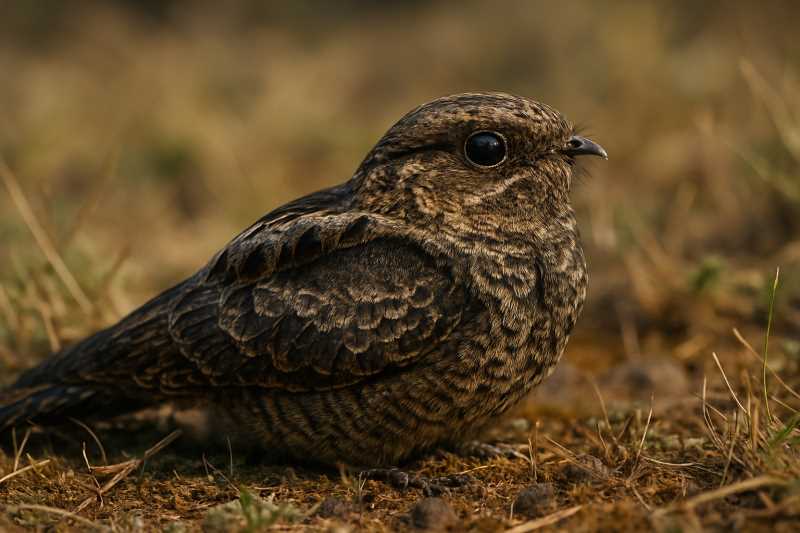
Prigogine’s Nightjar is known only from an adult female specimen, so the male, juvenile plumage and many aspects of sexual variation remain unknown. The bird is approximately 19 cm long and has a dark brown, heavily speckled plumage that would provide camouflage in forest vegetation.
The type specimen has a broad head, relatively short tail, short rictal bristles and stiff-looking feathers. Its wings show pale brown spots rather than the prominent white markings present in many related nightjars. The tail feathers have whitish tips. These features, particularly the combination of a broad head, short tail and strongly mottled plumage, helped distinguish it from other African nightjars.
Because the species has not been studied in life, descriptions of its posture, flight pattern, soft-part colouration and age-related plumage are limited.
Range and Habitat
The only confirmed locality is Malenge in the Itombwe Mountains of eastern Democratic Republic of the Congo. The specimen was collected in forest at approximately 1,280 metres above sea level. The Itombwe Mountains form part of the Albertine Rift, a region noted for high levels of endemism and continuing conservation importance.
Prigogine’s Nightjar is generally treated as a forest-associated species, but its precise habitat requirements are unknown. Reports of unidentified nightjars from forests in the Republic of the Congo and Cameroon have been considered possible records of this species, partly because some calls appeared similar to recordings associated with Itombwe. However, these observations have not been supported by a specimen, photograph or other conclusive identification.
The species is regarded as resident rather than migratory, although its movements have never been documented. Its confirmed range, population size and geographic variation cannot currently be established.
Behaviour and Diet
Almost nothing is known about the behaviour of Prigogine’s Nightjar. Like other nightjars, it is expected to be most active at dusk and during the night, when it would probably search for flying insects. Moths, beetles and other nocturnal arthropods are plausible components of its diet, but no species-specific dietary study has been conducted.
Breeding behaviour, nesting dates, clutch size, incubation, parental care and nest-site selection are unknown. Nightjars commonly lay their eggs directly on the ground, but this has not been confirmed for Prigogine’s Nightjar.
Unidentified nightjars heard in parts of the Congo Basin have included a dry, rapid churring sound and a knocking or staccato note. These vocalisations have sometimes been linked tentatively with C. prigoginei, but the species’ diagnostic song remains undocumented with certainty.
Targeted surveys using autonomous sound recorders, nocturnal observation and local ecological knowledge could help determine whether the species survives and clarify its behaviour.
Identification Tips
Prigogine’s Nightjar cannot currently be identified reliably in the field because the species has not been conclusively observed in life. The following features are based on the known specimen and should be treated as provisional field characters:
- Small to medium nightjar, approximately 19 cm long.
- Dark brown, heavily mottled and speckled plumage.
- Broad head and relatively short tail.
- Pale brown wing spots rather than a conspicuous white wing patch.
- Whitish tips to the tail feathers.
- Possible dry churring or staccato vocalisations, although these calls are not diagnostic at present.
Any proposed record should be documented with clear photographs, sound recordings, precise locality information and, where possible, independent expert review. Similar-looking forest nightjars occur in the wider region, so an unrecorded nocturnal call or brief view should not be assigned to Prigogine’s Nightjar without supporting evidence.
Conservation Status
Prigogine’s Nightjar is currently treated as Data Deficient in the latest reassessment information associated with the IUCN Red List process. This replaces the former Endangered classification and reflects the absence of reliable information about its current distribution, population size, trend and threats. Data Deficient does not mean that the species is safe; it means that the available evidence is insufficient for a confident extinction-risk assessment.
The main conservation concern is the condition of forest in and around the Itombwe Mountains. Logging, agricultural expansion, mining and settlement can reduce or fragment suitable habitat, although the direct effects on Prigogine’s Nightjar have not been quantified. The species’ apparent rarity may also partly reflect the difficulty of surveying nocturnal birds in remote and insecure areas.
Important conservation measures include protecting remaining forest, supporting the management of the Itombwe Natural Reserve, conducting systematic nocturnal surveys and developing local capacity for acoustic monitoring and bird identification. Verified records would be particularly valuable because they could provide the information needed for a more robust conservation assessment.
Frequently Asked Questions
Where does Prigogine’s Nightjar live?
The only confirmed locality is Malenge in the Itombwe Mountains of South Kivu, Democratic Republic of the Congo. The specimen was collected in forest at about 1,280 metres above sea level.
When was Prigogine’s Nightjar last confirmed?
The last confirmed record is the collection of a specimen in August 1955. The species was not formally described until 1990.
Is Prigogine’s Nightjar extinct?
It has not been proven extinct. Possible calls attributed to the species have been reported from the Congo Basin, but no post-1955 record has been confirmed conclusively with a specimen, photograph or definitive recording.
What does Prigogine’s Nightjar look like?
The known adult female is about 19 cm long, dark brown and heavily speckled, with a broad head, short tail, pale brown wing spots and whitish tail tips. The male and juvenile plumages are unknown.
What does Prigogine’s Nightjar eat?
Its diet has not been studied. As a nightjar, it is likely to catch flying insects at night, but the exact prey of this species is unknown.
What is its current conservation status?
The species is currently treated as Data Deficient in the latest IUCN Red List reassessment information. Reliable population and distribution data are lacking, so its present level of extinction risk cannot be determined confidently.
References
- Louette, M. 1990. A new species of nightjar from Zaïre. Ibis 132(3): 349–353. https://doi.org/10.1111/j.1474-919X.1990.tb01054.x
- Dowsett-Lemaire, F. and Dowsett, R. J. 2000. Birds of the Lobéké Faunal Reserve, Cameroon, and its regional importance for conservation. Bird Conservation International 10(1): 67–87. https://doi.org/10.1017/S095927090000006X
- BirdLife International. 2024. 2024 Red List status changes: Caprimulgus prigoginei, Prigogine’s Nightjar. BirdLife International, Globally Threatened Bird Forums. https://forums.birdlife.org/wp-content/uploads/2024/03/Red_List_status_changes_2024.1.pdf. Accessed 8 September 2026.
- BirdLife International. 2024. Prigogine’s Nightjar (Caprimulgus prigoginei), Globally Threatened Bird Forum assessment. BirdLife International. https://forums.birdlife.org/2024-1-prigogines-nightjar-caprimulgus-prigoginei/. Accessed 8 September 2026.
- International Union for Conservation of Nature. 2025. 2025 IUCN Red List of Threatened Species, Data Deficient species list, including Caprimulgus prigoginei. IUCN Red List. https://forums.birdlife.org/wp-content/uploads/2025/11/Data_Deficient_Species_v10-1.pdf. Accessed 8 September 2026.
- Gill, F., Donsker, D. and Rasmussen, P., eds. 2026. IOC World Bird List, version 15.2. International Ornithologists’ Union. https://www.worldbirdnames.org/new/. Accessed 8 September 2026.
- Royal Museum for Central Africa. n.d. Last seen in 1955: Prigogine’s Nightjar, a bird from eastern DRC. AfricaMuseum, Tervuren, Belgium. https://www.africamuseum.be/en/research/news/prigogine-nightjar. Accessed 8 September 2026.
- Search for Lost Birds. n.d. Itombwe Nightjar, Caprimulgus prigoginei. Re:wild and American Bird Conservancy. https://searchforlostbirds.org/birds/itombwe-nightjar. Accessed 8 September 2026.
Related posts