The Black-crested Antshrike: A Detailed Exploration of Sakesphorus canadensis
The Black-crested Antshrike (Sakesphorus canadensis) is a strikingly attractive bird that captivates bird enthusiasts and ornithologists alike. With its distinctive black crest and melodious song, this fascinating species holds a special place in the rich tapestry of South American avifauna. This article delves into the Black-crested Antshrike’s taxonomy, habitat, behavior, and conservation status, offering a comprehensive overview of one of the most intriguing members of the Thamnophilidae family.
Taxonomy and Distribution
Sakesphorus canadensis, commonly known as the Black-crested Antshrike, belongs to the Thamnophilidae family, which encompasses a diverse group of small passerine birds known as antbirds. The species was first described by Carl Linnaeus in 1766. The genus name ‘Sakesphorus’ is derived from Greek, referring to ‘a bird of the forest,’ while ‘canadensis’ is a misnomer, as it does not relate to Canada but instead references the French explorer Jacques Cartier, who was associated with the New World.
The Black-crested Antshrike’s distribution extends across several countries in northern South America, including Venezuela, Colombia, Trinidad and Tobago, and parts of Brazil and Guyana. It is typically found in tropical and subtropical forests, often favoring dense undergrowth and forest edges.
Physical Description
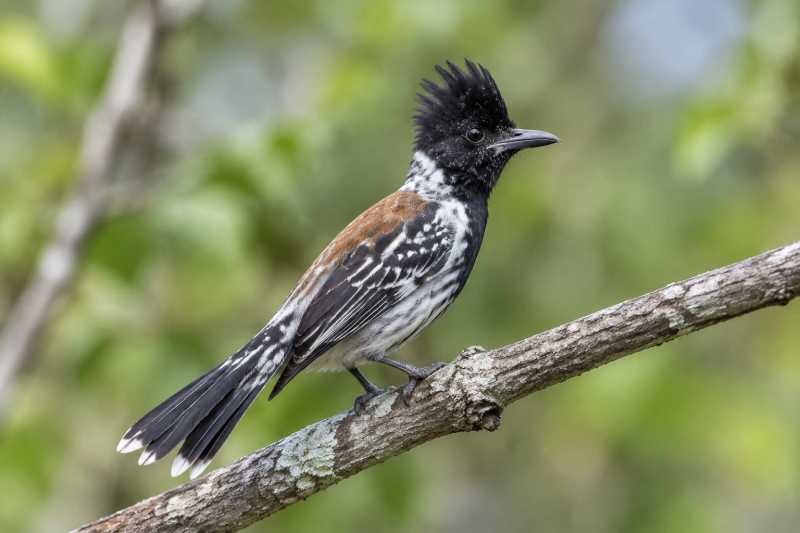
The Black-crested Antshrike is easily recognizable by its striking appearance. Males are characterized by their glossy black crests, which are often raised in display, and their predominantly black plumage adorned with white wing bars and underparts. Females, on the other hand, have a more subdued appearance with brownish tones replacing the black, yet they retain the characteristic crest, albeit less pronounced.
Both sexes measure approximately 15 to 17 cm in length and weigh around 20 to 25 grams. Their robust bill and strong legs are adaptations that aid in their insectivorous feeding habits.
Habitat and Ecology
Inhabiting a range of forested environments, the Black-crested Antshrike is particularly fond of dense scrub and secondary growth, where it can easily forage for insects and other small invertebrates. Its adaptability to various habitats, including mangroves and dry forests, underscores the species’ ecological versatility.
The antshrike is primarily insectivorous, with a diet consisting of ants, beetles, spiders, and other arthropods. It forages by gleaning prey from foliage, occasionally employing a hover-gleaning technique to capture insects mid-flight. This bird’s feeding behavior is often characterized by its methodical and deliberate movements as it navigates through dense vegetation.
Behavior and Reproduction
Black-crested Antshrikes are known for their territorial nature. Males are particularly vocal, using their complex and melodious songs to establish territory and attract mates. These songs vary in pitch and tempo, often accompanied by a series of clicks and whistles.
Breeding occurs during the wet season, which varies depending on the geographical location within their range. The species constructs cup-shaped nests, typically located in shrubs or low trees. Both parents participate in incubating the eggs and feeding the hatchlings, underscoring their cooperative breeding strategy.
Conservation Status
Currently, the Black-crested Antshrike is classified as a species of Least Concern by the International Union for Conservation of Nature (IUCN). Despite this favorable status, the species faces potential threats from habitat loss due to deforestation and land conversion for agriculture. Conservation efforts focusing on habitat preservation and sustainable land-use practices are crucial to maintaining healthy populations of this bird.
Conclusion
The Black-crested Antshrike is a testament to the wonder and diversity of avian life in South America. Its striking appearance, engaging behavior, and adaptability to various habitats make it a fascinating subject of study for ornithologists and bird watchers alike. As conservation efforts continue to address the challenges posed by habitat destruction, the Black-crested Antshrike remains an enduring symbol of the resilience and beauty of tropical bird species.
Whether observed in the wild or studied in scientific research, the Black-crested Antshrike captivates with its charisma and ecological significance. As we strive to protect our planet’s diverse ecosystems, understanding and appreciating the role of such species becomes increasingly important.
Related posts