Introduction
The Bearded Wood Partridge (Dendrortyx barbatus) is a rare, resident galliform endemic to Mexico. It is restricted to humid montane forests of the Sierra Madre Oriental, where its secretive behaviour and dense habitat make it more often heard than seen. The species is also known locally as the Veracruz Wood Partridge or Chivizcoyo.
Physical Description
The Bearded Wood Partridge is a robust, medium-sized New World quail. Published descriptions give a body length of approximately 22 to 36 centimetres and a weight of about 400 to 460 grams, although measurements vary between individuals and sources.
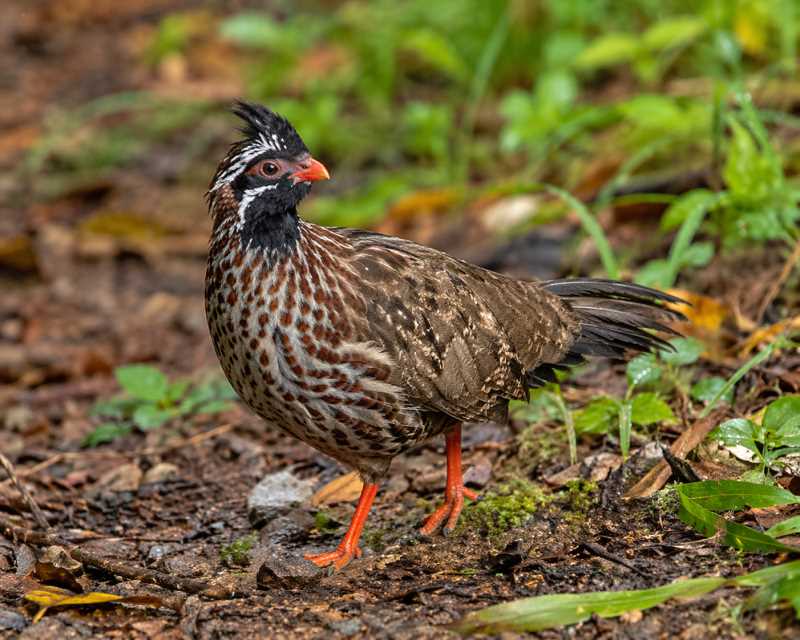
The plumage is mainly reddish brown, with darker wings marked by black and buff patterning. The head and upper neck are grey-blue, while the mantle and chest show greyish streaking. A small brown crest, pale underparts, and brightly coloured red legs, bill and orbital skin are useful identification features. The throat feathers form the short, beard-like feature that gives the species its common name.
The sexes are broadly similar in appearance, although males are generally larger. Reliable descriptions of juvenile plumage are limited, so age-related field identification should be treated cautiously.
Range and Habitat
The Bearded Wood Partridge is endemic to Mexico. Its distribution follows parts of the Sierra Madre Oriental from southern San Luis Potosí and Querétaro through Hidalgo, northern and central Veracruz, and into Puebla. The exact present-day range remains uncertain because the species is difficult to detect and some historical localities have experienced substantial forest loss.
It is associated mainly with humid montane forest, cloud forest, and adjacent pine-oak woodland with a dense shrub layer and abundant leaf litter. Documented localities generally lie at roughly 1,200 to 3,000 metres above sea level, although elevation varies between parts of the range. The species is resident rather than migratory.
Habitat fragmentation is particularly important because suitable forest is naturally restricted and is often separated by agricultural land, roads and settlements. Some historical records have not been confirmed in recent surveys, while other populations have been documented in protected areas and forested landscapes of Querétaro and San Luis Potosí.
Where to See This Species
The Bearded Wood Partridge is exceptionally elusive. Visits should be planned with local knowledge, and observers should rely on quiet listening rather than playback or persistent pursuit. The following protected areas have documented records or official species listings.
Sierra Gorda Biosphere Reserve, Querétaro, Mexico
The species has been recorded in cloud-forest localities within the Sierra Gorda Biosphere Reserve, including areas around Jalpan de Serra and Landa de Matamoros. Dense, humid forest with a well-developed understorey is the most suitable habitat. Early morning and late afternoon are the most sensible periods for listening for calling birds, although sightings are uncommon.
Nearby accommodation: Jalpan de Serra is the main gateway, with hotels, guest houses, cabins and community-based campsites available in the surrounding Sierra Gorda region.
Sierra del Abra Tanchipa Biosphere Reserve, San Luis Potosí, Mexico
Sierra del Abra Tanchipa is an officially protected area where the Bearded Wood Partridge is included in regional biodiversity and species listings. Forested slopes and remaining humid woodland provide potential habitat, although local access and detectability can vary. The reserve is best approached as a specialist birding destination rather than a site offering guaranteed views.
Nearby accommodation: Ciudad Valles is the principal practical base, with hotels, guest houses and other visitor accommodation.
Cofre de Perote National Park, Veracruz, Mexico
The species has historical records from the Cofre de Perote area, and recent monitoring by Mexico’s protected-area authority has included the Bearded Wood Partridge among the birds recorded in the national park. Forest remnants and suitable montane habitat on the lower and middle slopes are more relevant than the highest open elevations. Local advice is important because the species may be absent from apparently suitable areas.
Nearby accommodation: Perote is the main gateway town, with hotels and guest houses. Accommodation is also available in nearby settlements on the Veracruz highlands.
Behaviour and Diet
The Bearded Wood Partridge is primarily terrestrial and spends most of its time moving through thickets, dense undergrowth and leaf litter. It is wary and usually disappears quickly when disturbed. Birds may occur in pairs, family groups or small social groups, and they can roost in low trees or tall shrubs.
Its loud calls are often the first indication of its presence. Calling may be concentrated around dawn and dusk, with repeated whistles or short vocal choruses carrying through the forest. The species is not known to undertake regular long-distance migration.
The diet is poorly documented but includes plant material such as seeds, fruits, berries, nuts and other vegetation, together with small invertebrates. Birds forage by scratching through leaf litter and the soil surface. Breeding behaviour is also insufficiently known in the wild, although the species is believed to nest on or close to the ground and to produce precocial young.
Identification Tips
Look and listen for the following combination of features:
- A large, heavy-bodied partridge moving on the forest floor.
- Grey-blue head and upper neck contrasting with reddish-brown body plumage.
- Small brown crest and a short beard-like throat feathering.
- Dark, mottled wings with black and buff markings.
- Red legs, bill and skin around the eye.
- Loud, repeated whistles from dense montane forest, especially at dawn or dusk.
The Long-tailed Wood Partridge (Dendrortyx macroura) is the most relevant comparison in parts of the wider Mexican highlands. Identification should not rely on habitat alone, because the two species can be difficult to separate when seen briefly. The Bearded Wood Partridge is best confirmed by its grey-blue head and neck, reddish-brown body, red facial and leg coloration, and distinctive call. Photographs or recordings are preferable to uncertain visual reports.
Conservation Status
The Bearded Wood Partridge is currently assessed as Vulnerable on the IUCN Red List. It is endemic to Mexico and has a restricted, fragmented distribution. The population is difficult to estimate because the species is secretive and suitable habitat is scattered.
The principal threats are the loss, degradation and fragmentation of humid montane forest through agriculture, logging, development and associated infrastructure. Hunting may also have contributed to local declines. Some historical localities have suffered extensive forest clearance, and the species may have disappeared from parts of its former range.
Conservation priorities include protecting remaining cloud forest and pine-oak woodland, maintaining connections between forest fragments, improving population monitoring, and working with local communities to reduce habitat pressure and disturbance. Protected areas such as the Sierra Gorda, Sierra del Abra Tanchipa and Cofre de Perote provide important safeguards, but their effectiveness depends on continued habitat management and reliable field monitoring.
Frequently Asked Questions
Where does the Bearded Wood Partridge live?
It lives in humid montane forests of Mexico’s Sierra Madre Oriental, particularly in parts of San Luis Potosí, Querétaro, Hidalgo, Veracruz and Puebla.
Is the Bearded Wood Partridge endangered?
It is classified as Vulnerable, which means it faces a high risk of extinction in the wild. Habitat loss and fragmentation are the main concerns.
What does the Bearded Wood Partridge eat?
Its diet includes seeds, fruits, berries, nuts, other plant material and small invertebrates gathered from the ground and leaf litter.
Is the Bearded Wood Partridge migratory?
No. It is considered a resident species, although individuals may move locally through suitable forest habitat.
How can I identify this partridge in the field?
Listen for its loud repeated whistles in dense montane forest, then look for a stocky reddish-brown bird with a grey-blue head and neck, red legs and bill, and a small brown crest.
Where is the best place to look for this species?
The Sierra Gorda Biosphere Reserve, Sierra del Abra Tanchipa Biosphere Reserve and Cofre de Perote National Park all have documented records or official listings. None guarantees a sighting because the species is highly elusive.
References
- BirdLife International
- Animal Diversity Web
- Comisión Nacional de Áreas Naturales Protegidas (CONANP)
Related posts