The Enigmatic Band-bellied Owl: A Comprehensive Overview
The Band-bellied Owl (Pulsatrix melanota) is a captivating species that intrigues bird watchers and ornithologists alike. Known for its distinctive banded plumage, this owl inhabits the dense forests of South America, extending its presence across countries like Colombia, Ecuador, Peru, and Bolivia. Despite its fascinating features, the Band-bellied Owl remains relatively understudied, presenting a rich opportunity for avian researchers and enthusiasts to delve into its behaviors and ecological significance.
Taxonomy and Description
Belonging to the Strigidae family, the Band-bellied Owl is a member of the genus Pulsatrix, which includes other species such as the Spectacled Owl (Pulsatrix perspicillata). First described by ornithologists in the 19th century, this species has intrigued scientists with its mysterious nature and limited range. The Band-bellied Owl measures approximately 40 to 48 centimeters in length, with females typically larger than males—a common trait among raptors.
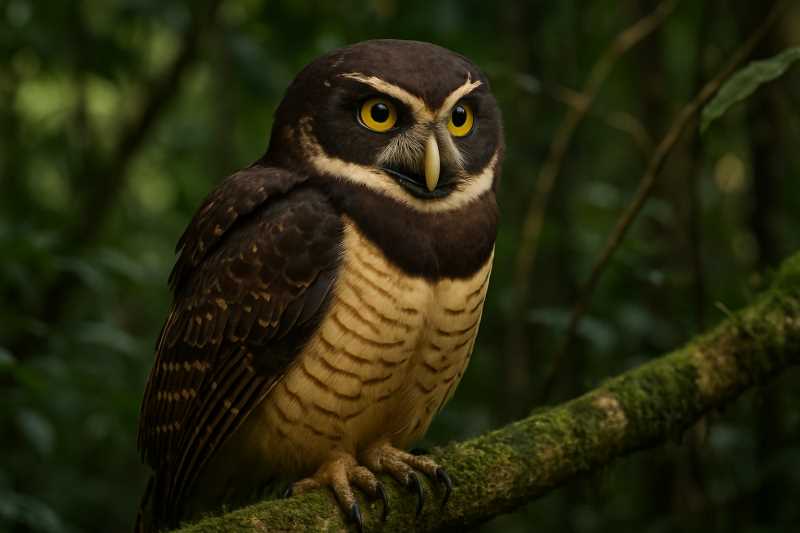
This owl’s most distinguishing feature is its plumage. It boasts a dark brown to blackish head and back, with a striking white band across its belly, giving it its common name. The facial disc is dark with a contrasting white outline, emphasizing its large, expressive eyes that are adapted for nocturnal vision. The wings and tail are also dark, adorned with subtle barring that provides camouflage within the forest canopy.
Habitat and Distribution
The Band-bellied Owl is primarily found in subtropical and tropical moist lowland forests and montane forests. It prefers altitudes ranging from 500 to 2,000 meters, thriving in dense, undisturbed forest environments. Its range encompasses the eastern slopes of the Andes, where it benefits from the rich biodiversity and abundant prey available in these regions.
Conservationists are particularly interested in the Band-bellied Owl due to its dependence on old-growth forests, which are increasingly threatened by deforestation and habitat fragmentation. As human activities encroach on these habitats, understanding the owl’s ecological role and requirements becomes crucial for developing effective conservation strategies.
Diet and Hunting Behavior
The Band-bellied Owl is a carnivorous bird of prey, primarily feeding on small mammals, birds, insects, and reptiles. Its hunting strategy involves perching silently on a high branch, using its acute hearing and vision to locate prey. Once a target is identified, the owl swoops down with precision, capturing its meal with powerful talons.
Unlike some other owl species, the Band-bellied Owl tends to hunt in the early evening and pre-dawn hours, taking advantage of the lower light conditions where its nocturnal adaptations give it a predatory edge. This behavior underscores the owl’s role in controlling the populations of small vertebrates and maintaining balance within its ecosystem.
Reproduction and Lifespan
Little is known about the breeding habits of the Band-bellied Owl, largely due to its elusive nature and the inaccessibility of its habitat. However, it is believed that like many owls, they are monogamous, forming long-term pair bonds. Breeding typically coincides with periods of food abundance, ensuring sufficient resources for raising their young.
Nesting occurs in tree cavities or sometimes in abandoned nests of other large birds. The female lays a clutch of 2 to 3 eggs, which she incubates while the male provides food. After hatching, the owlets remain in the nest for several weeks, receiving care and feeding from both parents until they are ready to fledge.
In terms of lifespan, owls in the wild generally live for around 10 to 15 years, but this can vary based on environmental factors and threats from predators and human activities.
Conservation Status and Challenges
The International Union for Conservation of Nature (IUCN) currently lists the Band-bellied Owl as a species of Least Concern, but this designation does not fully capture the regional threats and pressures it faces. Habitat loss due to logging and agricultural expansion poses significant risks, as does climate change, which can alter the delicate ecosystems on which the owl depends.
Conservation efforts aimed at protecting the Band-bellied Owl must prioritize habitat preservation and restoration. Initiatives such as establishing protected areas, promoting sustainable forestry practices, and raising awareness about the species’ ecological importance are crucial steps toward ensuring its survival.
Conclusion
The Band-bellied Owl remains an enigmatic and valuable component of South America’s rich biodiversity. Its striking appearance and ecological roles make it a subject of interest for both scientific research and conservation efforts. As we continue to learn more about this elusive owl, it becomes increasingly clear that preserving its habitat is vital not only for the owl itself but for the countless other species that share its forest home. By fostering a deeper understanding and appreciation of the Band-bellied Owl, we take an essential step toward safeguarding the future of this remarkable bird and the ecosystems it inhabits.
Related posts