Introduction
The Natal Spurfowl, also known as the Natal Francolin, is a ground-dwelling gamebird in the pheasant family, Phasianidae. Its accepted scientific name is Pternistis natalensis (A. Smith, 1833). It is a resident species of woodland and savanna habitats in southern Africa, where it is usually detected by its loud, raucous calls rather than seen in the open. (itis.gov)
Physical Description
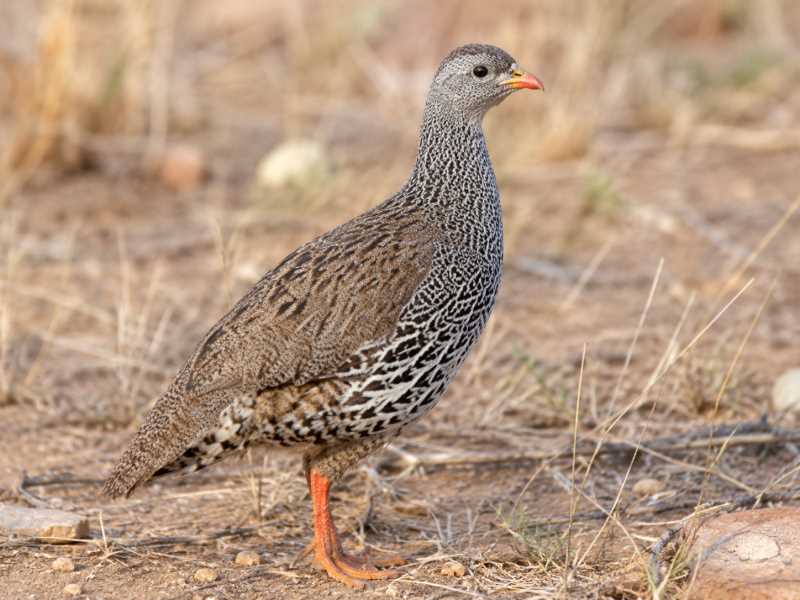
The Natal Spurfowl is a robust, short-tailed bird measuring approximately 30–38 cm in length. Adults are mainly brown above, with finely mottled or vermiculated plumage and strongly black-and-white barred underparts. The throat is pale to white, while the bill is reddish with a yellowish base. The legs are red or reddish, not bright yellow. Males have a backward-pointing leg spur, which is generally more developed than in females. The sexes are otherwise similar, and juveniles resemble adults but are usually duller in colour. (newmansbirds.com)
Range and Habitat
The Natal Spurfowl is a near-endemic resident of southern Africa. Its range includes eastern South Africa, Eswatini, Zimbabwe, southern Mozambique, southern Zambia and adjoining parts of eastern Botswana. Distribution accounts differ slightly in their treatment of peripheral records and subspecies, but the species is centred on the woodland and savanna belt of south-eastern Africa. (biodiversityexplorer.info)
It favours wooded savanna, thornveld, riverine bush, wooded valleys, thickets and rocky hillsides. It commonly remains near dense vegetation and watercourses, and may use cultivated areas where suitable cover is retained. In parts of its range, it is especially associated with drainage lines, the bases of hills and ridges, granite koppies and other rocky situations. It is generally sedentary rather than migratory. (biodiversityexplorer.info)
Behaviour and Diet
Natal Spurfowls spend most of their time on the ground. They usually walk or run when moving through cover and make short, rapid flights when flushed or alarmed. They may occur singly, in pairs or in small family groups, with parties of approximately six to ten birds reported in suitable habitat. Their loud territorial and contact calls are most conspicuous around dawn and dusk, although alarm calls may be given at other times. (newmansbirds.com)
The diet is varied and changes with local availability. Plant foods include roots, seeds, fruit, fallen grain and cultivated grains such as sorghum and maize. The birds also take insects and other invertebrates, including beetles, termites, grasshoppers and caterpillars. Foraging involves scratching through leaf litter and soil beneath shrubs and woodland vegetation. (biodiversityexplorer.info)
The nest is a shallow scrape on the ground, usually lined with grass stems and hidden beneath scrub or dense vegetation. Available regional breeding records indicate that laying may occur throughout the year in Zimbabwe, with a peak from March to May, while in South Africa the main period is December to May. Clutches contain approximately two to seven eggs, and incubation lasts about 20–25 days. The chicks are precocial and can make short flights roughly 10–14 days after hatching. (biodiversityexplorer.info)
Identification Tips
Look for a medium-sized, compact spurfowl with:
- Brown, finely marked upperparts.
- Bold black-and-white barring across the chest and belly.
- A reddish bill with a yellowish base.
- Red or reddish legs.
- Dense woodland, thornveld or riverine-bush habitat, often close to rocky ground or water.
- A loud, harsh call, often described as a repeated “kwali” or a raucous cackle.
The Natal Spurfowl can be confused with other brown spurfowls, especially where ranges approach one another. It is generally distinguished by its strongly barred underparts, reddish legs and bill, and preference for wooded savanna and thornveld. The Cape Spurfowl is larger and has a darker cap and pale cheeks, while the Red-necked Spurfowl has a red throat and more obvious bare facial skin. (newmansbirds.com)
Conservation Status
The Natal Spurfowl is classified as Least Concern on the IUCN Red List. Its global population has not been quantified, but it is described as generally abundant to locally common, and the population is suspected to be stable because there is no evidence of a substantial overall decline or major range-wide threat. (car.birdmap.africa)
Local pressures may include the loss or degradation of woodland, thornveld and riverine cover, as well as hunting in areas where the species is treated as a gamebird. Maintaining indigenous vegetation, protecting thickets and drainage-line habitat, and applying sustainable hunting regulations where relevant can help retain local populations. The IUCN assessment does not provide a reliable global population estimate, so numerical claims about abundance should be treated with caution. (car.birdmap.africa)
Frequently Asked Questions
Where does the Natal Spurfowl live?
It occurs mainly in eastern and south-eastern Africa, including eastern South Africa, Eswatini, Zimbabwe, southern Mozambique, southern Zambia and nearby parts of eastern Botswana. It favours wooded savanna, thornveld, riverine bush and dense thickets. (biodiversityexplorer.info)
Is the Natal Spurfowl migratory?
No. It is generally regarded as a sedentary resident, although local movements may occur in response to food, water and habitat conditions.
What does the Natal Spurfowl eat?
Its diet includes seeds, roots, fruit, fallen grain and cultivated grains, supplemented by insects and other invertebrates such as beetles, termites, grasshoppers and caterpillars. (biodiversityexplorer.info)
How can the Natal Spurfowl be identified?
Useful field marks include a brown, mottled body, strongly black-and-white-barred underparts, a reddish bill with a yellowish base, reddish legs and a loud, harsh call. It is most often found near dense cover rather than in open grassland. (newmansbirds.com)
Where does the Natal Spurfowl nest?
It nests on the ground in a shallow scrape concealed beneath grass, shrubs or other dense vegetation. Reported clutches contain about two to seven eggs, with incubation lasting approximately 20–25 days. (biodiversityexplorer.info)
What is the conservation status of the Natal Spurfowl?
The species is listed as Least Concern. Its total population has not been measured, but it is considered generally common in suitable habitat and is suspected to have a stable population trend. (car.birdmap.africa)
References
- BirdLife International. 2024. Pternistis natalensis. The IUCN Red List of Threatened Species 2024: e.T22678831A263597440. Available at: https://doi.org/10.2305/IUCN.UK.2024-2.RLTS.T22678831A263597440.en. Accessed 8 September 2026.
- Gill, F., Donsker, D. & Rasmussen, P. (eds). 2026. IOC World Bird List, version 15.2. International Ornithologists’ Union. Available at: https://www.worldbirdnames.org/. Accessed 8 September 2026.
- Hockey, P. A. R., Dean, W. R. J. & Ryan, P. G. (eds). 2005. Roberts Birds of Southern Africa, 7th edition. The Trustees of the John Voelcker Bird Book Fund, Cape Town.
- Robertson, H. n.d. Pternistis natalensis, Natal Spurfowl. Biodiversity Explorer, University of Cape Town. Available at: https://biodiversityexplorer.info/birds/phasianidae/pternistis_natalensis.htm. Accessed 8 September 2026.
- BirdLife South Africa. 2021. Appendix D: Endemic and near-endemic species. In The Eskom Red Data Book of Birds of South Africa, Lesotho and Eswatini. Available at: https://www.birdlife.org.za/wp-content/uploads/2021/02/RDBB-Final-copy.pdf. Accessed 8 September 2026.
- Coordinated Avifaunal Roadcounts. 2024. Natal Spurfowl, Pternistis natalensis: IUCN data and global status. BirdMap Africa. Available at: https://car.birdmap.africa/species/NS. Accessed 8 September 2026.
- South African National Biodiversity Institute. 2026. Cape Spurfowl. SANBI Animal of the Week. Available at: https://www.sanbi.org/animal-of-the-week/cape-spurfowl/. Accessed 8 September 2026.
Related posts