Introduction
Temminck’s Tragopan (Tragopan temminckii) is a medium-sized pheasant in the family Phasianidae. It is named after the Dutch zoologist Coenraad Jacob Temminck and is recognised for the male’s vivid red and orange plumage, blue facial skin and elaborate courtship display. The species occurs mainly in montane forests of China and adjoining parts of north-eastern India, northern Myanmar and northern Vietnam. (worldbirdnames.com)
Physical Description
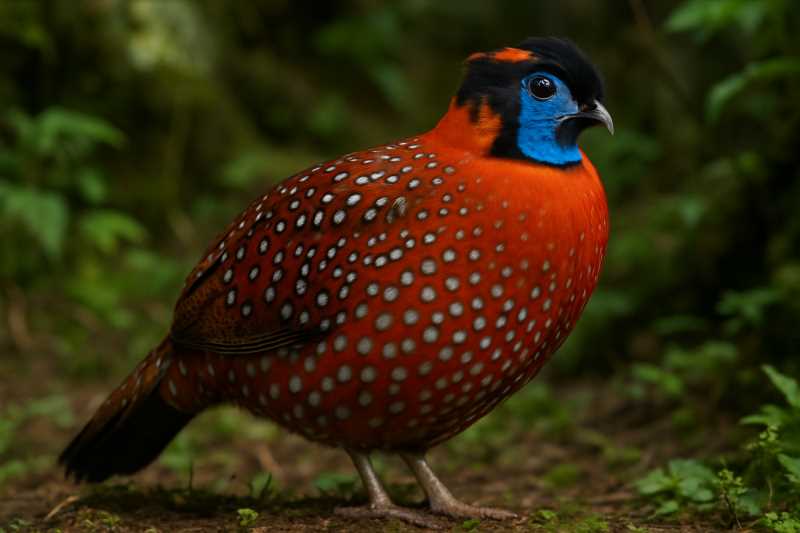
Temminck’s Tragopan is a stocky pheasant with a short tail and strong legs. Adult males are about 64 cm long, while females are approximately 58 cm. Males have predominantly red to orange plumage marked with numerous white spots, a dark head, bare blue facial skin, pinkish legs and a blue throat lappet. During courtship, the male inflates the lappet and raises two fleshy, horn-like structures above the head. (tokyo-zoo.net)
Females are smaller and cryptically coloured, with brown plumage and pale spotting or barring that helps them remain concealed while nesting. This strong difference between male and female plumage is pronounced sexual dimorphism. Juveniles and immature birds are less brightly coloured than adult males and more closely resemble the female’s subdued brown patterning.
Range and Habitat
Temminck’s Tragopan inhabits mountainous regions from north-eastern India eastwards through northern Myanmar and north-western Vietnam, with its main distribution in central and southern China. It is a resident species rather than a long-distance migrant, although local or seasonal movements may occur in response to elevation, weather and food availability. (pmc.ncbi.nlm.nih.gov)
The species favours dense, humid montane forests, including mixed coniferous and broad-leaved woodland, evergreen forest, bamboo and rhododendron vegetation. Reported elevations vary by locality, but studies commonly record it from approximately 1,800 to 3,900 metres. Suitable habitat usually includes a well-developed shrub layer, dense canopy or overhead cover, leaf litter and access to forest edges, streams or other moist areas. (pmc.ncbi.nlm.nih.gov)
Behaviour and Diet
Temminck’s Tragopan is mainly terrestrial and forages on the forest floor, although it can roost and move through low vegetation and trees. It is generally difficult to observe because its preferred habitat is dense and mountainous. Individuals may occur alone, in pairs or in small groups, with social behaviour varying between the breeding and non-breeding seasons.
The diet is omnivorous. Documented food items include herbs, ferns, shoots, seeds, fruits and other plant material, supplemented by insects and other small invertebrates. Diet changes seasonally: herbs and ferns are important during spring and winter, while mature fruits become more significant during summer and autumn. (zoores.ac.cn)
The breeding season commonly extends from April to June, although timing varies geographically. Males attract females with an elaborate display involving raised horns, an inflated blue throat lappet, expanded plumage, wing movements and vocalisations. The female is responsible for incubation and care of the precocial young. Published accounts report small clutches, commonly about three or four eggs, with incubation lasting roughly four weeks, but detailed information on wild breeding remains limited. (pmc.ncbi.nlm.nih.gov)
Identification Tips
- Look for a medium-sized, short-tailed pheasant in dense montane forest.
- An adult male is distinctive, with red and orange plumage, abundant white spotting, blue facial skin and a blue inflatable throat lappet.
- A displaying male may raise two blue, horn-like structures above the head and spread the throat lappet.
- The female is mainly brown and spotted, providing much better camouflage than the male.
- The species can be confused with other tragopans, particularly the similar Satyr Tragopan, but Temminck’s Tragopan usually shows a strongly red and orange male plumage with prominent white spotting and blue facial ornaments. Careful attention to the overall colour pattern and range is important.
Conservation Status
Temminck’s Tragopan is currently assessed as Least Concern on the IUCN Red List. This global category reflects the species’ relatively broad distribution, but it does not mean that local populations are secure. Population information is incomplete, and some assessments report a decreasing trend or continuing pressure on habitat. (worldbirdnames.com)
The principal threats are habitat loss, forest degradation, fragmentation, timber extraction, disturbance and hunting. Climate change may also alter the distribution and quality of suitable montane forest. Conservation measures include protecting remaining forests, maintaining connected habitat, managing human disturbance, enforcing hunting regulations and supporting field monitoring. Nature reserves are particularly important because the species depends on structurally complex forest with dense understorey vegetation. (pmc.ncbi.nlm.nih.gov)
Frequently Asked Questions
Where does Temminck’s Tragopan live?
It occurs in montane forests of central and southern China, north-eastern India, northern Myanmar and north-western Vietnam. It usually occupies dense, humid forest with substantial shrub, bamboo or rhododendron cover.
Is Temminck’s Tragopan endangered?
The species is currently listed as Least Concern by the IUCN. Nevertheless, local populations may be affected by habitat loss, degradation, hunting and fragmentation, and its population trend is not equally well known throughout its range.
What does Temminck’s Tragopan eat?
Its diet includes herbs, ferns, shoots, seeds, fruits and other plant material, together with insects and other small invertebrates. The relative importance of these foods changes between seasons.
How can a male Temminck’s Tragopan be identified?
The male is recognised by its red and orange body, extensive white spotting, blue facial skin, blue throat lappet and horn-like structures that are raised during courtship.
Are male and female Temminck’s Tragopans different?
Yes. Males are brightly coloured and conspicuous, whereas females are smaller and mainly brown with cryptic spotting or barring. This difference is an example of pronounced sexual dimorphism.
Does Temminck’s Tragopan migrate?
It is considered a resident mountain bird rather than a long-distance migrant. Local or seasonal movements may occur, especially in response to elevation, weather and food availability.
References
- BirdLife International. n.d. Temminck’s Tragopan Tragopan temminckii. BirdLife Data Zone species factsheet. Stable species account, accessed 8 September 2026.
- Gill, F., Donsker, D. and Rasmussen, P. (eds). 2026. IOC World Bird List, version 15.2. International Ornithological Congress. Stable online checklist, accessed 8 September 2026.
- IUCN Red List of Threatened Species. n.d. Tragopan temminckii. Assessment record, species account 22679169/264164899. Stable database record, accessed 8 September 2026.
- Shi, H.-T. and Zheng, G.-M. 1999. Study on the relation between habitat selection and diet of Temminck’s Tragopan. Zoological Research, 20(2), 131–136. https://www.zoores.ac.cn/article/id/560
- Cui, P., Kang, M. and Deng, W. 2008. Foraging habitat selection by sympatric Temminck’s tragopan and blood pheasant during breeding season in southwestern China. Biodiversity Science, 16(2), 143–149. https://doi.org/10.3724/SP.J.1003.2008.07165
- Tokyo Zoological Park Society. n.d. Temminck’s Tragopan Tragopan temminckii. Ueno Zoo animal encyclopaedia. Stable web account, accessed 8 September 2026.
- Wang, J. et al. 2026. Microhabitat use of Temminck’s Tragopan (Tragopan temminckii) during the breeding season in Laojunshan National Nature Reserve, western China. Animals, 16. Stable article record, accessed 8 September 2026.
- Wildlife Institute of India. 2026. Galliformes of National and Global Significance: Species Accounts. Government of India, Dehradun.
Related posts