Understanding the Ash-breasted Sierra Finch (Geospizopsis plebejus)
The Ash-breasted Sierra Finch, scientifically known as Geospizopsis plebejus, is a small passerine bird that forms part of the Thraupidae family. This fascinating species can be found in the high-altitude regions of South America, where it thrives amidst the rugged landscapes of the Andes. While it may not be the most conspicuous bird due to its modest coloring, the Ash-breasted Sierra Finch is an intriguing subject for ornithologists and bird watchers alike, offering insights into the adaptability and diversity of avian life in challenging environments.
Habitat and Distribution
The Ash-breasted Sierra Finch is predominantly found in the Andes mountains, with its range extending from Venezuela in the north through Colombia, Ecuador, Peru, and into Bolivia in the south. These birds are typically found at altitudes ranging from 2,500 to 4,800 meters, favoring open areas such as grasslands, shrublands, and agricultural fields. Their presence in these high-altitude regions speaks to their remarkable adaptability to harsh climates and limited resources.
The varied topography of the Andes provides a unique ecological niche for the Ash-breasted Sierra Finch. The bird’s preference for open, varied terrain allows it to exploit different food sources, which is vital for its survival in such a challenging environment.
Physical Characteristics
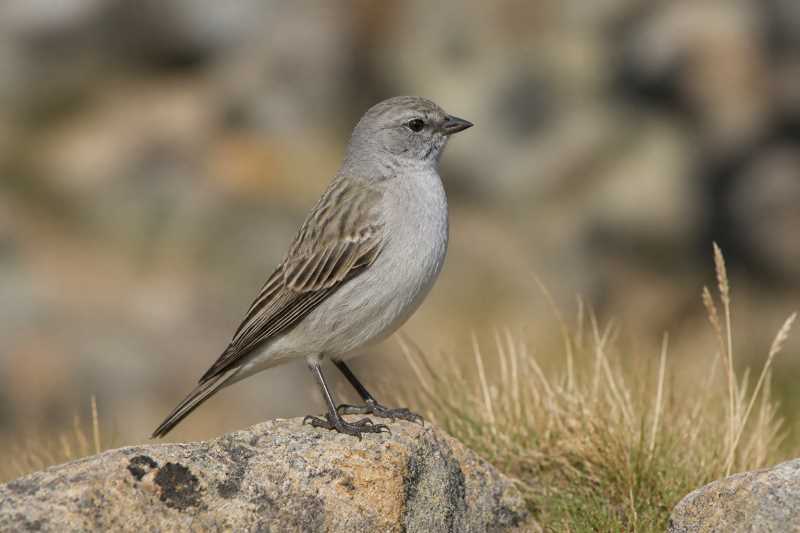
The Ash-breasted Sierra Finch is relatively small, measuring about 14 to 15 centimeters in length. Its plumage is predominantly gray, with a distinctive ash-colored breast that gives the species its common name. The bird’s wings and tail are darker, often with a bluish tint, while its beak is stout and conical, well-suited for its diet.
Males and females are similar in appearance, although females may exhibit slightly duller plumage. This lack of sexual dimorphism is not uncommon among finches, where both sexes need to be equally camouflaged from predators in their open habitats.
Behavior and Diet
In terms of behavior, the Ash-breasted Sierra Finch is known for its sociable nature. These birds are often observed in small flocks, particularly outside the breeding season. Their social behavior likely offers advantages in terms of foraging and predator detection, which are crucial in the open landscapes they inhabit.
The diet of the Ash-breasted Sierra Finch is primarily composed of seeds, which they forage from the ground. Their strong, conical beaks are perfectly adapted for cracking open hard seed coats, allowing them to access the vital nutrients within. In addition to seeds, they may also consume small insects, particularly during the breeding season when additional protein is necessary for chick development.
Breeding and Lifecycle
The breeding season for the Ash-breasted Sierra Finch typically coincides with the onset of the rainy season, when food resources become more abundant. During this time, males engage in displays and vocalizations to attract females, showcasing their physical fitness and genetic quality.
Nests are usually constructed in shrubs or small trees, made from grasses and lined with softer materials for insulation. The female typically lays two to three eggs, which she incubates for about two weeks. Both parents are involved in feeding the chicks, which fledge after approximately two weeks.
The relatively short breeding season requires these birds to be efficient in raising their young, ensuring that the next generation is equipped to survive in the demanding high-altitude environment.
Conservation Status
Currently, the Ash-breasted Sierra Finch is classified as a species of Least Concern by the International Union for Conservation of Nature (IUCN). This status reflects its wide distribution and stable population numbers. However, like many species that inhabit specific ecological niches, it is potentially susceptible to habitat changes caused by climate change and human activities such as agriculture and mining.
Conservation efforts are essential to monitor the population trends of the Ash-breasted Sierra Finch, ensuring that any potential threats to its habitat are identified and mitigated promptly.
Conclusion
The Ash-breasted Sierra Finch serves as a remarkable example of avian adaptation to high-altitude environments. Its ability to thrive in the challenging conditions of the Andes highlights the resilience and versatility of bird species across the globe. While not currently at risk, continued attention to its habitat and ecological needs will be crucial in preserving this unique species for future generations to appreciate.
For bird enthusiasts and researchers, the Ash-breasted Sierra Finch offers a fascinating glimpse into the dynamics of life in some of the world’s most awe-inspiring landscapes.
Related posts