Introduction
The Lemon Dove, Columba larvata, is a shy, mainly ground-feeding dove of evergreen forest in sub-Saharan Africa. It is also known as the Cinnamon Dove. Although often difficult to see, it may be detected by its soft calls or by the sudden movement of a bird flushed from leaf litter. Current taxonomic lists differ in their treatment of the genus, with some sources using Aplopelia larvata, but Columba larvata is retained here to match the article subject. (itis.gov)
Physical Description
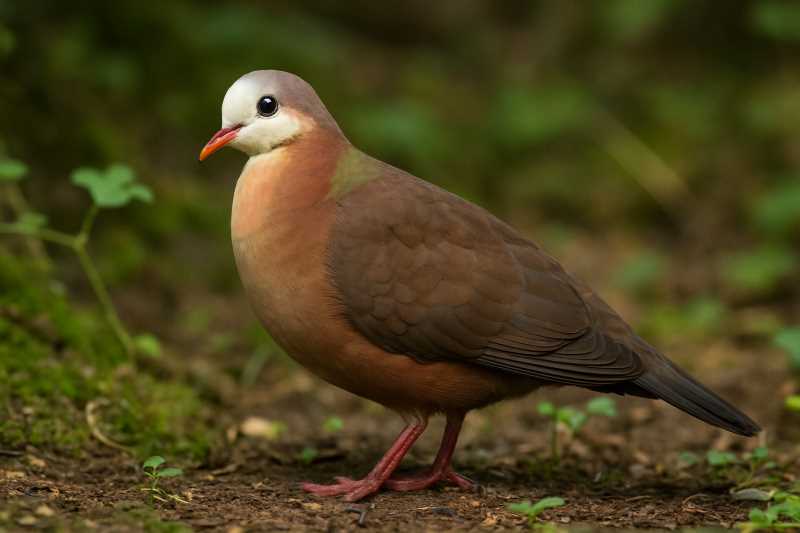
The Lemon Dove is a medium-sized dove with generally brownish-grey upperparts and warm cinnamon-brown underparts. Adult males usually show a conspicuous pale or whitish forehead and face, contrasting with the darker head and neck. The breast and belly are rich cinnamon to rufous brown, while the back and wings are darker brown. The bill is dark, and the legs and feet are pinkish.
Males and females are broadly similar, although females are generally duller and browner. Juveniles are less richly coloured and may show a more uniformly muted appearance, with less distinct facial contrast. Reliable sources vary in the measurements they provide, so a precise length and wingspan are not stated here. The species is best recognised by its warm cinnamon tones, pale face, compact shape and habit of walking or flushing from the forest floor. (birdforum.net)
Range and Habitat
The Lemon Dove has a broad but patchy distribution across sub-Saharan Africa. It occurs in parts of West, Central, East and southern Africa, including suitable forest regions from Ethiopia and Uganda southwards through eastern and southern Africa. Several island and regional forms have also been recognised within the species complex or species treatment, and taxonomy varies between authorities.
It is primarily associated with evergreen lowland, montane and Afromontane forest, especially areas with dense undergrowth and deep leaf litter. In southern Africa it may also occur in forest remnants, riverine forest, well-wooded gardens and some mature pine or oak plantations near indigenous forest. It is generally resident rather than migratory, although local movements may occur in response to food availability or changing conditions. Reported elevations range from near sea level to more than 2,000 metres in suitable forest habitats. (biodiversityexplorer.info)
Where to See This Species
Krantzkloof Nature Reserve, KwaZulu-Natal, South Africa
Krantzkloof protects densely vegetated valleys and coastal scarp forest west of Durban. BirdLife South Africa identifies the Lemon Dove as one of the reserve’s key forest species, making the shaded forest trails and valley habitats realistic places to search. Early morning walks are likely to be most productive, particularly where quiet paths pass through leaf litter and dense undergrowth. (gobirding.birdlife.org.za)
Nearby accommodation: Kloof, Durban and Pietermaritzburg provide practical accommodation bases, including hotels, guest houses, self-catering accommodation and campsites in the wider region.
Kirstenbosch National Botanical Garden, Western Cape, South Africa
The indigenous forest areas at Kirstenbosch, including the Arboretum and Enchanted Forest, are recognised by BirdLife South Africa as a reliable place to look for Lemon Doves on the forest paths. Birds are best searched for early in the day, before visitor activity increases, although they may occur throughout the day in suitable quiet areas. (gobirding.birdlife.org.za)
Nearby accommodation: Cape Town and the southern suburbs offer a wide range of hotels, guest houses, hostels and self-catering accommodation.
Mbombela Nature Reserve, Mpumalanga, South Africa
This accessible reserve in Mbombela contains riverine forest, thicket and other habitats. BirdLife South Africa notes that Lemon Doves can be heard or found near the forested sections, particularly around the Impala Street entrance. Listening quietly from the paths and watching shaded leaf litter may be more effective than scanning the canopy. (gobirding.birdlife.org.za)
Nearby accommodation: Mbombela, also known as Nelspruit, is the nearest practical base, with hotels, guest houses, lodges and self-catering accommodation.
Behaviour and Diet
Lemon Doves are secretive and are usually encountered singly or in pairs. They spend much of their time on the ground, walking through leaf litter and scratching or probing among fallen leaves. A bird may remain motionless in dense cover and is often noticed only when it is flushed at close range.
The diet consists mainly of fallen seeds, fruits and berries. Small quantities of invertebrates, including insects and other forest-floor prey, may also be taken. In some areas the birds are particularly associated with places where bamboo or other plants produce abundant seed.
The species is generally resident, although movements within or between forest patches may occur. Breeding information is comparatively limited. The nest is a simple, shallow platform of twigs and rootlets, usually placed in a tree, shrub, vine or other low vegetation. The clutch commonly contains two creamy white eggs, although clutches of one to three eggs have been reported. (biodiversityexplorer.info)
Identification Tips
- Look for a compact, warm brown dove walking quietly on the forest floor rather than feeding high in the canopy.
- The cinnamon-brown breast and belly contrast with the darker back and wings.
- The pale forehead and face are useful features on adult birds, especially in good light.
- Listen for soft cooing from dense forest, then search the leaf litter and nearby low branches.
- The species is more likely to flush from shaded undergrowth than to sit conspicuously in an exposed position.
- In southern African forests, compare it with the Tambourine Dove and other small forest doves. The Lemon Dove is generally larger and more cinnamon-coloured, with a more substantial body and a stronger association with deep forest leaf litter.
Conservation Status
The Lemon Dove is listed as Least Concern on the IUCN Red List. The species has a broad geographic range and is considered resident, but the assessed population trend is decreasing. The principal concern is the loss, fragmentation and degradation of evergreen forest through logging, agricultural expansion, plantations, development and other land-use changes. The species’ dependence on intact or well-connected forest makes it vulnerable where remaining forest patches become isolated. (doi.org)
Protecting indigenous forest, maintaining connections between forest patches and managing disturbance in important forest reserves are key conservation measures. Further monitoring is also valuable because the species is unobtrusive and may be under-recorded in areas where it is present.
Frequently Asked Questions
Where does the Lemon Dove live?
The Lemon Dove lives mainly in evergreen lowland and montane forests across sub-Saharan Africa. It may also occur in forest remnants, riverine forest and some mature plantations near natural forest.
Is the Lemon Dove migratory?
The Lemon Dove is generally resident and does not undertake long-distance seasonal migration. Local movements between nearby forest patches may occur.
What does the Lemon Dove eat?
It feeds mainly on fallen seeds, fruits and berries collected from the forest floor. Small invertebrates may also form part of its diet.
How can the Lemon Dove be identified?
Look for a shy, compact dove with brownish-grey upperparts, cinnamon-brown underparts and a pale face. Its habit of walking through leaf litter or flushing from shaded undergrowth is also distinctive.
Where is the best place to see a Lemon Dove?
The best opportunities are in quiet evergreen forests with dense undergrowth and leaf litter. In South Africa, documented birding sites include Krantzkloof Nature Reserve, Kirstenbosch National Botanical Garden and Mbombela Nature Reserve.
Is the Lemon Dove endangered?
No. The species is currently classified as Least Concern, although its population trend is decreasing and forest loss and fragmentation remain important threats.
References
- IUCN Red List of Threatened Species
- IOC World Bird List
- BirdLife South Africa
Related posts