The Enigmatic Japanese Waxwing: A Comprehensive Overview
The Japanese Waxwing (Bombycilla japonica) is a captivating bird species renowned for its striking appearance and unique behaviors. As a member of the Bombycillidae family, this species shares common traits with its relatives, the Bohemian and Cedar Waxwings. However, the Japanese Waxwing possesses distinct characteristics that set it apart, making it a subject of intrigue for ornithologists and bird enthusiasts alike.
Taxonomy and Classification
The Japanese Waxwing is scientifically classified under the genus Bombycilla, which comprises three species, including the Bohemian and Cedar Waxwings. The scientific name Bombycilla japonica underscores its association with Japan, although its range extends beyond the Japanese archipelago.
Physical Characteristics
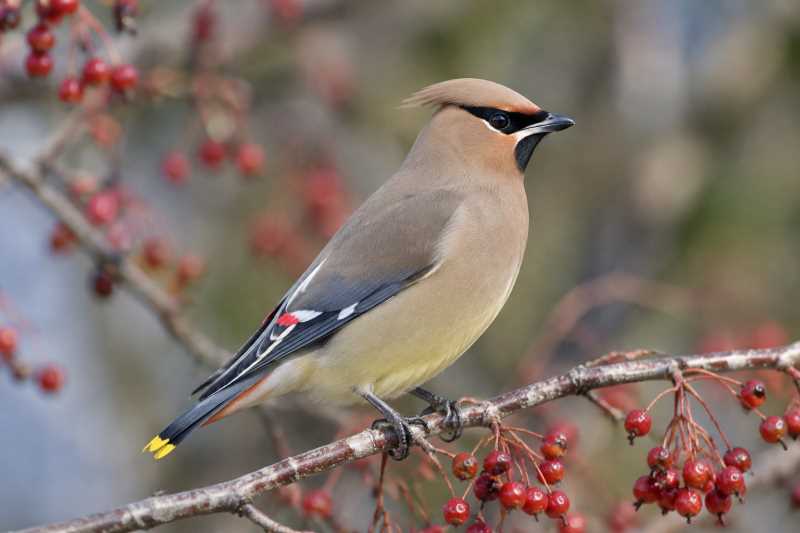
One of the most striking features of the Japanese Waxwing is its sleek, silky plumage that exhibits a harmonious blend of colors. The bird is predominantly gray with a subtle pinkish hue on its body. Its wings are adorned with bold white and yellow markings, while the tail feathers end in a distinctive yellow band. A hallmark of the species is the wax-like red tips on some of its secondary flight feathers, which give the bird its name.
The Japanese Waxwing is slightly smaller than the Bohemian Waxwing, measuring about 15-18 cm in length, with a wingspan reaching approximately 30 cm. Its crest, a prominent feature, adds to its elegant appearance, while its black mask and chin contrast sharply with the soft tones of its plumage.
Distribution and Habitat
The Japanese Waxwing’s range is primarily confined to eastern Asia. It breeds in northeastern China, southeastern Russia, and the Korean Peninsula. During the winter months, the bird migrates southwards to Japan and parts of southeastern China. Unlike many migratory birds, the Japanese Waxwing does not follow the same migratory paths each year, making its movements somewhat unpredictable.
In terms of habitat, the Japanese Waxwing is typically found in open woodlands, forests, and areas with abundant fruiting trees. It shows a preference for habitats that offer a mix of coniferous and deciduous trees, which provide both food and shelter.
Diet and Feeding Behavior
Japanese Waxwings are primarily frugivorous, with a diet that consists largely of fruits and berries. They have a particular fondness for mistletoe berries, which play a crucial role in their diet during the winter months. In addition to fruits, they occasionally consume insects, especially during the breeding season when protein demand is higher.
Their feeding behavior is characterized by a social dynamic, often seen in flocks ranging from a few individuals to several dozen. The social nature of their feeding habits facilitates efficient foraging as they move through their habitats in search of fruit-laden trees.
Breeding and Reproduction
The breeding season for the Japanese Waxwing occurs from late May to July. During this time, the birds engage in intricate courtship displays characterized by aerial acrobatics and the exchange of food between potential mates. The male often presents the female with berries in a gesture that strengthens pair bonds.
Nests are constructed in trees, typically in conifers or dense shrubs, and are composed of twigs, moss, and lichen. The female lays a clutch of about 3-5 eggs, which she incubates for approximately 13-14 days. Both parents participate in feeding the chicks, which fledge after about 15 days post-hatching.
Conservation Status
The International Union for Conservation of Nature (IUCN) currently lists the Japanese Waxwing as a species of Least Concern. However, like many bird species, it faces threats from habitat loss and environmental changes. Deforestation and urbanization in parts of its range pose significant challenges to its survival.
Efforts to conserve its habitat are crucial for ensuring the continued existence of the Japanese Waxwing. Conservation strategies include protecting critical breeding and feeding areas and promoting awareness about the ecological importance of this species.
Cultural Significance
The Japanese Waxwing holds a special place in the cultures of East Asia. In Japan, it is often depicted in art and literature, symbolizing beauty and grace. Its presence in traditional paintings and poetry underscores its cultural importance and the admiration it has garnered over centuries.
Conclusion
The Japanese Waxwing is a testament to the rich biodiversity of eastern Asia. Its captivating appearance and intriguing behaviors continue to fascinate bird watchers and researchers worldwide. Ensuring the conservation of its habitat not only protects this beautiful species but also maintains the ecological balance within its range. As we continue to study and understand the Japanese Waxwing, it serves as a reminder of the delicate interplay between nature and culture, and the role we play in preserving it for future generations.
Related posts