Introduction
The Least Nighthawk, Chordeiles pusillus, is a small nightjar of open landscapes in tropical South America. It is most active around dusk and dawn, when it leaves its daytime roost to catch flying insects. Its muted plumage and habit of resting motionless on the ground make it difficult to find, even where it is locally established.
Physical Description
The Least Nighthawk is approximately 15–19 centimetres long. It has long, pointed wings, a short bill surrounded by fine bristles, and a compact body typical of the nighthawk group.
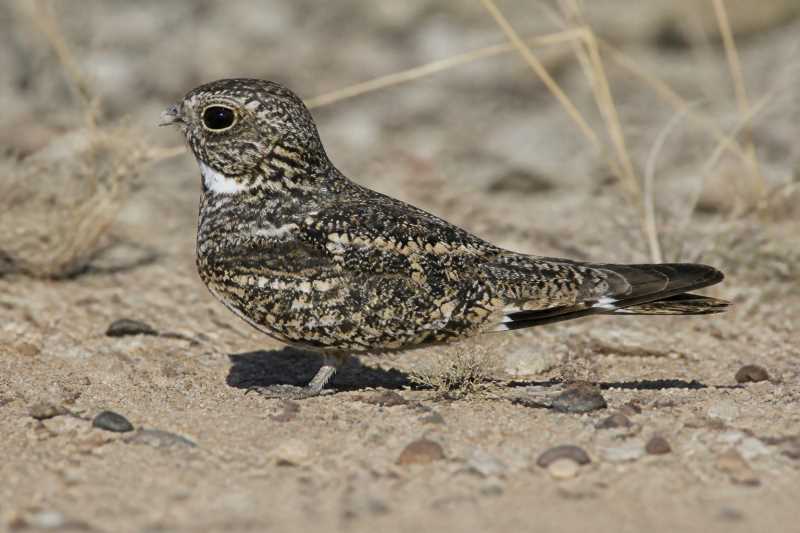
The upperparts are brownish or grey-brown, marked with rufous, buff and darker streaks. The underparts are paler and usually barred or mottled with brown. A pale trailing edge or wing marking can be visible in flight, although it is often difficult to see in low light. The plain pale vent and small size are useful identification features.
The plumage is cryptic and varies geographically. Several recognised subspecies differ in colour, pattern and measurements. Reliable evidence for consistent age-related plumage differences or strong sexual dimorphism is limited, and males and females are generally difficult to separate in the field.
Range and Habitat
The Least Nighthawk occurs in northern and central South America, including parts of Colombia, Venezuela, Guyana, Suriname, Bolivia and Brazil. It is not the North American Lesser Nighthawk, Chordeiles acutipennis, and the two species should not be confused because of their similar English names.
It is associated mainly with open and semi-open habitats, including cerrado, savanna, grassland, scrub, seasonally flooded plains and sandy or white-sand vegetation enclaves. In Amazonia, records are concentrated in naturally open patches such as campinas and savannas within the wider forest region. It may also occur along forest edges and on open, rocky or gravelly ground.
The species is generally a lowland or lower-elevation bird, although it has been recorded at higher elevations in parts of its range. Local movements and seasonal changes in occurrence are reported, but the extent of migration appears to vary geographically. Recent research indicates substantial geographic differentiation between Amazonian white-sand populations and birds from non-Amazonian savannas, so variation within the species remains an active area of study.
Where to See This Species
Brasília National Park, Federal District, Brazil
The Least Nighthawk is included in the official bird guide for Brasília National Park. The park’s cerrado habitats, open grasslands and scattered woodland provide suitable conditions for a species that hunts over open ground and may roost on bare or sparsely vegetated surfaces. Look around dusk and dawn, when nighthawks are most likely to become active.
Nearby accommodation: Brasília is the nearest practical base, with hotels, guest houses and self-catering accommodation in the city and surrounding districts.
Serra da Canastra National Park, Minas Gerais, Brazil
The species is listed in the park’s management plan. Serra da Canastra contains extensive cerrado grasslands, rocky ground and other open habitats that match the Least Nighthawk’s documented preferences. Early morning and late afternoon are the most appropriate periods for searching, particularly around open grassland and sparsely vegetated areas.
Nearby accommodation: São Roque de Minas and neighbouring gateway settlements offer pousadas, guest houses, small hotels and camping options.
Jaú National Park, Amazonas, Brazil
Least Nighthawks have been documented in Jaú National Park from campina shrubland, a naturally open habitat within the Amazonian forest landscape. The record was supported by a specimen and sound recordings, making the park a particularly important site for the Amazonian form of the species. Access is remote and normally requires organised arrangements through the park’s recognised access routes.
Nearby accommodation: Novo Airão is the most practical gateway for many visits to the park, with river lodges, guest houses, hotels and organised camp-based accommodation in the wider area.
Behaviour and Diet
The Least Nighthawk is crepuscular and nocturnal. During the day it usually rests on the ground or among sparse vegetation, where its mottled plumage provides effective camouflage. It may remain still until approached closely before flushing.
At dusk, it makes buoyant, twisting flights over open ground and vegetation. It feeds by catching insects in the air, probably including moths, beetles and other small flying invertebrates. Its broad gape and manoeuvrable flight are adaptations for aerial feeding.
Individuals are often encountered alone, although more than one bird may forage in the same suitable area. The species’ calls and flight activity can be more useful for detection than a visual search of the ground.
Breeding information is incomplete and may differ among regions. The eggs are laid directly on bare ground, gravel or another lightly covered surface rather than in a constructed nest. Field observations indicate that the female may remain closely associated with the egg or young during the day and use distraction behaviour when disturbed. The original article’s precise incubation period and generalised description of both parents feeding the young should be treated cautiously because detailed breeding data are not available for all populations.
Identification Tips
- Look for a very small nighthawk with long, narrow, pointed wings and a brown, grey and buff mottled appearance.
- Search open grassland, cerrado, savanna, scrub and sandy or rocky ground, especially near sunset and sunrise.
- In flight, watch for a pale wing edge or pale marking, but do not rely on this feature alone in poor light.
- The small size, pale vent and finely barred underparts help separate it from the larger and more strongly marked Nacunda Nighthawk, Chordeiles nacunda.
- Compare it carefully with the Lesser Nighthawk, Chordeiles acutipennis, where both occur. The Least Nighthawk is generally smaller and has a different combination of plumage pattern, size and range.
- The Common Nighthawk, Chordeiles minor, is also larger and is primarily associated with a much broader migratory range extending into North America.
Conservation Status
The Least Nighthawk is currently assessed as Least Concern. It has a broad South American distribution and occurs in a range of open habitats, but detailed information on population size and long-term population trends is limited.
The principal conservation concern is the loss or degradation of suitable open habitat through agricultural expansion, altered fire regimes, development and the conversion of natural savannas and campinas. Because the species feeds on flying insects, changes in insect abundance and the use of pesticides may also affect local populations, although the relative importance of these pressures has not been quantified for the species as a whole.
Protecting remaining cerrado, savanna, grassland and white-sand habitats, maintaining habitat mosaics and improving knowledge of regional movements and breeding ecology are important conservation priorities.
Frequently Asked Questions
Where does the Least Nighthawk live?
It occurs in parts of northern and central South America, especially in Brazil, Colombia, Venezuela, Guyana, Suriname and Bolivia. It favours open habitats such as savannas, cerrado, grasslands, scrub and campina vegetation.
Is the Least Nighthawk found in the United States?
No. The Least Nighthawk, Chordeiles pusillus, is a South American species. The similarly named Lesser Nighthawk, Chordeiles acutipennis, occurs in the United States and farther south.
What does the Least Nighthawk eat?
It feeds mainly on flying insects captured during aerial foraging, particularly around dusk and dawn. Moths, beetles and other small invertebrates are likely to form much of its diet.
Where does the Least Nighthawk nest?
It lays its eggs directly on the ground, often on bare soil, gravel or another sparsely vegetated surface. It does not build a conventional nest.
When is the best time to see a Least Nighthawk?
The best opportunities are shortly before and after sunset, and again around dawn. During daylight it usually rests quietly on the ground and can be extremely difficult to detect.
Is the Least Nighthawk endangered?
It is currently classified as Least Concern. That assessment does not mean that every population is secure, and local habitat loss or degradation may still affect the species.
References
- BirdLife International
- International Ornithologists’ Union, AviList and IOC World Bird List
- Instituto Chico Mendes de Conservação da Biodiversidade
Related posts