Introduction
The Venezuelan Wood-Quail (Odontophorus columbianus) is an elusive ground-dwelling member of the New World quail family, Odontophoridae. It is endemic to Venezuela and is associated mainly with humid montane and cloud forests. Because it spends much of its time in dense undergrowth, it is more often detected by its calls than seen. The species is currently assessed as Near Threatened because its restricted range is affected by habitat loss and hunting pressure.
Physical Description
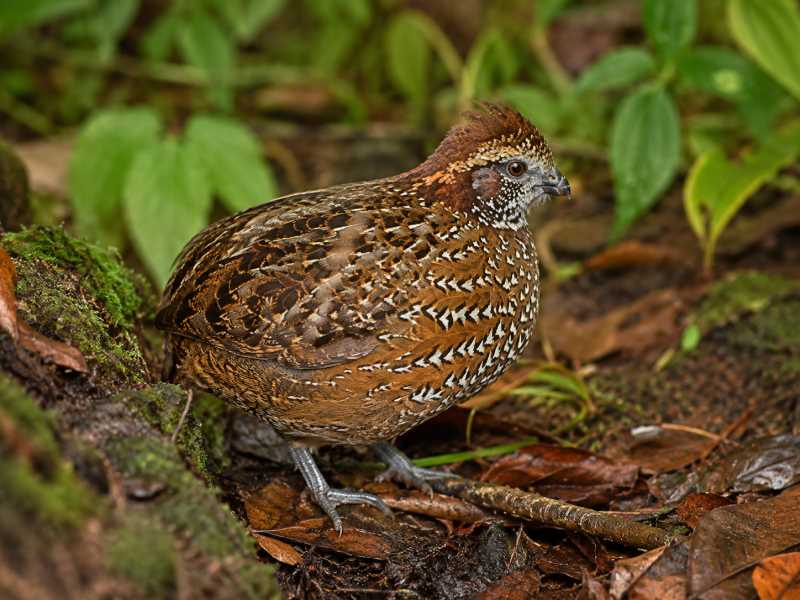
The Venezuelan Wood-Quail is approximately 25–30 cm long and has a compact, robust body, short rounded wings and a relatively short tail. Its plumage is predominantly reddish brown and dark brown, with black markings and contrasting white streaks or spots.
Adult males have a greyish crown, a darkly marked head and a white throat and chin crossed by black streaks. The throat is bordered by a broad dark band, while the breast and flanks are rich rufous-brown with conspicuous pale markings. The upperparts are brown with fine dark barring and pale or white streaks on the back and wing coverts.
Females are generally duller, with greyer or paler underparts and less conspicuous white markings. Juveniles resemble females and are less strongly patterned than adult males. Both sexes have dark bills and dark greenish-grey legs and feet.
Range and Habitat
The Venezuelan Wood-Quail is endemic to Venezuela. Its principal known range is in the central part of the Venezuelan Coastal Range, extending from Carabobo eastwards to north-western Miranda. Additional records have been reported from Táchira in western Venezuela, although the species remains poorly known and its distribution may be incompletely documented.
It inhabits humid subtropical and tropical montane forest, including cloud forest, generally at middle elevations. Published accounts place it broadly between about 800 and 2,000 metres above sea level, although local records may fall outside this range. The species is associated with dense ground vegetation, deep leaf litter and structurally complex understorey.
Research in Henri Pittier National Park found that the quail was more likely to occur in sites with dense low vegetation and a high frequency of non-palm monocots. It was less frequently associated with areas dominated by palms of the genus Bactris. These findings indicate that habitat structure at ground level is important for foraging and cover.
The Venezuelan Wood-Quail is considered sedentary. It is not known to undertake regular seasonal migration.
Behaviour and Diet
The species is secretive and usually moves through leaf litter and dense undergrowth rather than flying unless disturbed. It may occur alone, in pairs or in small family groups and coveys. Observations have included groups of up to approximately 14 birds, although smaller groups are more typical in field accounts.
Foraging takes place on the forest floor. The birds scratch through leaf litter and loose soil for seeds, fallen fruits, roots and small invertebrates, including insects and worms. Reliable information on the relative importance of these food items is limited.
Vocal communication is important because the birds are difficult to see in dense forest. Calls are reported to include repeated, rapidly delivered notes and antiphonal exchanges between birds. Calling activity may be especially useful for locating the species during surveys.
Breeding information is scarce. The available evidence suggests that breeding may occur during the wetter part of the year, broadly from March to July. One reported nest was placed at ground level near the base of palms, was concealed by vegetation and contained six eggs. These observations are limited, so the timing and details of reproduction should be treated as provisional.
Identification Tips
When searching suitable montane forest, listen for repeated quail calls before attempting to locate the bird. The Venezuelan Wood-Quail usually remains low in dense vegetation and may cross a trail quickly before disappearing into cover.
Key field marks include:
- A compact, heavy-bodied shape with short rounded wings.
- Predominantly reddish-brown and dark-brown plumage.
- A white throat and chin marked with black streaks.
- A broad dark border around the throat.
- Pale or white streaks and spots on the breast, flanks, back and wings, especially in adult males.
- A greyish crown and darkly marked head.
Females and juveniles are more subdued, with greyer underparts and less obvious pale markings. Identification should be based on the combination of head pattern, throat markings, body colour and location rather than on any single feature.
Conservation Status
The Venezuelan Wood-Quail is classified as Near Threatened on the IUCN Red List. The assessment reflects its restricted distribution and the continuing risk of decline associated with habitat loss and hunting pressure. A precise global population estimate should not be assumed because the species is poorly surveyed and its abundance is not well established.
The principal conservation concern is the loss and fragmentation of humid montane forest through agricultural expansion, logging, infrastructure and other forms of land conversion. Hunting may add pressure, particularly where remaining forest is accessible. The species has been recorded in protected areas, including Henri Pittier National Park, but protection of reserves alone may not prevent losses where surrounding habitats continue to be degraded.
Important conservation measures include maintaining large areas of connected montane forest, protecting dense understorey and leaf-litter habitat, improving enforcement against illegal hunting and carrying out targeted surveys. Further research is needed on population size, distribution, breeding success, habitat requirements and the effects of forest fragmentation.
Frequently Asked Questions
Where does the Venezuelan Wood-Quail live?
It is endemic to Venezuela and is principally known from humid montane and cloud forests in the Venezuelan Coastal Range, especially from Carabobo east to north-western Miranda. Additional records have been reported from Táchira.
What does the Venezuelan Wood-Quail look like?
It is a compact reddish-brown quail with a darkly marked head, a white and black-streaked throat, and pale markings on the breast, flanks, back and wings. Females are generally duller and greyer below than males.
What does the Venezuelan Wood-Quail eat?
It forages on the forest floor and is reported to eat seeds, fallen fruits, roots and small invertebrates such as insects and worms.
Is the Venezuelan Wood-Quail endangered?
It is currently classified as Near Threatened, rather than Vulnerable, Endangered or Critically Endangered. Habitat loss, habitat fragmentation and hunting pressure are the main documented concerns.
Is the Venezuelan Wood-Quail migratory?
No regular migration has been documented. Available accounts describe it as a sedentary species associated with humid montane forest.
Why is the Venezuelan Wood-Quail difficult to see?
It spends most of its time walking through dense undergrowth and leaf litter. Its cryptic plumage and secretive behaviour allow it to remain concealed, so observers often hear its calls before seeing it.
References
- BirdLife International. 2026. BirdLife International Taxonomic Checklist, version 10. BirdLife International. Available at: https://datazone.birdlife.org/about-our-science/taxonomy (accessed 8 September 2026).
- Bonaccorso, E. and Barreto, G. R. 2002. Microhabitat use by foraging Venezuelan Wood-Quails (Odontophorus columbianus). Journal of Field Ornithology, 73(3), 318–322. https://doi.org/10.1648/0273-8570-73.3.318
- Bonaccorso, E. and Barreto, G. R. 2004. Habitat preferences of the Venezuelan Wood-quail. In D. M. Brooks, J. Carroll, J. C. Eitniear and F. González-García (eds), Biology and Conservation of Neotropical Galliforms in the New Millennium, pp. 41–48. Miscellaneous Publication No. 3. San Antonio, Texas: Center for the Study of Tropical Birds.
- Bonaccorso, E., Lentino, M. and Barreto, G. R. 2004. Populations of the Venezuelan Wood-quail. In D. M. Brooks, J. Carroll, J. C. Eitniear and F. González-García (eds), Biology and Conservation of Neotropical Galliforms in the New Millennium, pp. 69–77. Miscellaneous Publication No. 3. San Antonio, Texas: Center for the Study of Tropical Birds.
- Carroll, J. P., Kirwan, G. M. and Sharpe, C. J. 2020. Venezuelan Wood-Quail (Odontophorus columbianus), version 1.0. In J. del Hoyo, A. Elliott, J. Sargatal, D. A. Christie and E. de Juana (eds), Birds of the World. Ithaca, New York: Cornell Lab of Ornithology. https://doi.org/10.2173/bow.venwoq1.01
- Gill, F., Donsker, D. and Rasmussen, P. (eds). 2026. IOC World Bird List, version 15.2. International Ornithologists’ Union. Available at: https://www.worldbirdnames.org/ (accessed 8 September 2026).
- IUCN. 2026. The IUCN Red List of Threatened Species. Version 2026-1. International Union for Conservation of Nature. Available at: https://www.iucnredlist.org/ (accessed 8 September 2026).
Related posts