Introduction
The Razor-billed Curassow, Mitu tuberosum, is a large member of the Cracidae family, which also includes guans and chachalacas. It is a resident of the Amazon Basin, where it inhabits mature lowland rainforest and associated riverine habitats. Although widespread and currently assessed as Least Concern, it is vulnerable to hunting and habitat degradation.
Physical Description
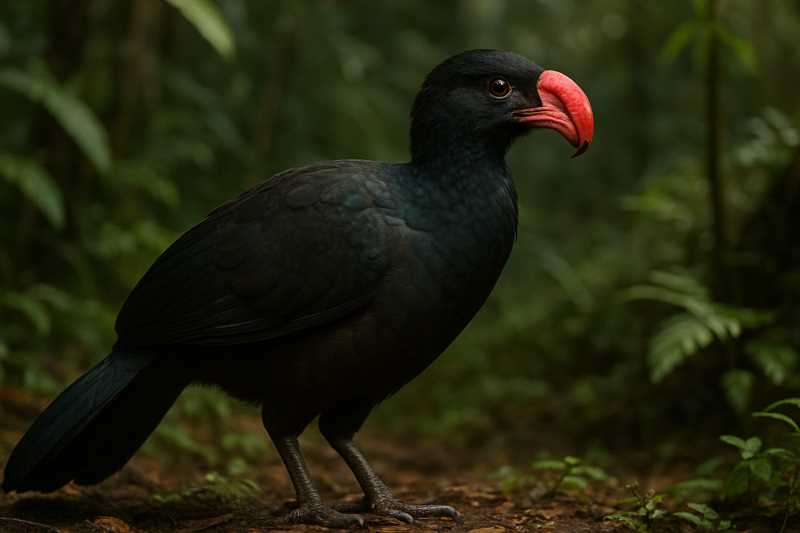
The Razor-billed Curassow is a large, turkey-sized bird measuring approximately 83–89 cm in length. Adults have predominantly black plumage with a blue or navy iridescent sheen, a well-developed crest, and a contrasting pale or white terminal band on the tail. The lower belly and vent may show chestnut or brown tones.
The bill is bright red, laterally compressed and strongly ridged along the upper surface. Its unusual shape is a diagnostic feature, but it should not be described as a defensive weapon. The legs are also reddish. Males and females are broadly similar in plumage, although males are generally larger and may have a more strongly developed bill. Reliable information on juvenile plumage and age-related variation is limited.
Range and Habitat
The species occurs in Amazonian South America, including Brazil, Peru, Bolivia and Colombia. Its range extends through much of the Amazon Basin, with records both south of the Amazon and Marañón rivers and in parts of the region north of those rivers.
The Razor-billed Curassow is associated mainly with mature, humid lowland rainforest. It uses terra firme forest, gallery forest, várzea and other seasonally flooded habitats, as well as forest near lakes, streams and river margins. It is generally found from near sea level to about 1,350 m, although most records are from low elevations.
This is a resident rather than a long-distance migratory species. It may travel locally through the forest in search of fruit and other food resources, but seasonal migration has not been established.
Behaviour and Diet
Razor-billed Curassows are usually seen alone or in pairs, although small groups may occur. They spend much of their time on the forest floor, where they search through leaf litter and consume fallen fruit. They may also climb or fly into trees to feed or roost, despite their strongly terrestrial habits.
The diet is primarily fruit-based and includes fallen fruits, seeds, leaves and flowers or palm stamens. Invertebrates, fungi and small vertebrates may also be taken. By consuming and moving fruit and seeds, the species can contribute to seed dispersal and forest regeneration, although the extent of this ecological role varies with local food availability.
The species is generally quiet and secretive, particularly in areas subject to hunting. Its vocal repertoire includes sharp, metallic notes and low booming calls, which may be heard around dawn, dusk and during the breeding period.
Breeding information remains incomplete. In northern Peru, nesting has been reported from November to February, and clutch size is usually given as two or three eggs. A reported nest was a cup constructed from branches, lianas and leaves. Claims that the species is consistently monogamous, that both adults share incubation, or that all nests are built on the ground are not sufficiently well established and should be treated cautiously.
Identification Tips
- Look for a large, dark curassow with a blue-black sheen, a prominent crest, reddish legs and a conspicuous red bill.
- The laterally compressed, strongly ridged bill and pale or white tail tip are particularly useful field marks.
- It is most likely to be encountered walking on the forest floor, alone or in pairs, although it can also occur in trees.
- Low booming calls at dawn or dusk may reveal a bird that is hidden by dense vegetation.
- Salvin’s Curassow, Mitu salvini, is a relevant comparison in the northern Amazon. The two species are geographically separated over much of their ranges, and distribution is often more useful for identification than subtle plumage differences.
Conservation Status
The Razor-billed Curassow is currently listed as Least Concern on the IUCN Red List. This category reflects its broad distribution and relatively large range, not an absence of conservation concerns. A precise global population estimate is unavailable, and the population is considered to be declining.
The principal threat is hunting for food, especially near settlements and along accessible rivers. The species is also affected by forest clearance, agricultural expansion, logging and the degradation of mature and floodplain forest. Curassows can be particularly sensitive to sustained hunting because they are large-bodied birds with relatively low reproductive rates.
Important conservation measures include protecting large areas of intact Amazonian forest, maintaining riverine and floodplain habitats, reducing unsustainable hunting and supporting locally appropriate wildlife-management programmes. Protected areas are most effective when they are adequately managed and connected to wider forest landscapes.
Frequently Asked Questions
Where does the Razor-billed Curassow live?
It lives in the Amazon Basin of Brazil, Peru, Bolivia and Colombia, mainly in mature lowland rainforest and associated gallery, várzea and riverine forests.
What does the Razor-billed Curassow eat?
Its diet is mainly composed of fallen fruit and seeds. It also eats leaves, flowers, palm stamens, insects, fungi and occasional small vertebrates.
How large is a Razor-billed Curassow?
Adults are approximately 83–89 cm long. Body mass varies, but published field and zoological sources place adults at roughly 3.5–4 kg in some populations.
Is the Razor-billed Curassow migratory?
No. It is considered a resident species. It may move locally through the forest in response to food availability, but long-distance migration has not been documented.
What is the conservation status of the Razor-billed Curassow?
The species is assessed as Least Concern by the IUCN. Nevertheless, hunting pressure and habitat loss are important threats, and local populations may decline substantially in heavily hunted areas.
How can it be identified in the field?
Look for a large blue-black curassow with a crest, red bill, reddish legs and a pale tail tip. It is usually detected on the forest floor, alone or in pairs, or by its low booming calls.
References
- BirdLife International. 2026. Razor-billed Curassow Mitu tuberosum. BirdLife Data Zone and HBW and BirdLife International Checklist. Accessed 8 September 2026. https://datazone.birdlife.org/
- IUCN SSC Cracid Specialist Group. 2025. Razor-billed Curassow Mitu tuberosum. In IUCN Red List of Threatened Species, current assessment. International Union for Conservation of Nature. Accessed 8 September 2026. https://www.iucnredlist.org/
- Gill, F., Donsker, D. and Rasmussen, P., eds. 2026. IOC World Bird List, version 15.2. International Ornithologists’ Union. Accessed 8 September 2026. https://www.worldbirdnames.org/
- Udoye, K. C. and Schulenberg, T. S. 2020. Razor-billed Curassow (Mitu tuberosum), version 1.0. In T. S. Schulenberg, ed., Birds of the World. Cornell Lab of Ornithology, Ithaca, New York. https://doi.org/10.2173/bow.rabcur2.01
- Barros, Y. M., et al. 2011. Use and knowledge of the razor-billed curassow Pauxi tuberosa (Spix, 1825) (Galliformes, Cracidae) by a riverine community of the Oriental Amazonia, Brazil. Journal of Ethnobiology and Ethnomedicine 7:1. https://doi.org/10.1186/1746-4269-7-1
- Ministerio del Ambiente, Peru. 2018. Guía de identificación de especies de caza. Government of Peru. https://sinia.minam.gob.pe/sites/default/files/siar-puno/archivos/public/docs/wcs_peru_guia_de_identificacion_de_especies_de_caza.pdf
- Peres, C. A. and van Roosmalen, M. G. M. 1996. Avian frugivory in Amazonian forests. Data cited in later ornithological treatments of Mitu tuberosum.
- eBird. n.d. Razor-billed Curassow Mitu tuberosum. Cornell Lab of Ornithology. Accessed 8 September 2026. https://ebird.org/species/rabcur2
Related posts