Introduction
Brass’s Friarbird, scientifically known as Philemon brassi, is a fascinating avian species belonging to the honeyeater family, Meliphagidae. This bird is endemic to the lush landscapes of New Guinea, where it thrives in the tropical and subtropical forests. As a representative of the friarbird genus, Philemon, Brass’s Friarbird is a remarkable subject for ornithologists and bird enthusiasts alike, offering insights into the biodiversity and ecological dynamics of the region.
Taxonomy and Nomenclature
The taxonomy of Brass’s Friarbird places it firmly within the Meliphagidae family, known for their specialized adaptations for nectar feeding. The genus Philemon comprises several species, commonly known as friarbirds, characterized by their bare, often knobbed head and robust body. The specific epithet, brassi, honors the contributions of Leonard Brass, an Australian botanist and explorer, who played a pivotal role in expanding our understanding of New Guinea’s flora and fauna.
Physical Characteristics
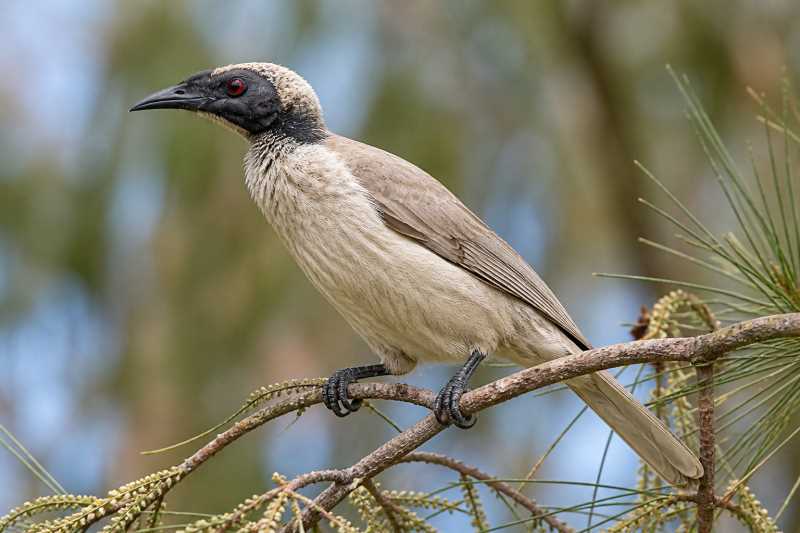
Brass’s Friarbird is a medium-sized bird, typically measuring between 27 to 30 centimeters in length. It exhibits a predominantly grayish-brown plumage with a lighter underbelly, providing effective camouflage against the forest canopy. One of the distinguishing features of this species is its bare, black head, which is devoid of feathers, a characteristic trait of friarbirds. The bird’s beak is long and curved, an adaptation for nectar feeding, yet it is also robust enough to consume insects and fruits.
Habitat and Distribution
The natural habitat of Brass’s Friarbird is primarily the lowland and montane forests of New Guinea. It thrives in a range of forested environments, from primary rainforests to secondary growth and forest edges. Although it is mainly found in lowland areas, Brass’s Friarbird can also inhabit elevations up to 1,500 meters. The species’ distribution is relatively widespread across the island, adapting to various ecological niches within its range.
Behavior and Ecology
Brass’s Friarbird exhibits fascinating behavioral patterns, particularly in its feeding and social dynamics. As a member of the honeyeater family, it predominantly feeds on nectar, playing a crucial role in pollination. The bird visits a variety of flowering plants, contributing to the reproductive success of these species. In addition to nectar, its diet is supplemented with insects and fruits, showcasing its omnivorous tendencies.
Socially, Brass’s Friarbird is known for its vocalizations, which are integral to its communication and territorial behavior. It produces a range of calls, from melodious songs to harsh, cackling sounds, to establish its presence and ward off intruders. These vocalizations are also essential during the breeding season, facilitating mate attraction and pair bonding.
Breeding and Reproduction
The breeding season for Brass’s Friarbird coincides with the peak flowering periods of its habitat, ensuring an abundant food supply for raising young. Nesting sites are typically located high in the forest canopy, providing safety from ground predators. The nests are constructed using twigs, leaves, and other plant materials, intricately woven to form a secure structure.
Clutch sizes generally consist of one to three eggs, with both parents sharing responsibilities for incubation and feeding the chicks. The cooperative breeding behavior observed in this species underscores the importance of parental investment in avian reproductive success.
Conservation Status
Currently, Brass’s Friarbird is classified as a species of Least Concern by the International Union for Conservation of Nature (IUCN). Despite its stable population, ongoing habitat destruction poses a potential threat. Logging, agricultural expansion, and deforestation are significant concerns, emphasizing the need for continued monitoring and conservation efforts to safeguard the ecological integrity of New Guinea’s forests.
Cultural Significance and Human Interactions
In the cultural context of New Guinea, birds, including Brass’s Friarbird, hold symbolic significance in many indigenous communities. These birds are often featured in traditional stories and rituals, reflecting their integral role in the cultural tapestry of the region. Furthermore, birdwatching has become a popular activity, drawing eco-tourists and contributing to the local economy, highlighting the interconnectedness of conservation and community well-being.
Conclusion
Brass’s Friarbird stands as a testament to the rich biodiversity of New Guinea, offering insights into the intricate ecological relationships that sustain tropical ecosystems. As an important pollinator and a charismatic species, it underscores the need for comprehensive conservation strategies to preserve these vital habitats. Continued research and awareness efforts are essential to ensure that this remarkable bird continues to thrive in its natural environment, enriching both the ecological and cultural landscapes of New Guinea.
References
- Coates, B. J. (1990). The birds of Papua New Guinea, including the Bismarck Archipelago and Bougainville. Dove Publications.
- Pratt, T. K., & Beehler, B. M. (2015). Birds of New Guinea: Second Edition. Princeton University Press.
- IUCN Red List of Threatened Species. (2023). Philemon brassi.
Acknowledgments
Special thanks to the indigenous communities and researchers whose knowledge and dedication contribute significantly to the understanding and conservation of New Guinea’s avian diversity.
Related posts