Introduction
Heuglin’s Bustard (Neotis heuglinii) is a large ground-dwelling bird in the bustard family, Otididae. It inhabits the dry open country of the Horn of Africa, where its cryptic plumage and preference for sparsely vegetated landscapes can make it difficult to find. The species is generally associated with arid and semi-arid grasslands, desert margins and open savanna.
Physical Description
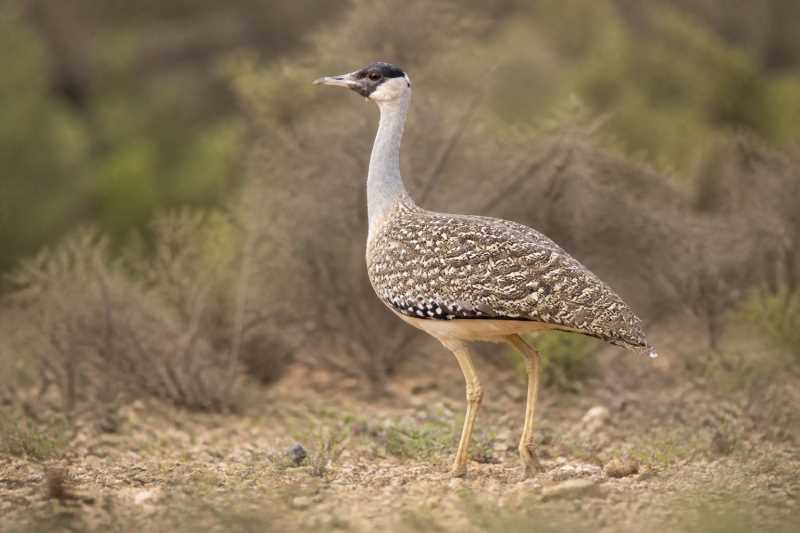
Heuglin’s Bustard is a large, long-legged bird measuring up to about 89 centimetres in length. Males are substantially heavier than females, with recorded male weights of approximately 4 to 8 kilograms and female weights of about 2.6 to 3 kilograms.
The adult male is distinctive, with a dark crown and face, a bluish-grey neck, a chestnut band across the lower breast and a white belly separated from the chestnut area by a narrow dark band. The female is smaller and much less boldly marked. Her plumage is mainly brown and buff, with subdued facial markings that provide effective camouflage among dry grass and scrub.
In flight, the species shows broad wings with a noticeable pale or white wedge in the otherwise dark upperwing. Juveniles and immature birds are less strongly marked than adult males and may resemble females until they acquire adult plumage.
Range and Habitat
Heuglin’s Bustard occurs in the Horn of Africa, from Eritrea and Djibouti through Ethiopia to northern Somalia and northern Kenya. It is a bird of dry lowlands, open desert with seasonal grasses, semi-desert savanna and tussocky grassland. It generally avoids dense woodland and heavily cultivated areas, favouring open ground where it can walk and forage.
The species is usually considered resident or locally nomadic rather than a long-distance migrant. Its movements may be influenced by rainfall, grass growth and the availability of insects and other food. Within its range, sightings can be widely separated because the bird occurs at low density and may move through apparently suitable habitat after rain.
Where to See This Species
Marsabit National Reserve, Marsabit County, Kenya
Marsabit National Reserve contains dry open habitats suitable for Heuglin’s Bustard, and the species has been documented there, including a recorded male. Look across open grassland, semi-desert edges and lightly vegetated areas, especially during careful morning or late-afternoon searches when birds are more likely to be active.
Nearby accommodation: Marsabit town is the practical base, with local hotels, guest houses, lodges and camping options.
Samburu National Reserve, Samburu County, Kenya
Heuglin’s Bustard is included on the documented bird list for Samburu National Reserve. The reserve’s open semi-arid landscapes, dry grassland and scrubby plains provide appropriate habitat. Search slowly from game-viewing tracks and other open areas, paying particular attention to distant, upright birds walking through short or patchy grass.
Nearby accommodation: The Samburu, Buffalo Springs and Shaba area provides lodges, tented camps, guest houses and other safari accommodation, with Archer’s Post serving as a practical gateway settlement.
Behaviour and Diet
Heuglin’s Bustard is mainly diurnal and spends much of its time walking across open ground rather than flying. It is usually encountered alone, in pairs or in small groups. Its subdued movements and camouflage can allow it to remain unnoticed until it walks into the open or takes flight.
The species is omnivorous. Its diet includes grasshoppers, locusts and other insects, as well as small reptiles, small mammals, seeds, berries and other plant material. Feeding activity is likely to vary with rainfall and seasonal food availability.
Breeding takes place on the ground. The female lays her eggs in a shallow scrape, usually with little or no nest material. A clutch commonly contains two eggs. As in other bustards, the male’s courtship involves visual display and vocalisation, while the nest and young are exposed to predators because they are not concealed in trees or dense vegetation.
Identification Tips
- Look for a very large, long-legged bird walking through dry open country rather than perching or climbing.
- An adult male has a dark crown and face, bluish-grey neck, chestnut lower breast and white belly.
- Females, juveniles and immature birds are browner, duller and more difficult to separate from the surrounding grass and soil.
- In flight, note the broad dark wings with a contrasting pale wedge in the upperwing.
- The species is generally slimmer and more lightly built than a Kori Bustard, while its male plumage is more strongly patterned than that of many similarly sized brown bustards.
- Identification should be made cautiously at long range, particularly when comparing females and immature birds with other large bustards in northern Kenya.
Conservation Status
Heuglin’s Bustard is currently classified as Least Concern on the IUCN Red List. This category does not mean that the species is free from local pressures. Habitat conversion, agricultural expansion, overgrazing, disturbance and hunting may affect birds in parts of its range, while changing rainfall patterns can alter the availability of grassland and insect prey.
The most useful conservation measures are the protection of remaining dry open habitats, responsible management of grazing and agriculture, enforcement of hunting regulations, and improved monitoring. More information is also needed on population size, movements, breeding success and local trends, because the species is inconspicuous and may be under-recorded.
Frequently Asked Questions
Where can Heuglin’s Bustard be found?
It occurs in the Horn of Africa, including Eritrea, Djibouti, Ethiopia, Somalia and northern Kenya. It favours dry open lowlands, semi-desert savanna and grassland.
Is Heuglin’s Bustard migratory?
It is generally regarded as resident or locally nomadic rather than a long-distance migrant. Local movements may follow rainfall, grass growth and changing food availability.
How can Heuglin’s Bustard be identified?
The adult male has a dark face and crown, bluish-grey neck, chestnut lower breast and white belly. Females and immature birds are mostly brown and buff. The species is large, long-legged and usually seen walking in open dry country.
What does Heuglin’s Bustard eat?
Its diet includes insects such as grasshoppers and locusts, small reptiles, small mammals, seeds, berries and other plant material.
Where is the best place to look for Heuglin’s Bustard in Kenya?
Marsabit National Reserve and Samburu National Reserve are documented locations within its Kenyan range. Open semi-arid grassland and desert-edge habitat should receive particular attention.
Is Heuglin’s Bustard threatened?
The species is currently listed as Least Concern, but it can be affected locally by habitat loss, overgrazing, hunting, disturbance and changes in rainfall. Continued monitoring is important because reliable population information is limited.
References
- BirdLife International
- IUCN Red List of Threatened Species
- Cornell Lab of Ornithology
Related posts