Introduction
The Short-tailed Nighthawk (Lurocalis semitorquatus) is a nocturnal member of the nightjar family, Caprimulgidae. It occurs widely in tropical and subtropical Central and South America, where it is most often seen at dusk flying over forest canopies, river edges and nearby clearings. Its unusually short, square-ended tail, broad wings and dark, heavily mottled plumage distinguish it from many other nighthawks.
Physical Description
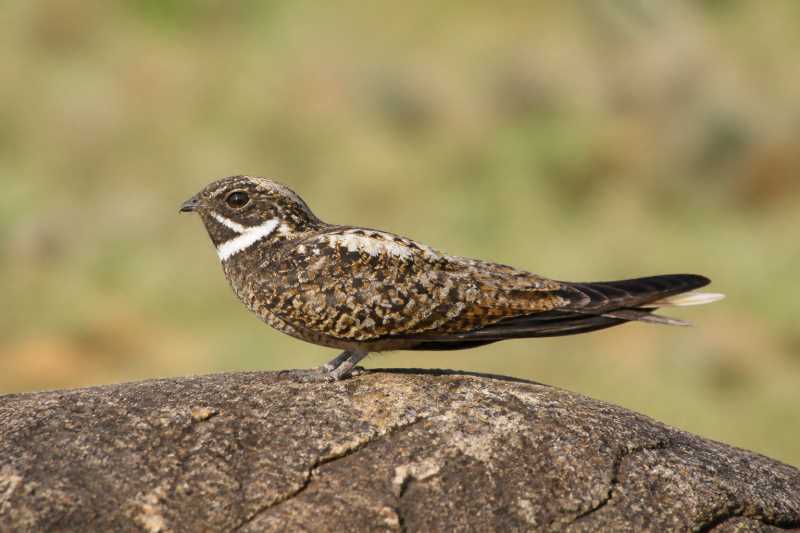
The Short-tailed Nighthawk is a medium-sized nightjar, usually about 19–25 centimetres long. It has a compact body, long pointed wings and a notably short, square tail. The wings may extend to, or slightly beyond, the end of the tail when the bird is perched.
The upperparts are dark brown to blackish, marked with rufous, buff and greyish speckles. The throat is pale or whitish, while the breast is dark and mottled. The lower breast, belly and flanks are generally buff or rufous-buff with dark barring. The wings are dark and lack the bold white wing patches seen in several other nighthawks. The tail is also dark, with subdued greyish or buff barring and a narrow pale terminal band.
Plumage varies geographically, with recognised forms differing in size and in the intensity of their spotting and barring. Males and females are broadly similar in external appearance, and reliable field separation by sex is not normally possible. Juveniles are likely to appear duller and more softly marked than adults, although detailed age-related differences are not well documented in standard field references.
Range and Habitat
The species has a broad distribution from southern Mexico through much of Central America and into northern and eastern South America. Its range includes Trinidad and Tobago, the Guianas, the Amazon Basin, Brazil, Bolivia, Peru, Colombia, Ecuador, Venezuela, Paraguay and northern Argentina. It is not a species of Chile or Uruguay.
The Short-tailed Nighthawk is associated mainly with tropical lowland evergreen forest, river-edge forest, humid woodland and forest margins. It may also occur in secondary forest and other partially modified habitats where suitable canopy and abundant flying insects remain. It has been recorded from sea level to approximately 1,700 metres, although it is most strongly associated with lowlands and foothills.
Geographic variation is reflected in several recognised subspecies. The species is generally treated as resident across its range, although local movements and seasonal differences in detectability may occur.
Where to See This Species
Aconquija National Park, Tucumán, Argentina
The Short-tailed Nighthawk is documented for Aconquija National Park, where the protected area includes yungas forest, woodland and other habitats used by the species. The most productive approach is to watch forest edges and open areas near forest at dusk, particularly in the warmer months when aerial insect activity is high. Access conditions can be demanding, and some sectors require four-wheel-drive vehicles or walking access.
Nearby accommodation: Camping is available in designated areas of the park, while guest houses, cabins, campsites and other accommodation are available in nearby Alpachiri and Concepción.
Behaviour and Diet
The Short-tailed Nighthawk is mainly active at dusk and during the night, with additional activity around dawn. It usually hunts on the wing, making fast, irregular passes above the forest canopy, rivers and open areas beside woodland. Its broad wings and shallow wing beats can give it a bat-like appearance in the fading light.
The diet consists primarily of flying insects. Recorded prey includes moths, beetles and flying ants, although other aerial insects are probably taken opportunistically. Feeding flights may remain close to the canopy, making the bird difficult to observe from the ground.
During daylight, it commonly rests on large horizontal branches or other concealed perches. Its dark, mottled plumage provides effective camouflage. Birds may be encountered singly, in pairs or in small groups, particularly where insects are concentrated near rivers or forest openings.
Breeding information is limited and varies between regions. Unlike the ground-nesting behaviour described for several other nightjars, the Short-tailed Nighthawk has been recorded laying a single camouflaged egg directly on a horizontal branch in the forest canopy. Breeding seasons differ geographically, and detailed information on incubation and parental care remains incomplete.
Identification Tips
- Look for a relatively large, dark nighthawk with an exceptionally short, square tail.
- The wings are long and broad but lack a conspicuous white wing band.
- The flight is fast, erratic and shallow-winged, often above the canopy or along forest edges at dusk.
- The pale throat contrasts with the dark, mottled breast.
- The underparts are barred and generally buff or rufous-buff rather than clean white.
- At rest, the wings may project to the end of, or beyond, the short tail.
The Common Nighthawk and other Chordeiles nighthawks usually show more obvious white wing markings and a less distinctly abbreviated tail. The Rufous-bellied Nighthawk may occur in overlapping parts of the Andes, but it is generally associated with higher elevations and has a different, more uniformly rufous underbody pattern.
Conservation Status
The Short-tailed Nighthawk is currently assessed as Least Concern. Its extensive geographic range and ability to use some secondary and modified habitats reduce the likelihood of an immediate global population crisis.
Nevertheless, the species depends on functioning forest landscapes and may be affected locally by deforestation, forest degradation, agricultural expansion, insecticide use and the loss of river-edge vegetation. Protecting large forest areas, retaining mature canopy and maintaining connected forest edges are important conservation measures. Because the species is difficult to survey and its population trend is not well quantified, continued monitoring is warranted.
Frequently Asked Questions
Where can the Short-tailed Nighthawk be found?
It occurs from southern Mexico through Central America and across much of northern, central and eastern South America, including Brazil, Peru, Bolivia, Colombia, Venezuela, the Guianas, Paraguay and northern Argentina.
What habitat does the Short-tailed Nighthawk prefer?
It mainly uses tropical evergreen forest, river-edge forest, humid woodland and forest margins. It may also occur in secondary forest and other lightly modified habitats.
What does the Short-tailed Nighthawk eat?
It is an aerial insectivore that feeds mainly on flying insects, including moths, beetles and flying ants.
When is the best time to see this species?
The best opportunities are usually shortly after dusk or before dawn, when birds leave concealed roosts and make feeding flights over forest canopy, rivers and clearings.
Does the Short-tailed Nighthawk nest on the ground?
Not usually, based on the available breeding records. It has been recorded laying a single egg directly on a horizontal branch in the forest canopy, which differs from the ground-nesting behaviour of many other nightjars.
How can it be distinguished from other nighthawks?
Its very short square tail, dark wings without bold white patches, pale throat and strongly barred underparts are the most useful identification features. Its flight is also notably erratic and bat-like.
References
- BirdLife International
- IOC World Bird List
- Administración de Parques Nacionales, Argentina
Related posts