Introduction
The Ifola Tree Kangaroo, scientifically known as Dendrolagus notatus, is a fascinating marsupial that calls the lush forests of Papua New Guinea its home. This elusive creature is part of the tree kangaroo family, a group of arboreal mammals that have adapted to life in the trees. The Ifola Tree Kangaroo is not as widely known as some of its relatives, but its unique characteristics and critical conservation status make it a subject of significant interest for scientists and nature enthusiasts alike.
Tree kangaroos are a striking example of evolutionary adaptation, having transitioned from terrestrial to arboreal life. While the Ifola Tree Kangaroo shares many similarities with other species in its genus, it possesses distinct features and behaviors that set it apart. Understanding this species is crucial for its preservation, especially considering the threats it faces in its natural habitat.
Physical Description
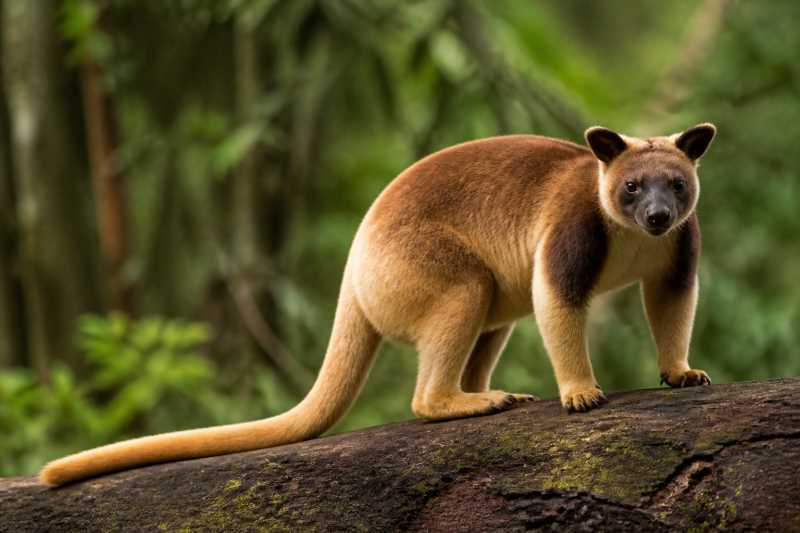
The Ifola Tree Kangaroo is a medium-sized marsupial, with adults typically weighing between 7 to 10 kilograms (15 to 22 pounds) and measuring about 50 to 80 centimeters (20 to 31 inches) in body length. Its tail, often as long as its body, aids in balance and movement among the trees.
Characterized by its dense, woolly fur, the Ifola Tree Kangaroo exhibits a striking color pattern. Its coat is primarily a rich chestnut brown, with lighter patches on the belly and a distinct dark stripe running down its back. The facial features of this tree kangaroo are marked by a lighter, cream-colored fur around the eyes and nose, which enhances its expressive appearance.
The limbs of the Ifola Tree Kangaroo are strong and muscular, adapted for climbing and grasping. Its forelimbs are equipped with curved claws, ideal for gripping branches, while its hind limbs provide powerful leaps from tree to tree. This unique anatomy enables it to navigate the complex canopy with agility and precision.
Range and Habitat
The Ifola Tree Kangaroo is endemic to the rainforests of Papua New Guinea, specifically in the Huon Peninsula region. This area is characterized by its montane forests, which provide the ideal habitat for this arboreal species. The tree kangaroo prefers altitudes ranging from 1,000 to 3,000 meters (3,280 to 9,840 feet), where the dense canopy offers both food and protection.
These rainforests are rich in biodiversity, providing a home to numerous plant and animal species. The presence of tall trees with interconnected canopies is critical for the Ifola Tree Kangaroo, as it relies on these structures for shelter and sustenance. The forest floor, often dense with underbrush, also plays a role in the kangaroo’s habitat, providing cover from predators when it descends to the ground.
Behavior and Diet
The Ifola Tree Kangaroo is primarily solitary, with individuals maintaining their own territories. They communicate through vocalizations and scent markings, using specialized glands to mark trees and branches. Despite their solitary nature, tree kangaroos are not entirely antisocial. During the mating season, they become more interactive, and mothers are often seen with their young.
As a folivore, the diet of the Ifola Tree Kangaroo consists mainly of leaves, supplemented by fruits, flowers, and bark. Its digestive system is adapted to break down fibrous plant material, allowing it to extract essential nutrients. The kangaroo’s slow metabolism is suited to its low-energy diet, enabling it to thrive in its environment.
Feeding typically occurs during the early morning and late afternoon, when the forest is cooler. The Ifola Tree Kangaroo exhibits a unique behavior known as "crepuscular activity," which means it is most active during twilight hours, avoiding the heat of the day.
Identification Tips (Field Recognition Cues)
Identifying the Ifola Tree Kangaroo in the wild requires keen observation and some patience. Here are some tips to recognize this elusive mammal:
- Look for Movement Among the Trees: The Ifola Tree Kangaroo is arboreal, often seen moving among the branches. Watch for movement in the canopy, especially during dawn and dusk.
- Listen for Vocalizations: Tree kangaroos communicate with a series of clicks and barks. These sounds can help you locate them in the dense forest.
- Spot the Distinctive Coloration: The contrast of its chestnut brown fur with lighter facial markings is a key visual cue.
- Notice the Tail: The long, bushy tail is often visible even when the body is obscured by foliage. It is used for balance and can be a giveaway of the kangaroo’s presence.
- Check for Scent Marks: Trees with noticeable scratch marks and scent deposits may indicate the territory of an Ifola Tree Kangaroo.
Conservation Status (With Threats and Protections)
The Ifola Tree Kangaroo is currently classified as Endangered on the IUCN Red List. Its population is decreasing due to several threats, primarily habitat loss and hunting.
Habitat Loss: Deforestation for agriculture and logging is the most significant threat to the Ifola Tree Kangaroo. As forests are cleared, the kangaroo loses both its home and food sources, leading to population declines.
Hunting: Indigenous hunting practices and illegal poaching also contribute to the species’ decline. Although traditional hunting is part of local culture, increased pressure from outside sources exacerbates the threat.
Protections: Conservation efforts are underway to protect the Ifola Tree Kangaroo. These include the establishment of protected areas within its range and initiatives to promote sustainable land-use practices. Education and engagement with local communities are vital components of these efforts, as they help reduce hunting and encourage conservation-friendly practices.
Frequently Asked Questions
What is the primary diet of the Ifola Tree Kangaroo?
The Ifola Tree Kangaroo primarily feeds on leaves, with a diet supplemented by fruits, flowers, and bark. This folivorous diet is well-suited to its arboreal lifestyle, allowing it to extract nutrients from fibrous plant material efficiently.
How does the Ifola Tree Kangaroo differ from other tree kangaroo species?
The Ifola Tree Kangaroo is distinguished by its unique fur coloration, with a rich chestnut brown coat and lighter facial markings. It primarily inhabits the montane forests of the Huon Peninsula in Papua New Guinea, whereas other species have different ranges and habitats.
What conservation efforts are in place to protect the Ifola Tree Kangaroo?
Conservation efforts for the Ifola Tree Kangaroo include the establishment of protected areas, community education, and the promotion of sustainable land-use practices. These initiatives aim to mitigate threats such as habitat loss and hunting.
How can you identify an Ifola Tree Kangaroo in the wild?
To identify an Ifola Tree Kangaroo, observe for movement in the trees, listen for their distinctive vocalizations, and look for their chestnut brown fur with lighter facial markings. Their long, bushy tails and scent-marked trees are also key indicators.
What is the current conservation status of the Ifola Tree Kangaroo?
The Ifola Tree Kangaroo is classified as Endangered on the IUCN Red List, with its population declining due to habitat loss and hunting. Conservation efforts are crucial to prevent further decline and ensure the species’ survival.
Related posts