Introduction
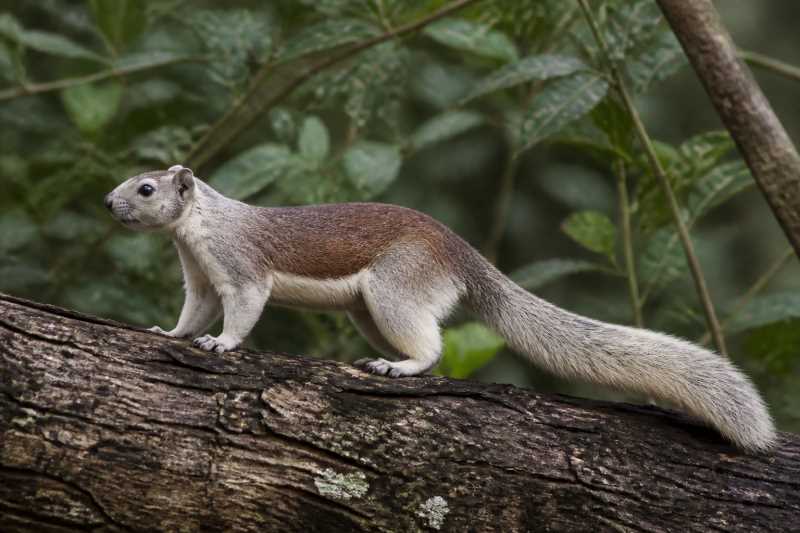
The Pale Giant Squirrel, scientifically known as Ratufa affinis, is a fascinating member of the family Sciuridae. This arboreal mammal is renowned for its impressive size and striking appearance, making it a subject of interest for wildlife enthusiasts and researchers alike. Native to the lush forests of Southeast Asia, the Pale Giant Squirrel plays a crucial role in its ecosystem, acting as both a seed disperser and a prey species. As such, understanding its biology and ecology is vital for conservation efforts.
Physical Description
The Pale Giant Squirrel is among the largest squirrels in the world, with adults reaching an impressive body length of 36 to 40 centimeters, not including their bushy tails, which can add another 41 to 44 centimeters. This results in a total length that can exceed 80 centimeters, making them a truly remarkable sight in the wild.
Their fur is predominantly pale gray to brown, with a creamy underbelly, which provides excellent camouflage in their forest habitats. The tail is long and bushy, aiding in balance as the squirrel navigates the treetops. Additionally, the Pale Giant Squirrel has strong, muscular limbs and sharp claws that make it an adept climber.
Range and Habitat
Ratufa affinis is native to the tropical rainforests of Southeast Asia. Its range spans several countries, including Thailand, Malaysia, Indonesia, and parts of Myanmar. Within these regions, they inhabit primary and secondary forests, often preferring areas with dense canopy cover where they can find ample food and shelter.
The Pale Giant Squirrel is typically found at elevations ranging from sea level to about 1,500 meters. However, their exact distribution can vary based on the availability of suitable habitat and food sources.
Behavior and Diet
The Pale Giant Squirrel is a diurnal creature, most active during the day. It spends the majority of its time in the trees, rarely descending to the ground except to forage or escape predators. Their arboreal lifestyle is supported by their exceptional climbing skills and keen eyesight.
Their diet is primarily herbivorous, consisting of fruits, nuts, seeds, and occasionally flowers. They are known to be seed dispersers, playing a critical role in forest regeneration. By consuming and subsequently excreting seeds in different locations, they contribute to the propagation of various plant species.
Identification Tips (field recognition cues)
Identifying the Pale Giant Squirrel in the field can be challenging due to its elusive nature and preference for high canopy levels. However, there are several cues that can aid in their identification:
- Size: Their large size is a distinguishing feature. Look for a squirrel significantly larger than common tree squirrels.
- Coloration: The pale gray to brown fur with a creamy underbelly is a key characteristic.
- Behavior: Observe their movement in the trees. They are agile climbers, often seen leaping between branches.
- Vocalizations: Listen for their distinctive calls, which can be a series of chattering or clucking sounds.
Conservation Status (with threats and protections)
The Pale Giant Squirrel is currently listed as Near Threatened on the IUCN Red List. The primary threats to their survival include habitat loss due to deforestation, logging, and agricultural expansion. As forests are cleared or fragmented, the squirrels lose their homes and food sources, leading to population declines.
Conservation efforts are in place to protect the remaining habitats of the Pale Giant Squirrel. Protected areas and national parks in their range offer some refuge, but enforcement of conservation laws and sustainable forestry practices are crucial for their long-term survival.
Frequently Asked Questions
1. What is the average lifespan of a Pale Giant Squirrel in the wild?
The average lifespan of a Pale Giant Squirrel in the wild is estimated to be around 8 to 12 years. This can vary based on environmental conditions and predation pressures.
2. How does the Pale Giant Squirrel contribute to its ecosystem?
The Pale Giant Squirrel plays an essential role in its ecosystem primarily through seed dispersal. By spreading seeds, they aid in forest regeneration and contribute to the genetic diversity of plant populations.
3. Are Pale Giant Squirrels social animals?
Pale Giant Squirrels are generally solitary creatures. They usually interact with others only during mating season or when raising young. However, they may be seen foraging in loose groups when food is abundant.
4. What are the main predators of the Pale Giant Squirrel?
The main predators of the Pale Giant Squirrel include birds of prey, such as eagles and owls, and larger arboreal mammals like civets and clouded leopards.
5. Can Pale Giant Squirrels adapt to human-altered environments?
While they primarily thrive in dense forests, some Pale Giant Squirrels have been observed in plantations and secondary forests. However, their ability to adapt to human-altered environments is limited, and they are more vulnerable to threats in such areas.
Related posts