The Ferruginous-backed Antbird: A Glimpse into the Secret Life of a Lesser-Known Amazonian Avian
The Amazon rainforest, renowned for its astounding biodiversity, is home to a myriad of bird species, each playing a unique role in the delicate ecological balance. Among these is the Ferruginous-backed Antbird (Myrmoderus ferrugineus), a lesser-known but fascinating member of the Thamnophilidae family. This article delves into the life and habits of this elusive bird, highlighting its unique characteristics, habitat, and the conservation challenges it faces.
Taxonomy and Description
The Ferruginous-backed Antbird belongs to the genus Myrmoderus, within the extensive Thamnophilidae family, commonly known as the antbird family. The species was first described in the mid-19th century and has since intrigued ornithologists with its distinctiveness. The Ferruginous-backed Antbird is a medium-sized bird, with adults typically measuring around 14 centimeters in length and weighing approximately 20 grams.
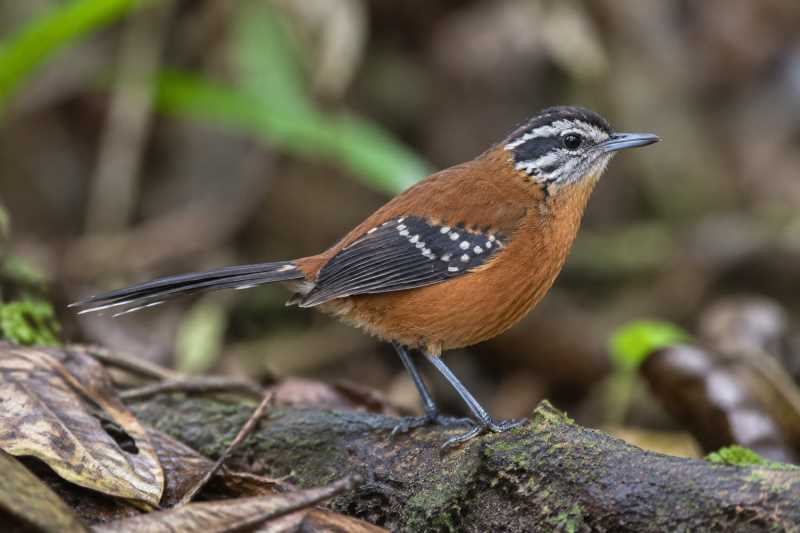
Its plumage is striking: a rich, ferruginous or rusty-brown color adorns its back, wings, and tail, providing the bird with its common name. The underparts are usually a contrasting white or pale gray, and the face is marked by a distinctive dark mask, giving it a somewhat mysterious appearance. The sexual dimorphism in this species is subtle, with males and females displaying similar plumage, although males may exhibit slightly brighter colors.
Habitat and Distribution
The Ferruginous-backed Antbird is primarily found in the lowland rainforests of the Amazon Basin, with its range extending across several South American countries, including Brazil, Peru, and Colombia. It favors dense, humid forests with thick undergrowth, where it can often be found foraging close to the ground.
This species is a resident bird, meaning it does not undertake long migrations, unlike many other avian species. Its preference for the forest floor and dense undergrowth makes it somewhat elusive and difficult to observe, contributing to its status as one of the less-studied birds of the Amazon.
Behavior and Diet
True to its name, the Ferruginous-backed Antbird has a diet that primarily consists of insects and other small arthropods. It is particularly known for its association with army ant swarms, a behavior that is characteristic of many antbird species. As the ants march through the forest, they flush out various insects and small creatures, which the antbird then opportunistically captures.
The bird’s foraging technique involves a keen sense of hearing and sight. It listens for the movements of army ants and other disturbances in the leaf litter, then quickly darts to capture its prey. This dependency on army ant swarms makes the Ferruginous-backed Antbird a key species in the forest ecosystem, as it helps control insect populations.
Socially, Ferruginous-backed Antbirds are known for their territorial behavior. Pairs remain in their territories throughout the year, with both males and females participating in the defense of their domain. Their vocalizations are a crucial aspect of their territorial behavior, with a repertoire of calls that serve different functions, from signaling alarm to attracting a mate.
Reproduction and Lifespan
The breeding season for the Ferruginous-backed Antbird typically coincides with the rainy season, which varies depending on the specific region within the Amazon. During this time, pairs engage in elaborate courtship displays, which include vocalizations and physical displays to strengthen pair bonds.
Nests are usually constructed close to the ground, camouflaged within dense vegetation. The female typically lays two eggs, which both parents help incubate. After hatching, the chicks are altricial, meaning they are born relatively undeveloped and require significant parental care. Both parents are involved in feeding and nurturing the young until they are ready to fledge.
The lifespan of the Ferruginous-backed Antbird in the wild is not well-documented, but like many small bird species, it is likely to face numerous environmental challenges that could impact its survival and longevity.
Conservation Status and Challenges
The Ferruginous-backed Antbird is currently classified as a species of Least Concern by the International Union for Conservation of Nature (IUCN). However, this classification does not imply that the species is free from threats. The primary threat to its survival is habitat loss due to deforestation, driven by logging, agriculture, and infrastructure development.
The Amazon rainforest is undergoing rapid changes, and the fragmentation of habitats poses a significant risk to the Ferruginous-backed Antbird and countless other species. Conservation efforts are essential to preserve the integrity of these ecosystems and ensure the survival of the diverse avian populations within.
Conclusion
The Ferruginous-backed Antbird remains a testament to the incredible biodiversity of the Amazon rainforest. Despite its elusive nature, this bird plays a vital role in the ecosystem, serving as both predator and prey in the intricate web of life. As we continue to explore and understand the complexities of the Amazon, the preservation of species like the Ferruginous-backed Antbird becomes increasingly crucial.
By raising awareness and supporting conservation initiatives, we can help protect the habitats that sustain such remarkable species. As stewards of the planet, it is our responsibility to ensure that future generations will have the opportunity to marvel at the wonders of avian life in the Amazon and beyond.
Related posts