Introduction
Kalinowski’s Opossum, scientifically known as Hyladelphys kalinowskii, is a fascinating yet elusive marsupial that resides primarily in the dense forests of South America. This small, nocturnal creature is part of the Didelphidae family, which includes all opossums found in the Americas. Despite its small size, Kalinowski’s Opossum plays a significant role in its ecosystem as both a seed disperser and a predator of insects. Named after the Polish naturalist Jan Kalinowski, who made substantial contributions to the study of South American wildlife, this species is a subject of intrigue for researchers and wildlife enthusiasts alike.
Physical Description
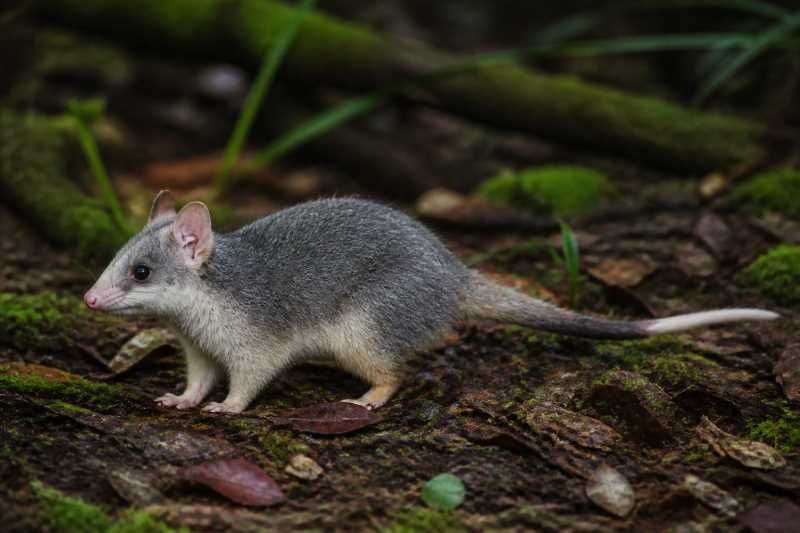
Kalinowski’s Opossum is characterized by its petite size and distinctive features. Adult individuals typically measure between 7 and 10 centimeters in body length, excluding the tail, which is notably longer, measuring about 11 to 14 centimeters. This long tail is prehensile, allowing the opossum to adeptly navigate through the arboreal landscape of its habitat. The fur of Kalinowski’s Opossum is generally grayish-brown on the dorsal side, providing effective camouflage among the foliage, while the ventral side is lighter, often a creamy white.
One of the most striking features of this opossum is its face, which bears large, dark eyes adapted for nocturnal vision. The ears are relatively large and rounded, contributing to its acute sense of hearing, essential for detecting predators and prey in the dense forest environment. The snout is pointed, facilitating its insectivorous diet. The paws are equipped with sharp claws, aiding in climbing and foraging.
Range and Habitat
Kalinowski’s Opossum is endemic to the neotropical regions of South America, with confirmed sightings primarily in Peru and Brazil. It inhabits the lowland rainforests and cloud forests, thriving in environments that offer ample vegetation and high humidity. These forests provide a rich tapestry of biodiversity, and Kalinowski’s Opossum is a critical component of this ecosystem.
The species shows a preference for undisturbed forest areas, where it can exploit its arboreal skills to the fullest. While primarily arboreal, it occasionally descends to the forest floor in search of food. Its habitat is characterized by a mosaic of trees, dense underbrush, and an abundance of epiphytes, which offer both food and shelter.
Behavior and Diet
As a nocturnal creature, Kalinowski’s Opossum is most active during the nighttime hours. It exhibits solitary behavior, with individuals generally avoiding contact with one another except during the breeding season. This solitary nature is typical among opossums, which are known for their territorial tendencies.
Kalinowski’s Opossum is primarily insectivorous, feeding on a variety of insects and other small invertebrates. However, it is also known to consume fruits and seeds, which aids in seed dispersal within its habitat. This dietary flexibility allows the opossum to adapt to seasonal changes in food availability.
The opossum’s foraging strategy involves meticulous examination of crevices in bark, leaves, and the forest floor, using its keen sense of smell and touch to locate prey. Its climbing abilities enable it to reach fruits and flowers that other terrestrial animals cannot.
Identification Tips (field recognition cues)
Identifying Kalinowski’s Opossum in the field can be challenging due to its elusive nature and nocturnal habits. However, several key characteristics can aid in its identification:
- Size and Shape: Look for a small, slender marsupial with a long prehensile tail, which is often held in a coiled position when at rest.
- Fur Coloration: The opossum’s grayish-brown dorsal fur and lighter ventral side are distinguishing features.
- Facial Features: Large, dark eyes and rounded ears are indicative of this species, helping differentiate it from other small mammals in its habitat.
- Behavior: Observing movement patterns can be helpful. Kalinowski’s Opossum is an adept climber and often found in trees at varying heights.
- Vocalizations: While generally quiet, they may emit soft clicks or chirps, especially when disturbed.
Conservation Status (with threats and protections)
The conservation status of Kalinowski’s Opossum is currently classified as "Data Deficient" by the International Union for Conservation of Nature (IUCN). This classification indicates that there is insufficient information to make a direct or indirect assessment of its risk of extinction.
Threats to Kalinowski’s Opossum include deforestation and habitat fragmentation, primarily due to logging, agricultural expansion, and infrastructure development in the Amazon and surrounding regions. These activities reduce the available habitat and can lead to isolated populations, which are more vulnerable to stochastic events.
To protect this species, conservation efforts should focus on preserving its natural habitat through the establishment of protected areas and sustainable land management practices. Research initiatives aimed at understanding the species’ ecology and population dynamics are also critical in formulating effective conservation strategies.
Frequently Asked Questions
1. What do Kalinowski’s Opossums eat?
Kalinowski’s Opossums are primarily insectivorous, feeding on insects and other small invertebrates. They also consume fruits and seeds, which aids in seed dispersal within their forest habitats.
2. Where can Kalinowski’s Opossums be found?
These opossums are found in the neotropical regions of South America, particularly in Peru and Brazil. They inhabit lowland rainforests and cloud forests, preferring undisturbed areas with dense vegetation.
3. Are Kalinowski’s Opossums endangered?
Currently, the conservation status of Kalinowski’s Opossum is classified as "Data Deficient" by the IUCN, indicating that more research is needed to determine their population status and conservation needs.
4. How can I identify Kalinowski’s Opossum in the wild?
To identify Kalinowski’s Opossum, look for its small size, long prehensile tail, grayish-brown fur, large dark eyes, and rounded ears. It is primarily active at night and exhibits adept climbing behavior.
5. What are the main threats to Kalinowski’s Opossum?
The main threats to this species include deforestation and habitat fragmentation due to human activities such as logging and agriculture, which reduce their available habitat and can isolate populations.
Related posts