Introduction
The Baudo Guan (Penelope ortoni) is a large, forest-dwelling member of the guan family, Cracidae. It is restricted to humid forests on the western Andean slopes and adjacent lowlands of Colombia and north-western Ecuador. The species is poorly known and is considered Endangered because habitat loss and hunting have reduced and fragmented its range.
Physical Description
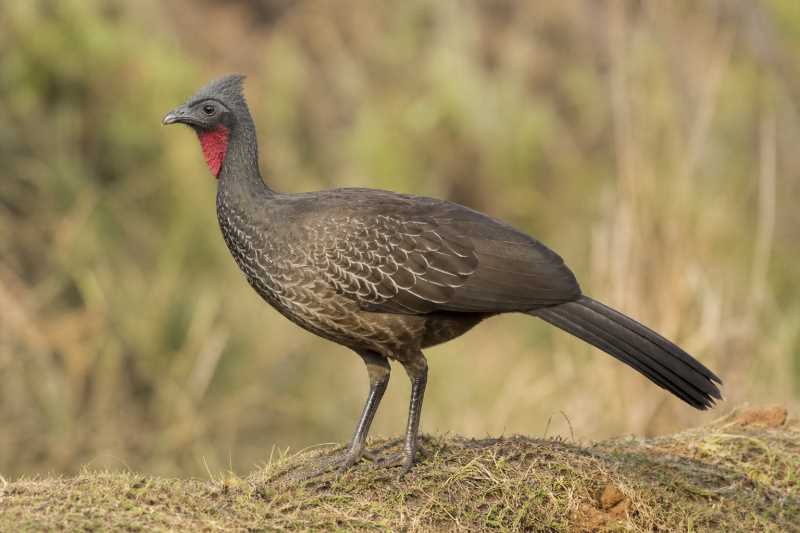
The Baudo Guan is a medium-sized to large guan, measuring approximately 60–63 cm in length. It has predominantly dark brown plumage, with a darker back and crest, a greyish-brown head and neck, and fine pale streaking on the breast and underparts. The tail is long, and the wings are rounded, as in other forest guans.
The bare facial skin is bluish, while the throat has a conspicuous red wattle or caruncle. The legs are reddish or pinkish, and the eyes are reddish-brown. Males and females are generally similar in appearance, and no strong sexual dimorphism is recognised. The species is monotypic, with no currently recognised subspecies.
Range and Habitat
The Baudo Guan occurs on the Pacific slope of the Andes in western Colombia and north-western Ecuador. Its range lies within the Chocó biogeographic region, one of the wettest and most biologically diverse areas in the Americas. The species is resident rather than migratory.
It uses humid and wet forest from lowland areas and coastal plains to foothill and lower montane forest, with records extending to approximately 1,500 m above sea level. It has been recorded in forest at different stages of succession, including mature forest and regenerating forest. Steep foothills, ridges and forested slopes may provide important refuge because they are less accessible to hunters, although the species also occurs in flatter lowland terrain.
Deforestation for agriculture, logging, road construction and other development has removed and fragmented substantial areas of suitable habitat. The remaining populations are consequently unevenly distributed and may be isolated from one another.
Behaviour and Diet
The Baudo Guan uses all levels of the forest. It feeds, calls, preens and performs courtship behaviour in the canopy, seeks cover in the middle storey and also descends to the ground to forage or cross open tracks and roads.
It is primarily frugivorous. Its diet includes fruits and seeds, with documented records of fruit from chanul (Humiriastrum procerum). Leaves, flowers and small invertebrates may also be taken, but detailed dietary information remains limited. By consuming and moving seeds through the forest, the species may contribute to natural regeneration, although the importance of this role has not been quantified specifically for the Baudo Guan.
Pairs are territorial during the breeding period. After breeding, birds may form family groups of about four individuals, with larger groups occasionally recorded. The species is vocal, particularly around dawn and during courtship or territorial interactions, but its natural history remains incompletely documented.
Available observations suggest that breeding occurs between July and September, and the clutch is thought to contain two eggs. Further field research is needed to confirm nesting dates, incubation, chick development and breeding success across the species’ range.
Identification Tips
Look for a large, long-tailed guan with an almost uniformly dark brown appearance in humid forest on the Pacific Andean slope. The most useful field marks are:
- dark brown plumage with fine pale streaking on the breast and lower neck;
- a long tail and broad, rounded wings;
- bluish bare facial skin;
- a noticeable red throat wattle or caruncle; and
- reddish or pinkish legs.
The Baudo Guan can be difficult to see because it moves through dense vegetation and often remains in the middle or upper forest layers. Its loud calls may reveal its presence before the bird is visible. Care is needed when identifying it from brief views, because several other guans in the region are similarly dark and long-tailed. Range, habitat and the combination of dark plumage, pale breast streaking and red throat skin are particularly useful when confirming an identification.
Conservation Status
The Baudo Guan is classified as Endangered on the IUCN Red List. Its population is considered to be declining, although a precise current global population estimate is not available in the sources consulted.
The principal threats are the continuing loss and fragmentation of humid forest, together with hunting. Road expansion, logging, agricultural conversion and settlement increase access to previously remote forest and can intensify hunting pressure. Fragmentation may also isolate local populations and reduce the species’ ability to recolonise areas where it has disappeared.
Conservation priorities include protecting remaining forest throughout the Colombian and Ecuadorian range, maintaining connected habitat, improving management of protected areas and reducing hunting. Surveys and long-term monitoring are also important because the Baudo Guan is difficult to detect and its distribution and population size remain incompletely known. Conservation programmes that involve local communities and support sustainable land-use practices are likely to be more effective than habitat protection alone.
Frequently Asked Questions
Where does the Baudo Guan live?
The Baudo Guan lives in humid and wet forests on the western Andean slopes and adjacent lowlands of western Colombia and north-western Ecuador, within the Chocó biogeographic region.
What does the Baudo Guan eat?
It is primarily frugivorous and eats fruits and seeds. It may also take leaves, flowers and small invertebrates. Chanul fruit has been recorded in its diet.
How can the Baudo Guan be identified?
It is a large, dark brown guan with a long tail, pale streaking on the breast, bluish facial skin, a red throat wattle and reddish legs. Its loud calls can help locate it in dense forest.
Is the Baudo Guan endangered?
Yes. The Baudo Guan is classified as Endangered by the IUCN. Habitat loss, forest fragmentation and hunting are the principal threats.
Does the Baudo Guan migrate?
No regular migration is known. It is regarded as a resident species within its restricted range.
How does the Baudo Guan contribute to the forest ecosystem?
By eating fruit and moving seeds through the forest, the Baudo Guan may help disperse plant seeds and support forest regeneration. The exact scale of this ecological role has not been measured in detail.
References
- BirdLife International. n.d. Baudo Guan Penelope ortoni. BirdLife DataZone. Accessed 8 September 2026. https://datazone.birdlife.org/
- del Hoyo, J. and Kirwan, G. M. 2020. “Baudo Guan (Penelope ortoni), version 1.0.” In Birds of the World, edited by J. del Hoyo, A. Elliott, J. Sargatal, D. A. Christie and E. de Juana. Cornell Lab of Ornithology, Ithaca, New York. https://doi.org/10.2173/bow.baugua1.01
- Gill, F., Donsker, D. and Rasmussen, P., eds. 2026. IOC World Bird List, version 15.2. International Ornithologists’ Union. Accessed 8 September 2026. https://www.worldbirdnames.org/
- Idrobo-Medina, C. J., Gallo-Cajiao, E. and Jahn, O. 2006. “Baudó Guan (Penelope ortoni).” In D. M. Brooks, ed., Conserving Cracids: The Most Threatened Family of Birds in the Americas, pp. 46–49. Miscellaneous Publications of the Houston Museum of Natural Science, no. 6. Houston Museum of Natural Science. https://digitalcommons.unl.edu/galliformes_reports/35/
- IUCN. n.d. The IUCN Red List of Threatened Species. Species assessment and conservation information for Penelope ortoni. Accessed 8 September 2026. https://www.iucnredlist.org/
- Strahl, S. D. and collaborators. 2000. Status Survey and Conservation Action Plan for Cracids 2000–2004. IUCN, World Pheasant Association and Cracid Specialist Group. https://portals.iucn.org/library/efiles/documents/2000-015.pdf
Related posts