
Introduction
The Andean Hillstar (Oreotrochilus estella) is a high-altitude hummingbird of the central Andes. It occurs as a resident in Argentina, Bolivia, Chile and Peru, where it inhabits cold puna grasslands, rocky slopes and flowering montane shrublands. Its ability to remain active in thin air and freezing conditions is among its most notable adaptations.
Physical Description
The Andean Hillstar is a medium-sized hummingbird, measuring approximately 13–15 centimetres in length. It has a fairly straight, medium-length bill and a compact body suited to life in exposed mountain habitats.
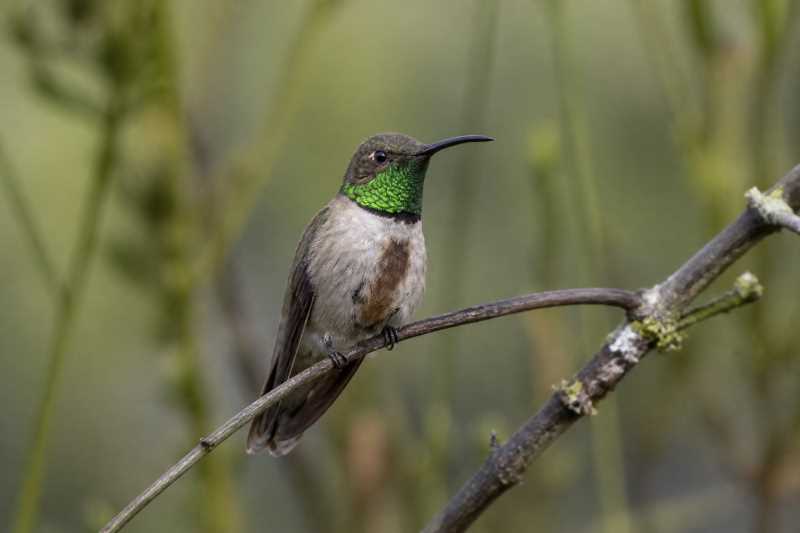
Adult males have olive-brown to greyish-brown upperparts, a brilliant green throat bordered by a dark band, white breast and belly, and a narrow chestnut or rusty stripe down the centre of the abdomen. The tail is distinctive, with contrasting pale or white areas and darker bronze-green central and marginal feathers.
Females are duller overall. Their throat is pale and finely spotted, the underparts are more brownish, and the tail appears darker and less strongly contrasted than that of the male. Young birds resemble females, while young males gradually develop the adult green throat and belly markings.
Range and Habitat
The Andean Hillstar is distributed through the high Andes of western and north-western South America. Its confirmed range includes parts of Peru, western Bolivia, northern Chile and north-western Argentina. BirdLife International records the species from approximately 2,400 to 5,000 metres above sea level.
It favours puna grasslands, alpine meadows, rocky outcrops, high-elevation shrublands and other open habitats containing flowering plants. The species is also associated with sheltered rock faces, ravines and patches of vegetation that provide feeding and nesting sites. It is considered resident rather than migratory, although local movements may occur in response to flowering conditions, weather and food availability.
The Andean Hillstar is sometimes confused taxonomically with the Green-headed Hillstar, Oreotrochilus stolzmanni. Current major checklists, including the IOC World Bird List, recognise O. estella and O. stolzmanni as separate species.
Where to See This Species
Salinas and Aguada Blanca National Reserve, Arequipa, Peru
The Andean Hillstar is documented in the Salinas and Aguada Blanca National Reserve, where it occurs in high puna grasslands, rocky areas and flowering vegetation. The reserve’s biodiversity records specifically include the species, making it one of the more reliable protected areas in southern Peru for looking for this high-altitude hummingbird. It may be encountered around flowering shrubs and sheltered rocky slopes, particularly during periods of greater floral activity.
Nearby accommodation: Arequipa is the most practical major base, with hotels, guest houses and other visitor accommodation. Smaller settlements near the reserve may offer basic rural lodging and community-based accommodation.
Lauca National Park, Arica and Parinacota Region, Chile
The Andean Hillstar is recorded in Lauca National Park, an extensive high-altitude protected area of volcanoes, wetlands, grasslands and rocky puna landscapes. The species is documented through Chile’s national biodiversity records, and suitable habitat occurs around rocky slopes and flowering high-Andean vegetation. The park’s remote conditions mean that sightings are best approached as part of a general altiplano birding visit rather than as a guaranteed close encounter.
Nearby accommodation: Putre is the principal gateway settlement, with small hotels, guest houses, hostels and other basic visitor accommodation.
Volcán Isluga National Park, Tarapacá Region, Chile
Volcán Isluga National Park contains high-altitude grasslands, volcanic slopes, wetlands and puna shrubland, all of which are suitable for the Andean Hillstar. Chilean biodiversity records document the species in the park. Look for it near flowering plants, rocky outcrops and sheltered vegetation, especially where highland habitats are accessible by public roads or established visitor routes.
Nearby accommodation: Colchane is the nearest practical settlement for basic lodging, while visitors may also use small guest houses or rural accommodation in nearby altiplano communities.
Behaviour and Diet
The Andean Hillstar is often seen alone and may defend productive feeding areas. Males can be aggressive towards other hummingbirds near flowering plants, especially where nectar is concentrated. Individuals commonly perch on exposed rocks, shrubs or other elevated viewpoints before making rapid flights to flowers or chasing intruders.
Nectar forms the main energy source. The bird visits a range of high-Andean flowers, including species of Chuquiraga and other native shrubs, as well as flowering cacti and bromeliads where available. It also takes small insects and spiders from vegetation or catches flying insects in the air. These animal foods provide protein and other nutrients that nectar does not supply.
Breeding information is less comprehensive than for many lowland hummingbirds, but the species is known to nest in sheltered places associated with rock faces, crevices, banks and overhangs. The female builds the nest, incubates the eggs and raises the young. The clutch normally consists of two white eggs. Published field information indicates an incubation period of about 20 days and a nestling period that may extend to approximately 38 days, depending on conditions at high elevation.
Identification Tips
- Look for a medium-sized hummingbird in open, rocky puna or high-elevation shrubland, often between 2,400 and 5,000 metres.
- Adult males are recognised by the vivid green throat, dark throat border, white underparts and central rusty belly stripe.
- Females and juveniles are less colourful, with finely spotted pale throats and browner underparts.
- The contrasting pale and dark tail pattern is useful when the bird is perched or flying away.
- Do not rely on the green throat alone, as lighting can make the male’s gorget appear duller or brighter.
- In Chile and Argentina, take care to distinguish it from the White-sided Hillstar, Oreotrochilus leucopleurus, which has a different distribution and typically shows more extensive white on the sides and tail.
Conservation Status
The Andean Hillstar is currently assessed as Least Concern by the IUCN Red List. Its population size has not been quantified, but the overall population trend is considered stable, and the species has a large geographic range.
Potential pressures include the degradation and fragmentation of high-Andean habitats through mining, agriculture, infrastructure, overgrazing and other land-use changes. Climate change may also affect flowering patterns, water availability and the distribution of suitable high-elevation vegetation. Conservation measures include maintaining protected areas, safeguarding puna grasslands and shrublands, reducing habitat disturbance and monitoring the species and its food plants. International trade controls also apply to hummingbirds through CITES provisions.
Frequently Asked Questions
Where does the Andean Hillstar live?
It lives in high-elevation habitats of the Andes in Peru, Bolivia, Chile and north-western Argentina, usually in puna grasslands, rocky slopes and montane shrublands.
How high does the Andean Hillstar occur?
The species has been recorded from approximately 2,400 to 5,000 metres above sea level, although local elevation varies across its range.
What does the Andean Hillstar eat?
It feeds mainly on nectar from high-Andean flowers and supplements this diet with small insects and spiders.
How can the male be identified?
The adult male has a brilliant green throat bordered by a dark band, white underparts and a narrow rusty stripe on the centre of the belly.
Is the Andean Hillstar migratory?
It is regarded as a resident species rather than a migrant. Individuals may still make local movements in response to flowering, food availability and severe weather.
Is the Andean Hillstar endangered?
No. It is currently listed as Least Concern, although mining, habitat degradation, land-use change and climate-related effects may pose local risks.
References
- BirdLife International
- IOC World Bird List
- Cornell Lab of Ornithology, Birds of the World
Related posts


