Introduction
Hubbs’s beaked whale, scientifically known as Mesoplodon carlhubbsi, is a lesser-known species of beaked whale found in the North Pacific Ocean. First described in 1963, this elusive marine mammal was named in honor of the notable American ichthyologist Carl Leavitt Hubbs. The species is part of the Ziphiidae family, a group of cetaceans characterized by their elongated beaks and deep-diving capabilities. Despite their elusive nature, Hubbs’s beaked whales have garnered interest from marine biologists and cetacean enthusiasts due to their unique adaptations and behaviors.
Physical Description
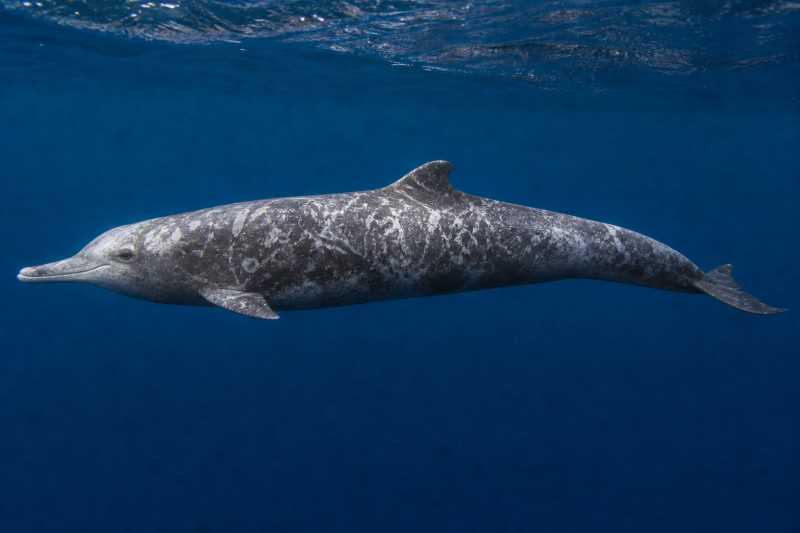
Hubbs’s beaked whale exhibits a streamlined body built for deep diving and efficient movement through the water. Adult males can reach lengths of up to 5.4 meters (approximately 18 feet), while females are slightly smaller, growing up to 4.5 meters (about 15 feet). The body coloration is generally dark gray on the dorsal side with lighter undersides. A distinctive feature of this species is the presence of two converging white or light gray scars on the males’ throats, often referred to as "cross-hatching" patterns.
The beak of Hubbs’s beaked whale is relatively long and slender, akin to that of other members of the Mesoplodon genus. The males possess a pair of large, triangular teeth that protrude from the lower jaw, which are thought to play a role in male-to-male combat during mating contests. Females and juveniles have smaller, less prominent teeth that remain mostly hidden.
Range and Habitat
Hubbs’s beaked whale is predominantly found in the North Pacific Ocean. Their range extends from the southern coast of Japan, across the Aleutian Islands, to the waters off the west coast of North America, including California and British Columbia. These whales prefer deep oceanic waters and are often found far from shore, typically inhabiting regions with depths exceeding 200 meters (approximately 656 feet).
The preferred habitat of Hubbs’s beaked whale is characterized by steep continental slopes and deep-sea canyons. These areas offer the ideal conditions for deep diving and foraging, as they are rich in squid and other cephalopods that form the bulk of their diet.
Behavior and Diet
Hubbs’s beaked whales are deep-diving cetaceans, capable of reaching depths of over 1,000 meters (3,280 feet) and remaining submerged for up to an hour. This remarkable diving ability allows them to exploit deep-water prey that is inaccessible to many other marine predators. Their diet primarily consists of squid, supplemented by fish and crustaceans.
These whales are generally solitary or found in small groups, typically consisting of a few individuals. Their elusive nature and preference for deep waters make them difficult to study, and as a result, much of their behavior remains a mystery. However, it is known that like other beaked whales, they use echolocation to navigate and hunt in the dark ocean depths.
Identification Tips (Field Recognition Cues)
Identifying Hubbs’s beaked whale in the field can be challenging due to their elusive nature and preference for deep, offshore waters. However, there are several key features that can aid in their identification:
- Size and Shape: Look for a medium-sized whale with a streamlined body and a long, slender beak.
- Coloration: Note the dark gray dorsal side and lighter underside. Males may have distinctive white scars on their throats.
- Teeth: In males, look for the pair of large, triangular teeth that may be visible even when the whale is at the surface.
- Behavior: Hubbs’s beaked whales are usually solitary or in small groups. They are deep divers, so prolonged surface time is uncommon.
- Location: Consider the geographical location and depth of the water, as they are typically found in deep oceanic regions of the North Pacific.
Conservation Status (With Threats and Protections)
As of the latest assessments, Hubbs’s beaked whale is listed as Data Deficient by the International Union for Conservation of Nature (IUCN). This classification indicates that there is insufficient information available to make a direct assessment of its population status and trends.
Threats:
- Bycatch: Although specific data is scarce, Hubbs’s beaked whales, like other cetaceans, may become entangled in fishing gear, leading to injury or death.
- Noise Pollution: The increasing levels of anthropogenic noise, particularly from naval sonar and commercial shipping, pose a significant threat. Noise pollution can interfere with their echolocation abilities and cause disorientation.
- Climate Change: Changes in ocean temperatures and prey availability due to climate change could impact their feeding grounds and migration patterns.
Protections:
Conservation efforts for this species are limited due to the lack of detailed knowledge. However, they are indirectly protected under various international agreements that aim to reduce the impacts of bycatch and noise pollution on marine life. Continued research and monitoring are crucial to understanding their population dynamics and implementing effective conservation measures.
Frequently Asked Questions
1. What are the distinguishing features of Hubbs’s beaked whale?
Hubbs’s beaked whale is characterized by its medium size, streamlined body, and long, slender beak. Males have distinctive triangular teeth and white throat scars. They are found in deep, offshore waters of the North Pacific.
2. What is the primary diet of Hubbs’s beaked whale?
The primary diet of Hubbs’s beaked whale consists of squid and other cephalopods, supplemented by fish and crustaceans. Their deep-diving ability allows them to access prey in deep oceanic waters.
3. How does noise pollution affect Hubbs’s beaked whale?
Noise pollution, particularly from naval sonar and shipping, can interfere with the echolocation abilities of Hubbs’s beaked whale, leading to disorientation and difficulty in communication and hunting. This can have detrimental effects on their survival.
4. Where can Hubbs’s beaked whale be found?
Hubbs’s beaked whale is found in the North Pacific Ocean, ranging from the southern coast of Japan to the west coast of North America. They prefer deep oceanic waters, often near steep continental slopes and canyons.
5. Why is Hubbs’s beaked whale listed as Data Deficient?
Hubbs’s beaked whale is listed as Data Deficient due to a lack of comprehensive data on its population size, distribution, and trends. This makes it challenging to assess their conservation status accurately.
Related posts