Introduction
Blainville’s Beaked Whale, scientifically known as Mesoplodon densirostris, is one of the intriguing yet elusive members of the cetacean family. With its distinct physical features and deep-diving capabilities, this species piques the interest of marine biologists and whale enthusiasts alike. First described by Henri Marie Ducrotay de Blainville in the early 19th century, these whales are distributed across the world’s oceans but remain largely enigmatic due to their deep-sea habitat and elusive nature. This article delves into the fascinating world of Blainville’s Beaked Whale, exploring its physical characteristics, habitat, behavior, and conservation status.
Physical Description
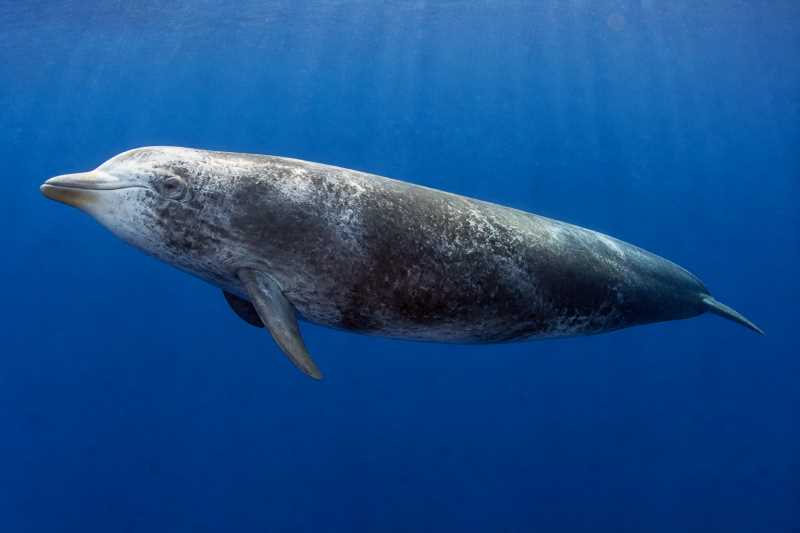
Blainville’s Beaked Whale is a medium-sized cetacean, with adults typically ranging from 4.5 to 5 meters in length and weighing between 800 to 1,000 kilograms. One of the most distinctive features of this species is its beak-like snout, which is more pronounced in males. The males are also characterized by the presence of two large, dense teeth that protrude from the lower jaw, giving them a unique appearance.
The body of Blainville’s Beaked Whale is robust, tapering to a narrow tail stock. Their skin color ranges from dark gray to brownish, often adorned with lighter spots and scars, likely from encounters with predators or intraspecific interactions. These scars are more prevalent in males, possibly due to aggressive encounters during mating.
Range and Habitat
Blainville’s Beaked Whales are found in warm and temperate waters worldwide, particularly in deep oceanic environments. Their distribution includes the Atlantic, Pacific, and Indian Oceans, with sightings reported in regions as diverse as the Caribbean, the coasts of Hawaii, and the waters off Japan.
These whales prefer deep-sea habitats, typically inhabiting waters over 200 meters deep. They are known to frequent continental slopes and offshore oceanic islands, where they can dive to remarkable depths exceeding 1,400 meters. This preference for deep waters makes them one of the least observed cetacean species.
Behavior and Diet
Blainville’s Beaked Whales are deep divers, capable of staying submerged for over an hour as they hunt for food. Their diet primarily consists of deep-sea squid, but they also consume fish and crustaceans. They use echolocation to locate their prey in the dark depths of the ocean.
Socially, these whales are believed to be somewhat solitary, often observed alone or in small groups of 3 to 7 individuals. They are known for their elusive behavior, making them difficult to study. When surfacing, they are typically quiet, exhaling with minimal splash, which adds to the challenge of observing them in the wild.
Identification Tips (Field Recognition Cues)
Identifying Blainville’s Beaked Whale in the field can be challenging due to their deep-sea habitat and elusive nature. However, there are specific cues that can aid in their identification:
- Distinctive Beak: Look for the characteristic long, tube-like beak, especially pronounced in males.
- Protruding Teeth: In mature males, the notable protruding teeth on the lower jaw are a key identifying feature.
- Scarring: Males often have more extensive scarring on their bodies, which can be visible from a distance.
- Quiet Surfacing: They tend to surface quietly with minimal disturbance, creating a small, smooth footprint on the water.
Conservation Status (With Threats and Protections)
Blainville’s Beaked Whale is currently listed as "Data Deficient" by the International Union for Conservation of Nature (IUCN), primarily due to the lack of comprehensive data on their population numbers. However, they face several threats, including:
- Bycatch: Accidental capture in fishing nets poses a significant threat to their population.
- Noise Pollution: Increased naval and commercial shipping activities contribute to underwater noise pollution, which can disrupt their echolocation abilities.
- Climate Change: Alterations in ocean temperatures and currents can affect their prey availability.
Efforts to protect Blainville’s Beaked Whale include marine protected areas where human activities are regulated, as well as international agreements aimed at reducing bycatch and noise pollution.
Frequently Asked Questions
1. What is the typical lifespan of a Blainville’s Beaked Whale?
Blainville’s Beaked Whales are believed to live for approximately 25 to 30 years. However, exact data on their lifespan is limited due to the challenges in studying these elusive creatures.
2. How deep can Blainville’s Beaked Whales dive?
These whales are exceptional divers, capable of reaching depths of over 1,400 meters. They can remain submerged for long periods, sometimes exceeding an hour.
3. Are Blainville’s Beaked Whales social animals?
Blainville’s Beaked Whales are generally solitary or found in small groups. They exhibit elusive behaviors, which makes studying their social interactions challenging.
4. What do Blainville’s Beaked Whales eat?
Their diet primarily consists of deep-sea squid, but they also consume fish and crustaceans. They use echolocation to hunt in the deep ocean.
5. Where can I see Blainville’s Beaked Whales?
They are found in warm and temperate deep ocean waters worldwide, including the Atlantic, Pacific, and Indian Oceans. Sightings are rare due to their deep-sea habitat and elusive nature.
Related posts