Introduction
Jackson’s Spurfowl, Pternistis jacksoni, is a large, ground-dwelling member of the pheasant family, Phasianidae. Formerly often called Jackson’s Francolin, it is a high-altitude bird of the mountains of Kenya, with a marginal range in Uganda. It is associated with montane forest, bamboo, moorland and forest edges, and is usually encountered in pairs or small groups.
Physical Description
Jackson’s Spurfowl is a robust spurfowl weighing approximately 1,130–1,160 g, with females slightly smaller than males. The sexes are broadly similar in plumage, although males have one or two spurs on the tarsi and are generally larger.
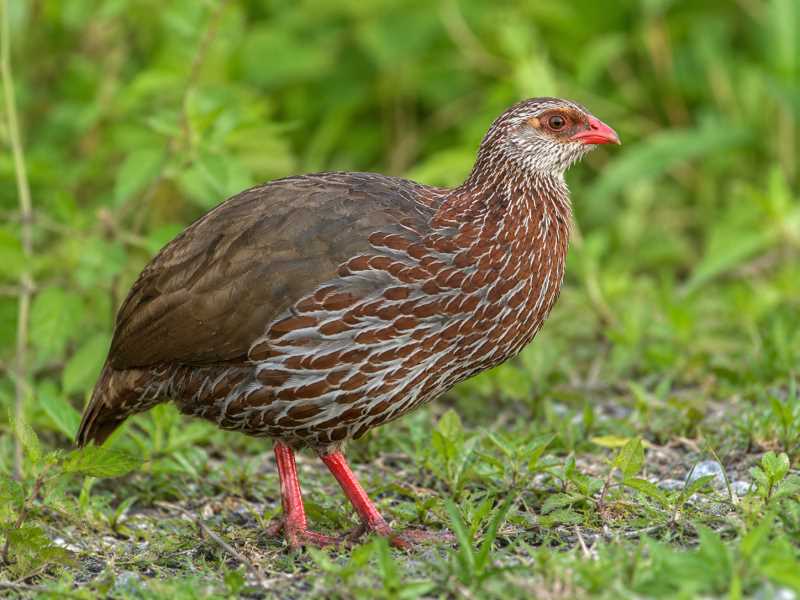
Adults have a red bill, yellow-orange ear-patch and eye-ring, and red legs. The head is grey-brown, the throat is buff, and the back and wings are dark maroon or rufous-brown. The lower neck and belly are chestnut, with individual feathers edged in greyish, buff or whitish tones that create a subtle scalloped pattern. These markings provide useful camouflage in leaf litter, bamboo and dense upland vegetation.
Reliable published information on juvenile plumage is limited, but young birds are duller and less clearly marked than adults, with more extensive dark barring on the upperparts and lower underparts.
Range and Habitat
Jackson’s Spurfowl is virtually endemic to Kenya. Its main range includes the Aberdare Range, Mount Kenya, the Mau Escarpment and the Cherangani Mountains. It extends marginally into Uganda, including records from the Mount Elgon region. The species is not normally regarded as a Tanzanian bird, despite the broader East African setting of its range.
It occurs at approximately 2,200–3,700 metres above sea level. Preferred habitats include montane forest, forest margins, bamboo patches, moorland, forest scrub and Afro-alpine vegetation containing trees such as Podocarpus and Juniperus. It is a resident species rather than a long-distance migrant, although local movements may occur in response to food, weather and habitat conditions.
The species is currently treated as monotypic. Some named geographic forms have been proposed, but recent taxonomic work does not support recognising them as separate subspecies.
Behaviour and Diet
Jackson’s Spurfowl is primarily terrestrial and spends most of its time walking and feeding on the ground. It is generally secretive, especially in dense vegetation, but may be seen crossing tracks, open moorland or forest edges. Pairs and small groups are commonly reported, and the species is usually more active during daylight hours.
Its diet includes plant material such as seeds and other vegetable matter, supplemented by insects and other small invertebrates. Like other ground-feeding galliforms, it uses its strong feet to disturb leaf litter and soil while searching for food.
The species has a loud, harsh call that may be delivered in a slow sequence. Detailed information about its courtship, nest placement, clutch size, incubation period and parental care remains comparatively limited in the accessible literature, so precise breeding claims should be treated cautiously.
Identification Tips
- Look for a large, heavy-bodied spurfowl in high-elevation forest, bamboo or moorland.
- The combination of a red bill, red legs, yellow-orange ear-patch and yellow-orange eye-ring is especially useful.
- The buff throat contrasts with the darker maroon-brown back and wings.
- The chestnut underparts have pale feather edges, producing a scalloped or lightly barred appearance.
- Males may show one or two spurs on the legs; females lack these prominent spurs.
- In areas where ranges overlap, the red bill and legs help separate Jackson’s Spurfowl from the Moorland Spurfowl. The smaller Scaly Spurfowl has a different, more extensively scaly appearance and lacks the strongly chestnut, pale-edged underparts of Jackson’s Spurfowl.
Conservation Status
Jackson’s Spurfowl is classified as Least Concern on the IUCN Red List. The species has a restricted high-altitude distribution, but it occurs in several protected mountain areas, including the Aberdare and Mount Kenya landscapes.
Habitat loss and degradation remain relevant conservation concerns. Montane forests, bamboo stands, moorlands and forest edges may be affected by agricultural expansion, timber extraction, fire, grazing pressure and other forms of human disturbance. Maintaining connected upland habitats, protecting remaining forest and monitoring populations at range-restricted sites are important conservation measures.
No reliable global population estimate is given here. The available sources do not provide a sufficiently secure basis for quoting a total number of mature individuals or a detailed population trend.
Frequently Asked Questions
Where does Jackson’s Spurfowl live?
It lives mainly in the highlands of Kenya, especially the Aberdare Range, Mount Kenya, the Mau Escarpment and the Cherangani Mountains. It also occurs marginally in Uganda.
What habitat does Jackson’s Spurfowl prefer?
It favours montane forest, bamboo, moorland, forest edges, forest scrub and high-altitude Afro-alpine vegetation, generally between about 2,200 and 3,700 metres.
What does Jackson’s Spurfowl eat?
Its diet consists mainly of seeds and other plant material, with insects and other small invertebrates also taken. It searches for food on the ground, often disturbing leaf litter and soil with its feet.
How can Jackson’s Spurfowl be identified?
The most useful features are its large size, red bill, red legs, yellow-orange ear-patch and eye-ring, buff throat, dark maroon-brown upperparts and chestnut underparts with pale feather edges.
Is Jackson’s Spurfowl endangered?
It is currently listed as Least Concern. Nevertheless, its restricted montane range means that continued protection of high-altitude forest, bamboo and moorland habitats is important.
Is Jackson’s Spurfowl migratory?
It is considered a resident species rather than a long-distance migrant. Local movements may occur, but there is no established evidence of regular long-distance migration.
References
- BirdLife International. 2026. Jackson’s Spurfowl Pternistis jacksoni. BirdLife Data Zone species factsheet and IUCN Red List assessment information. Available at: https://datazone.birdlife.org/species/factsheet/jacksons-spurfowl-pternistis-jacksoni (accessed 8 September 2026).
- Gill, F., Donsker, D. & Rasmussen, P., eds. 2026. IOC World Bird List, version 15.2. International Ornithologists’ Union. Available at: https://www.worldbirdnames.org/new/ (accessed 8 September 2026).
- ITIS. n.d. Pternistis jacksoni (Ogilvie-Grant, 1891), Integrated Taxonomic Information System, TSN 553861. Available at: https://www.itis.gov/servlet/SingleRpt/SingleRpt?search_topic=TSN&search_value=553861 (accessed 8 September 2026).
- Mandiwana-Neudani, T. G., Little, R. M., Crowe, T. M. & Bowie, R. C. K. 2019. Taxonomy, phylogeny and biogeography of African spurfowls Galliformes, Phasianidae, Phasianinae, Coturnicini: Pternistis spp. Ostrich: Journal of African Ornithology 90(2): 145–172. https://doi.org/10.2989/00306525.2019.1584925
- Ogilvie-Grant, W. R. 1891. On some new Francolins and a new Hornbill discovered by Mr. F. J. Jackson in Eastern Africa. The Ibis, series 6, 3(9): 123–127. Available at: https://www.biodiversitylibrary.org/part/389802 (accessed 8 September 2026).
- Stevenson, T. & Fanshawe, J. 2020. Field Guide to the Birds of East Africa: Kenya, Tanzania, Uganda, Rwanda, Burundi. Helm Field Guides. Bloomsbury Publishing.
- Wachira, W. 2022. Jackson’s Spurfowl Pternistis jacksoni, version 2.0. In B. K. Keeney, ed., Birds of the World. Cornell Lab of Ornithology, Ithaca, New York. https://doi.org/10.2173/bow.jacfra2.02
Related posts