Introduction
The Ahanta Spurfowl (Pternistis ahantensis) is a resident ground-dwelling bird of the humid forest belt of West Africa. It belongs to the pheasant family, Phasianidae, and was formerly known in much of the literature as the Ahanta Francolin. Current major bird checklists use the name Ahanta Spurfowl. The species occurs in several disjunct parts of the Upper Guinea and Guinea-Congo forest region.
Physical Description
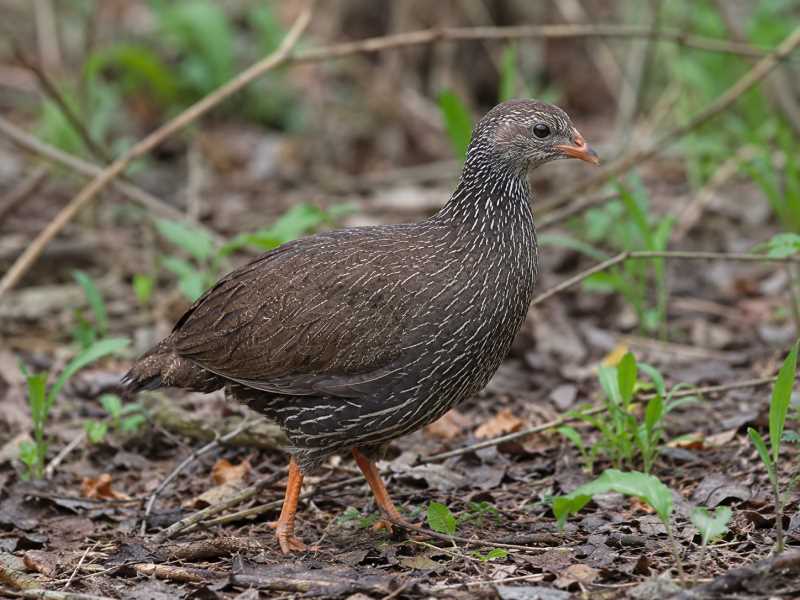
The Ahanta Spurfowl is a medium-sized, robust spurfowl. Reliable sources give approximate adult masses of about 608 g for males and 487 g for females, although individual size varies. The sexes are broadly similar in plumage, but males are generally larger and have one or two spurs on the legs, whereas females usually lack these prominent spurs.
The plumage is mainly brown, chestnut and darkly patterned. The breast and flanks show contrasting pale-edged feathers with darker centres, while the upperparts are finely vermiculated with blackish markings and reddish-brown shaft streaks. The lower neck has distinctive pale or whitish patterning. The bill is orange with a darker base, and the legs are yellowish to orange. Reddish bare skin around the face and eyes can be visible at close range.
Juvenile plumage is less well documented than adult plumage. As in other ground-dwelling Phasianidae, young birds are comparatively cryptic and are mobile soon after hatching.
Range and Habitat
The Ahanta Spurfowl is endemic to West Africa and is not migratory. Its distribution is divided into three broad, disjunct areas:
- Southern Senegal, The Gambia and northern Guinea-Bissau.
- Southern Guinea, Sierra Leone and western Liberia.
- Parts of Côte d’Ivoire, Ghana, Togo, Benin and south-western Nigeria.
It is associated mainly with moist lowland forest, including gallery forest, secondary forest, forest margins and other areas where dense cover remains. Records from degraded forest and managed landscapes show that it can persist outside mature forest, but this does not mean that extensive habitat conversion is harmless. The species is generally encountered at low elevations, and it is best regarded as a forest and forest-edge bird rather than an open-country spurfowl.
The recognised species is treated as monotypic by Birds of the World and current taxonomic treatments. The formerly proposed western subspecies P. a. hopkinsoni is not generally recognised as a separate subspecies in recent ornithological work.
Behaviour and Diet
The Ahanta Spurfowl spends most of its time on the ground, moving through leaf litter and undergrowth. It can fly strongly when flushed, but it normally relies on walking or running through cover. It may occur singly, in pairs or in small groups, depending on local conditions.
The species is often detected by its loud calls before it is seen. In parts of its range, calling is particularly noticeable at night or around dawn, although daytime calling also occurs. Vocal activity appears to vary with season, rainfall and local conditions.
Detailed species-specific dietary studies are limited. Observations of the genus and field records indicate ground foraging for seeds and other plant material, with insects and other small invertebrates also likely to be taken. The bird searches among leaf litter and low vegetation, using its feet and bill to uncover food.
Breeding information remains sparse. A documented Nigerian record involved a ground nest containing four buffish eggs, found in January 2017 at the International Institute of Tropical Agriculture in Ibadan. Young birds are precocial, leaving the nest soon after hatching and remaining dependent on adult protection while they develop.
Identification Tips
- Look for a medium-sized, stocky spurfowl moving quietly through forest undergrowth or leaf litter.
- The overall impression is brown and chestnut, with strongly patterned breast, flank and neck feathers.
- The upperparts are finely vermiculated rather than plain.
- The orange bill, yellow-orange legs and reddish facial skin can be useful at close range.
- Adult males may show one or two leg spurs.
- Its loud, repeated call is often the first indication of its presence, particularly in the early morning or at night.
- Habitat is an important clue. In West African forest, a heavily patterned spurfowl in moist forest, gallery forest or dense secondary growth is more likely to be an Ahanta Spurfowl than an open-country species such as the Double-spurred Spurfowl.
Conservation Status
The Ahanta Spurfowl is currently assessed as Least Concern on the IUCN Red List. This global category reflects its broad distribution and does not mean that all local populations are secure. Population size is not reliably quantified, and local declines have been associated with forest conversion, agricultural expansion, urban growth and hunting pressure.
Conservation priorities include retaining connected blocks of moist forest, protecting gallery forest and forest margins, managing hunting sustainably, and monitoring populations in areas undergoing rapid land-use change. Protected areas and community-based conservation can help, particularly where remaining forest is fragmented or where the species is locally uncommon.
Frequently Asked Questions
Where does the Ahanta Spurfowl live?
It occurs in West Africa, from southern Senegal and Guinea-Bissau eastwards through the Upper Guinea forest region to south-western Nigeria. Its main habitats are moist lowland forest, gallery forest, secondary forest and dense forest edges.
Is the Ahanta Spurfowl migratory?
No. It is regarded as a resident species. Individuals may move locally in response to food availability, disturbance or changing habitat conditions, but it does not undertake regular long-distance migration.
What does the Ahanta Spurfowl eat?
Its diet is not fully documented, but it forages on the ground for seeds and other plant material and also takes insects and small invertebrates. It searches through leaf litter and low vegetation for food.
How can the Ahanta Spurfowl be identified?
Look for a stocky, brown and chestnut spurfowl with finely patterned upperparts, a strongly marked breast and flanks, an orange bill and yellowish-orange legs. It is also frequently detected by its loud call before it is seen.
How many eggs does the Ahanta Spurfowl lay?
Breeding data are limited. One documented nest in Nigeria contained four buffish eggs. The nest was on the ground, and the young are precocial.
Is the Ahanta Spurfowl endangered?
It is currently classified as Least Concern globally. Nevertheless, habitat loss, forest fragmentation and hunting can cause local declines, especially where remaining forest is small or heavily disturbed.
References
- Awoyemi, A. G., Bown, D., Manu, S., Ajayi, A., Olasupo, O. & Olubodun, O. 2018. First breeding record of Ahanta Francolin for Nigeria. Bulletin of the African Bird Club 25(1): 70–71. African Bird Club PDF.
- BirdLife International. 2025. Ahanta Spurfowl (Pternistis ahantensis) in BirdLife DataZone. BirdLife International. Stable species and country records available through BirdLife DataZone. Accessed 8 September 2026.
- Gill, F., Donsker, D. & Rasmussen, P., eds. 2026. IOC World Bird List, version 15.2. International Ornithologists’ Union. IOC World Bird List. Accessed 8 September 2026.
- Mandiwana-Neudani, T. G., Little, R. M., Crowe, T. M. & Bowie, R. C. K. 2019. Taxonomy, phylogeny and biogeography of African spurfowls, Galliformes, Phasianidae, Phasianinae, Coturnicini: Pternistis spp. Ostrich: Journal of African Ornithology 90(2): 145–172. https://doi.org/10.2989/00306525.2019.1584925.
- McGowan, P. J. K. & Kirwan, G. M. 2020. Ahanta Spurfowl (Pternistis ahantensis), version 1.0. In J. del Hoyo, A. Elliott, J. Sargatal, D. A. Christie & E. de Juana, eds, Birds of the World. Cornell Lab of Ornithology, Ithaca, New York. https://doi.org/10.2173/bow.ahafra2.01. Accessed 8 September 2026.
- International Union for Conservation of Nature. 2025. Pternistis ahantensis, IUCN Red List assessment, Least Concern. IUCN Red List of Threatened Species. Accessed 8 September 2026.
- Avibase. 2026. Ahanta Spurfowl (Pternistis ahantensis), taxonomic and distribution records. Denis Lepage, Canadian Biodiversity Information Facility. Avibase species account. Accessed 8 September 2026.
Related posts