Introduction
The Blue-headed Hummingbird (Riccordia bicolor) is a small hummingbird restricted to the Lesser Antillean islands of Dominica and Martinique. It is recognised for the male’s intense blue head, green plumage and fast, precise flight. The species was formerly widely treated as Cyanophaia bicolor, but the current IOC classification places it in the genus Riccordia.
Physical Description
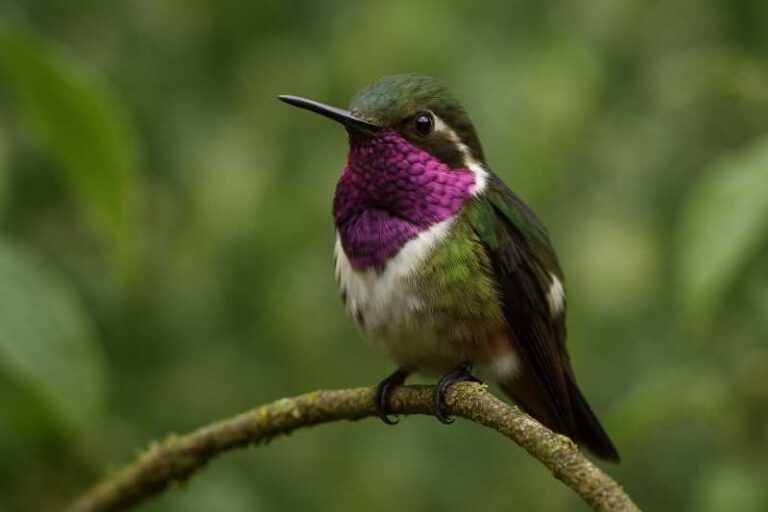
This is a small hummingbird, approximately 9–11 centimetres long. The adult male is predominantly emerald-green, with a strongly iridescent blue head and crown. The tail also shows blue tones, particularly in good light, while the underwing is relatively dark. The bill is slender and slightly curved.
The female is less vividly coloured. She is mainly green above, with pale to whitish underparts, a darker-looking face, and blue iridescence on the crown and tail. Juveniles are generally duller than adults and may have shorter-looking bills, wings and tail feathers. As in other hummingbirds, the wings support sustained hovering while the bird feeds at flowers.
Range and Habitat
The Blue-headed Hummingbird is endemic to Dominica and Martinique. It is mainly associated with humid mountain forest, secondary forest, forest edges and riverine vegetation, and may also visit gardens, plantations and other areas where flowering plants are available.
The species is generally found at middle to high elevations, with records concentrated in mountainous forest. It is considered sedentary rather than migratory, although individuals may move locally in response to food availability, weather and changing conditions in forest habitats.
Where to See This Species
Syndicate Nature Trail, Morne Diablotin National Park, Dominica
The Syndicate Nature Trail passes through humid rainforest and montane forest in one of Dominica’s best-known birdwatching areas. The Blue-headed Hummingbird has been documented along the trail and on the surrounding access road. Early morning and late afternoon are sensible times to search, particularly around forest edges, clearings, streams and flowering plants.
Nearby accommodation: Portsmouth and the surrounding villages provide practical bases with guest houses, small hotels and self-catering accommodation.
Morne Diablotin National Park, Dominica
The wider national park contains extensive rainforest, mountain streams and suitable riverine habitat for the species. It is a protected area of particular importance for Dominica’s endemic and restricted-range birds, and the Blue-headed Hummingbird is documented as occurring within the park.
Nearby accommodation: Portsmouth is the main gateway town, with hotels, guest houses and self-catering accommodation, while smaller village accommodation may be available nearer the park approaches.
Mont Pelée and the Pitons du Carbet, Martinique
The forested mountain areas around Mont Pelée and the Pitons du Carbet provide suitable habitat and are recognised birdwatching areas for the Blue-headed Hummingbird. Look along managed mountain trails, forest margins and humid vegetation, especially in the northern and central uplands.
Nearby accommodation: Morne-Rouge, Saint-Pierre and Ajoupa-Bouillon are useful bases, offering hotels, guest houses, rural lodgings and self-catering accommodation.
Behaviour and Diet
The Blue-headed Hummingbird is active during the day and usually forages alone. It feeds mainly on nectar from flowering plants, hovering at flowers or perching nearby between visits. Small insects and spiders are also taken and provide important protein, particularly during the breeding season.
Males may defend productive feeding areas from other hummingbirds by making rapid chases and short aerial displays. The species is not known to undertake long-distance migration, but local movements may occur between forest, edge and garden habitats as flowers become available.
Breeding information is limited, but the female builds the nest and raises the young without assistance from the male. The nest is a small cup made from plant material and other fibres, often secured with spider silk and placed on a slender branch or tree-fern frond. Clutches generally contain two white eggs. Incubation lasts about 16–18 days, and young birds usually leave the nest roughly three weeks after hatching.
Identification Tips
- Look for a small, fast-moving hummingbird in humid forest, woodland edges and clearings.
- The adult male is identified by his dark blue, highly iridescent head combined with green body plumage and a blue-toned tail.
- The female is paler below and greener above, but retains blue iridescence on the crown and tail.
- The dark face, blue tail and relatively long, slender bill help separate the female from the Antillean Crested Hummingbird, which often shows a crest, a shorter bill and lacks the Blue-headed Hummingbird’s blue tail.
- Colour can appear much duller in shade, so observe the bird from several angles where possible.
- Metallic, high-pitched notes and rapid descending calls may help locate a bird hidden in dense vegetation.
Conservation Status
The Blue-headed Hummingbird is currently listed as Near Threatened on the IUCN Red List. Its restricted distribution on only two islands makes it vulnerable to habitat degradation, severe storms and other environmental changes.
Hurricanes can damage forest structure and temporarily reduce flowering and feeding opportunities. Climate change may also alter rainfall, storm intensity, flowering times and the elevation at which suitable habitat occurs. The species has shown an ability to persist and recover after major storms, but continued protection of humid mountain forest and careful monitoring on both islands remain important conservation measures.
Frequently Asked Questions
Where does the Blue-headed Hummingbird live?
It is found only on Dominica and Martinique in the Lesser Antilles, mainly in humid mountain forest, secondary forest, riverine vegetation and forest edges.
Is the Blue-headed Hummingbird migratory?
No. It is generally regarded as a sedentary species, although it may make local movements between habitats as food availability and weather conditions change.
What does the Blue-headed Hummingbird eat?
Its diet consists mainly of flower nectar, supplemented by small insects and spiders. Nectar provides energy, while animal prey supplies protein and other nutrients.
How can the male be recognised?
The male has an intensely iridescent blue head and crown, emerald-green body plumage and blue tones in the tail. These features are most obvious in direct or angled light.
Where is the best place to see this species in Dominica?
The Syndicate Nature Trail in Morne Diablotin National Park is one of the most reliable publicly accessible places to look. Search humid forest, clearings, streams and flowering plants during the early morning or late afternoon.
Why is the species considered Near Threatened?
Its range is confined to two islands, and its habitat may be affected by hurricanes, habitat degradation and climate-related changes in weather, vegetation and flowering patterns.
References
- IOC World Bird List
- BirdLife International and IUCN Red List of Threatened Species
- Cornell Lab of Ornithology, eBird and Macaulay Library
Related posts