Introduction
The Congo Peafowl, Afropavo congensis, is the only species in the genus Afropavo and the only peafowl native to Africa. Endemic to the forests of the Democratic Republic of the Congo, it is a secretive ground-dwelling member of the pheasant family, Phasianidae. Unlike the Indian and Green Peafowls, it lacks an extravagant train of elongated upper-tail coverts, but males still show striking blue, green and violet plumage. Molecular research supports a close evolutionary relationship between Afropavo and the Asian peafowls of the genus Pavo. (ww.worldbirdnames.org)
Physical Description
The Congo Peafowl is a medium-sized peafowl. Adult males measure approximately 64–70 cm in length, while females measure about 60–63 cm. Recorded male wing lengths are approximately 31–33 cm, and females weigh about 1.1–1.2 kg in the available measurements. (animaldiversity.org)
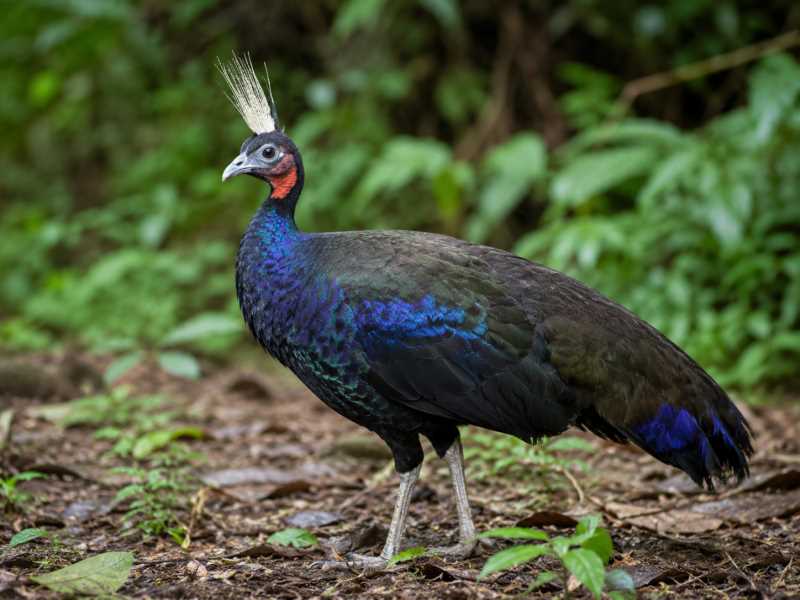
Males are larger and more vividly coloured than females. Their plumage is mainly bronze-green and dark blue, with violet-blue tones on the breast, wing coverts and tail tips. The tail is relatively short and lacks the large, eye-spotted train characteristic of the Indian Peafowl. Males have a distinctive two-part crest, with pale, bristle-like feathers at the front and darker feathers behind, together with a bare red throat, grey bill and blue-grey legs.
Females are more cryptically coloured. They have predominantly brown and glossy green plumage, a chestnut crest, a darker underside and a shorter, less colourful tail. Both sexes have bare red throat skin and greyish bills, although the male’s crest, plumage and leg spurs are more developed. Young birds are comparatively dull, and first-year males retain much brown plumage before acquiring the stronger adult colours. (animaldiversity.org)
Range and Habitat
The Congo Peafowl is a non-migratory, breeding-endemic species of the Congo Basin. Its known distribution lies in the Democratic Republic of the Congo, where it occurs in a patchy pattern across parts of the central and eastern lowland forest zone. The species is difficult to survey because it is quiet and elusive, and local absence can be difficult to distinguish from a failure to detect it. (datazone.birdlife.org)
It uses lowland rainforest, old secondary forest, forest margins and some relatively dry forest on low hills and ridges. It has also been associated with floodplains, streams and areas with an open understorey. Available ecological summaries place it broadly between about 100 and 1,200 m above sea level, although the species is principally associated with lowland forest and appears to become uncommon at higher elevations. (animaldiversity.org)
Field surveys have suggested that the species may favour relatively dry forest within the wider rainforest landscape, particularly forest on shallow soils and ridges between watersheds. This differs from the simple description of the bird as a species of uniformly wet, undisturbed rainforest. It can also use old secondary forest where fruit and other food resources are plentiful. (cambridge.org)
Behaviour and Diet
Congo Peafowl spend much of their time on the forest floor, where they search through leaf litter and low vegetation. They can fly and may perch or roost in trees, particularly at night, but they are primarily terrestrial foragers. They may occur alone, in pairs or in small family groups. Males can give loud warning calls when people or potential predators approach, and vocal communication may include duets and other harsh or hoarse calls. (animaldiversity.org)
The diet is varied and includes fallen fruit, berries, seeds, plant material and small invertebrates. Reported animal foods include termites, ants, grasshoppers, crickets, mosquito larvae and other leaf-litter invertebrates. The available evidence does not indicate that the species depends on one specialised food plant or prey item. (cambridge.org)
Breeding information comes largely from field observations and captive birds. Pairs may form strong bonds, and the species is generally described as monogamous. Courtship displays include raising and angling the tail, positioning the body laterally and lowering the head towards the mate. Nests may be placed in trees or above the ground, and reported clutches usually contain two or three eggs. Incubation has been recorded at approximately 26–28 days. Both parents may help protect and feed the chicks after hatching. (animaldiversity.org)
Identification Tips
Look for the following combination of features when identifying a Congo Peafowl:
- A compact, forest-dwelling peafowl without a long, eye-spotted train.
- A male with dark bronze-green and blue plumage, violet-blue highlights, a bristly two-part crest and a bare red throat.
- A female with chestnut-brown and glossy green plumage, a shorter chestnut crest and a darker underside.
- A relatively short blackish tail with green or blue tones near the tips.
- Blue-grey or grey legs and a grey bill.
- Secretive behaviour in dense forest, often detected by movement, calls or tracks rather than by prolonged views.
The lack of a large train is the most immediate distinction from the Indian Peafowl and Green Peafowl. The Congo Peafowl’s compact tail, forest-adapted appearance and contrasting red throat also help separate it from other large galliforms in its range. (animaldiversity.org)
Conservation Status
The Congo Peafowl is currently classified as Vulnerable on the IUCN Red List. It is also listed by BirdLife International as a breeding-endemic species. A precise, current wild population estimate should be treated cautiously because the bird is difficult to detect and its distribution is patchy. (nc.iucnredlist.org)
The principal threats are hunting and the loss or degradation of forest habitat. Logging, agricultural expansion, mining, settlement and associated access routes can increase disturbance, fragment habitat and make remote forests more accessible to hunters. Historical fieldwork also documented local declines and probable disappearances from parts of the species’ range, although the extent and timing of more recent changes require continued assessment. (cambridge.org)
Important conservation measures include protecting remaining forest, maintaining effective management in national parks and reserves, reducing uncontrolled hunting, and working with local communities whose livelihoods depend on forest resources. Maiko National Park, Salonga National Park, the Okapi Wildlife Reserve and Kahuzi-Biega National Park have all been identified in published sources as areas relevant to the species, although protection on paper does not by itself guarantee effective conservation. Further surveys and ecological research are needed to clarify distribution, population trends, habitat requirements and the effectiveness of conservation actions. (cambridge.org)
Frequently Asked Questions
Where does the Congo Peafowl live?
The species is endemic to the Democratic Republic of the Congo, where it inhabits parts of the Congo Basin’s lowland and upland forests. Its distribution is patchy and it is difficult to detect in dense vegetation. (datazone.birdlife.org)
Is the Congo Peafowl a true peafowl?
Yes. It belongs to the peafowl group within the pheasant family, but it is the only species in the genus Afropavo. Genetic studies support a close relationship between Afropavo and the Asian peafowls in the genus Pavo. (ww.worldbirdnames.org)
Does the Congo Peafowl have a large colourful train?
No. The male has a relatively short tail and does not possess the long, eye-spotted train of the Indian Peafowl. Its courtship display instead involves the tail, wings, body posture and crest. (animaldiversity.org)
What does the Congo Peafowl eat?
It is an omnivorous forest forager that eats fruit, berries, seeds, other plant material and small invertebrates such as termites, ants and grasshoppers. (cambridge.org)
Is the Congo Peafowl endangered?
It is classified as Vulnerable on the IUCN Red List, meaning that it faces a high risk of extinction in the wild. Hunting and habitat loss are major concerns, while the species’ elusive behaviour makes reliable population monitoring difficult. (nc.iucnredlist.org)
Can Congo Peafowl fly?
Yes. Although it spends much of its time walking and foraging on the ground, it can fly into trees and may roost above ground. (animaldiversity.org)
References
- BirdLife International. 2026. Congo Peafowl Afropavo congensis Species Factsheet. BirdLife DataZone. Accessed 8 September 2026. https://datazone.birdlife.org/species/factsheet/congo-peafowl-afropavo-congensis
- Gill, F., Donsker, D. and Rasmussen, P., eds. 2026. IOC World Bird List, version 15.2. International Ornithologists’ Union. Accessed 8 September 2026. https://www.worldbirdnames.org/
- Hart, J. A. and Upoki, A. 2000. Distribution and conservation status of Congo Peafowl Afropavo congensis in eastern Zaire. Bird Conservation International, 10, 307–318. https://doi.org/10.1017/S0959270900001647
- Hall, K. 2021. Afropavo congensis (Congo peacock). Animal Diversity Web, University of Michigan Museum of Zoology. Accessed 8 September 2026. https://animaldiversity.org/accounts/Afropavo_congensis/
- Kimball, R. T., Braun, E. L. and Ligon, J. D. 1997. Resolution of the phylogenetic position of the Congo peafowl, Afropavo congensis: a biogeographic and evolutionary enigma. Proceedings of the Royal Society B: Biological Sciences, 264(1387), 1517–1523. https://doi.org/10.1098/rspb.1997.0210
- van Bemmel, A. C. V. 1961. Breeding the Congo Peacock. Bijdragen tot de Dierkunde, 31(1), 23–26. https://repository.naturalis.nl/pub/504049
- De Boer, L. E. M. and Van Bocxstaele, R. 1981. Somatic chromosomes of the Congo Peafowl (Afropavo congensis) and their bearing on the species’ affinities. The Condor, 83(3), 204–208. https://doi.org/10.2307/1367308
- International Union for Conservation of Nature. 2022. IUCN Red List version 2022-1: Table 7, changes in IUCN Red List categories. IUCN Red List of Threatened Species. Accessed 8 September 2026. https://nc.iucnredlist.org/redlist/content/attachment_files/2022-1_RL_Stats_Table_7.pdf
Related posts