Introduction
The Singing Quail, Dactylortyx thoracicus, is a secretive New World quail in the family Odontophoridae. It is the only species in the genus Dactylortyx and is recognised for its clear, whistled vocalisations, short tail, long toes and largely terrestrial habits. The species is resident in suitable habitats from Mexico through parts of Central America. [1][2][3]
Physical Description
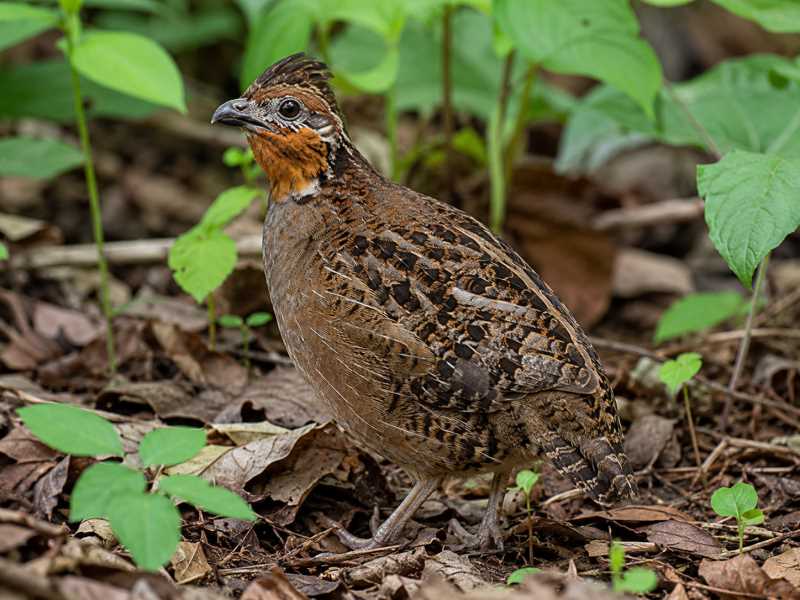
The Singing Quail is a compact, plump bird measuring approximately 20–23 cm in length. Reported mass varies geographically and between sexes, with males generally heavier than females. Its short tail, stout legs and notably long toes reflect its ground-dwelling lifestyle. [3][4]
The plumage is predominantly brown, grey, buff and chestnut, with darker mottling and vermiculation that provide camouflage in leaf litter and dense vegetation. Adults typically show a dark crown, a buff-and-black collar, a warm tawny or orange-buff face, and a dark stripe extending behind the eye towards the neck. The throat and upper breast are marked with pale streaks or spots, while the back and wings are patterned in subdued brown and grey tones. [3][4]
Males and females are broadly similar, although females may show differences in head and breast colouring and are generally smaller. Young birds are duller and more heavily marked than adults. Plumage varies considerably among geographic populations, with montane birds tending to be darker than birds from warmer, drier areas. [3][4]
Range and Habitat
The Singing Quail is a resident species of Mexico and Central America. Its distribution is discontinuous and includes several regions of Mexico, the Yucatán Peninsula, southern Mexico, Guatemala, El Salvador and Honduras. Published range accounts differ in their treatment of peripheral populations and subspecies, so local occurrence should be checked against current regional bird lists. [2][4]
It occupies a wide range of forest environments, including montane evergreen forest, pine–oak forest, tropical evergreen forest and some tropical deciduous forest. The species may occur from near sea level to approximately 2,600 m, although the elevational range differs between populations. It generally favours dense ground cover, forest edges, thick undergrowth and areas with ample leaf litter, where it can forage while remaining concealed. [2][4]
The species is not known to undertake regular long-distance migration. Its fragmented distribution reflects the patchy nature of suitable forest habitat and the long-term isolation of some populations. [4]
Behaviour and Diet
Singing Quails spend most of their time on the ground, moving through leaf litter and low vegetation rather than flying unless disturbed. They are secretive and are more often detected by their vocalisations than seen. Birds may occur singly, in pairs or in small family groups and coveys, with group size varying across the range and with the season. [3][4]
The species feeds by walking and scratching through the forest floor. Its diet includes seeds, berries and other plant material, supplemented by insects and other small invertebrates. Feeding activity is usually concentrated in areas where dense cover provides protection from predators. [3][4]
Its song consists of distinctive, musical whistles and trilled phrases. Calls are important in communication between members of a pair or covey and are particularly conspicuous during the breeding period. Because the bird usually calls from dense cover, locating the source of the sound can be difficult. [3][4]
Breeding biology is incompletely documented across the entire range. Available observations describe ground nests concealed among vegetation, eggs incubated in the nest, and precocial chicks that leave the nest soon after hatching and follow the adults. Breeding dates vary geographically and are associated in some areas with the rainy season. [4]
Identification Tips
- Listen for a clear, repeated whistle or musical series of notes before searching for the bird on the ground.
- Look for a compact quail with a very short tail, long toes and a small crest or lengthened crown feathers.
- Note the combination of a dark crown, tawny face, dark post-ocular stripe, buff-and-black collar and finely mottled brown back.
- Search slowly along dense forest edges, shaded paths, steep woodland floors and areas with thick leaf litter.
- The species is more likely to run into cover than to remain in the open or fly for a long distance.
- In parts of Mexico and Central America, comparison may be necessary with other forest quails and wood-partridges. The Singing Quail is distinguished by its short tail, long toes, compact shape and strongly patterned head and throat. [3][4]
Conservation Status
The Singing Quail is assessed as Least Concern on the global IUCN Red List assessment used by BirdLife International. This status does not mean that every population is secure. The species occupies a fragmented range, and local populations may be affected by forest clearance, agricultural expansion, logging, settlement and the degradation of dense understorey habitat. [5][6]
A reliable global population estimate and a consistent current population trend are not available in the sources consulted. Conservation measures should therefore focus on retaining connected native forest, protecting montane and other important forest habitats, maintaining dense ground cover, and monitoring local populations where habitat is being converted or fragmented. [5][6]
Frequently Asked Questions
Where does the Singing Quail live?
It occurs in Mexico and parts of Central America, including Guatemala, El Salvador and Honduras. Its distribution is patchy, and it is usually associated with forest habitats containing dense undergrowth and leaf litter.
Is the Singing Quail migratory?
No regular long-distance migration is recognised. The species is generally considered resident, although individuals may make local movements in response to breeding conditions, food availability or habitat changes.
Why is it called the Singing Quail?
The name refers to its distinctive whistled and trilled vocalisations. The bird is often heard before it is seen because it calls from dense vegetation and is reluctant to enter open ground.
What does the Singing Quail eat?
Its diet includes seeds, berries and other plant material, together with insects and other small invertebrates found in leaf litter and low vegetation.
Does the Singing Quail live in groups?
It may occur alone, in pairs or in small family groups and coveys. Group size can vary with location and season, particularly around the breeding period.
Is the Singing Quail endangered?
The species is currently assessed globally as Least Concern. Nevertheless, habitat loss and fragmentation can threaten local populations, so protection of suitable forest remains important.
References
- [1] Gill, F., Donsker, D. and Rasmussen, P. (eds). 2026. IOC World Bird List, version 15.2. International Ornithologists’ Union. Available at: https://www.worldbirdnames.org/ (accessed 8 September 2026).
- [2] American Ornithologists’ Union. 1998. Check-list of North American Birds, 7th edition. American Ornithologists’ Union, Washington, D.C. Species account for Dactylortyx thoracicus, including habitat and distribution. Available at: https://americanornithology.org/wp-content/uploads/2019/07/AOSChecklistGall-Charad.pdf (accessed 8 September 2026).
- [3] Carroll, J. P., Kirwan, G. M. and Boesman, P. F. D. 2020. Singing Quail (Dactylortyx thoracicus), version 1.0. In: del Hoyo, J., Elliott, A., Sargatal, J., Christie, D. A. and de Juana, E. (eds), Birds of the World. Cornell Lab of Ornithology. https://doi.org/10.2173/bow.sinqua1.01
- [4] Warner, D. W. and Harrell, B. E. 1957. The systematics and biology of the Singing Quail, Dactylortyx thoracicus. The Wilson Bulletin 69(2): 123–148. Available at: https://digitalcommons.usf.edu/wilson_bulletin/vol69/iss2/1/ (accessed 8 September 2026).
- [5] BirdLife International. 2024. Handbook of the Birds of the World and BirdLife International Illustrated Checklist of the Birds of the World, version 9. BirdLife International. Species entry for Dactylortyx thoracicus. Available at: https://datazone.birdlife.org/ (accessed 8 September 2026).
- [6] IUCN. n.d. The IUCN Red List of Threatened Species. Conservation status framework and species assessments. International Union for Conservation of Nature. Available at: https://www.iucnredlist.org/ (accessed 8 September 2026).
Related posts