Introduction
The Bearded Emperor Tamarin, scientifically known as Saguinus subgrisescens, is a fascinating primate species found within the diverse ecosystems of South America. This small yet charismatic monkey is part of the Callitrichidae family, which is known for its striking appearance and intriguing social behaviors. The Bearded Emperor Tamarin captivates the interest of primatologists and wildlife enthusiasts alike, not only because of its unique physical characteristics but also due to its complex social structures and adaptive behaviors.
The Bearded Emperor Tamarin has often been a subject of research due to its relatively restricted range and specific habitat requirements. Understanding the ecology and behavior of this species is crucial for conservation efforts, especially in the face of environmental threats. This article delves into various aspects of the Bearded Emperor Tamarin, including its physical description, habitat, behavior, and conservation status.
Physical Description
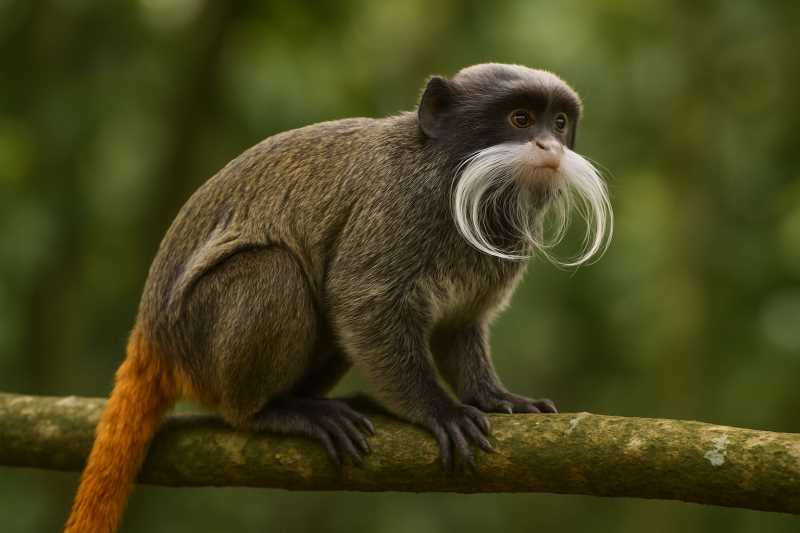
The Bearded Emperor Tamarin is easily recognizable due to its distinctive facial features. As its name suggests, one of its most defining characteristics is the long, white mustache that extends downward, giving it a regal appearance reminiscent of an emperor. This feature is not only striking but also serves as a key identifier for the species.
These tamarins are small in size, with adults weighing between 500 to 600 grams and measuring approximately 23 to 26 centimeters in body length, excluding the tail. The tail itself is notably long, often reaching up to 40 centimeters, aiding in balance as they navigate the forest canopy. Their fur is predominantly grey with a slight reddish hue on the lower back, while the hands and feet are black. The contrast between the dark body and the white mustache makes them easily distinguishable from other tamarin species.
Their limbs are adapted for gripping and leaping, with claw-like nails instead of the flat nails seen in other primates, which assist them in climbing and foraging among tree branches.
Range and Habitat
The Bearded Emperor Tamarin is native to the tropical rainforests of the Amazon Basin, specifically in regions spanning northern Bolivia, western Brazil, and southeastern Peru. These areas are characterized by dense, humid forests with a rich biodiversity, providing ample resources and shelter for tamarin populations.
They predominantly reside in the middle to lower canopy layers of the forest, where they can exploit a wide range of food sources. The complex structure of the rainforest canopy allows them to move efficiently in search of food while avoiding predators. Despite their adaptability, Bearded Emperor Tamarins are sensitive to habitat disturbance, making them vulnerable to deforestation and habitat fragmentation.
Behavior and Diet
Bearded Emperor Tamarins are diurnal animals, primarily active during the day. They live in small social groups typically consisting of 4 to 15 individuals. These groups are highly social and exhibit a complex hierarchy, with a dominant breeding pair and their offspring forming the core of the troop.
Communication within the group is vital and is facilitated through various vocalizations, body postures, and facial expressions. Grooming each other is a common social activity that helps to reinforce social bonds and maintain group cohesion.
Their diet is omnivorous, comprising fruits, flowers, nectar, insects, and small vertebrates. The availability of food resources can vary seasonally, and Bearded Emperor Tamarins have adapted by being opportunistic feeders. Their small size allows them to exploit food sources unavailable to larger primates, giving them a competitive edge in the dense forest environment.
Identification Tips (Field Recognition Cues)
Identifying the Bearded Emperor Tamarin in the wild can be an exciting challenge for wildlife enthusiasts. Here are some key recognition cues:
- Distinctive Mustache: Look for the prominent white mustache that contrasts sharply with their darker fur. This feature is a primary identifier.
- Small Size with Long Tail: Their small body size combined with a proportionally long tail is characteristic of the species, aiding in their agility.
- Coloration: Note the grey fur with a reddish tint on the back and black limbs. This color pattern is consistent among individuals.
- Behavior: Observe their agile movements through the canopy. They often leap between branches and are active during daylight hours.
- Social Structure: Spotting groups rather than solitary individuals can also be indicative, as they are highly social animals.
Conservation Status (with Threats and Protections)
The Bearded Emperor Tamarin is currently classified as Near Threatened on the IUCN Red List. The primary threats to their survival include habitat destruction due to logging, agriculture, and infrastructure development. These activities lead to fragmentation of their forest habitat, which can isolate populations and reduce genetic diversity.
Conservation efforts are focused on habitat preservation and restoration, as well as the establishment of protected areas to safeguard existing populations. Environmental education and sustainable development initiatives are also crucial in regions where human-tamarin interactions are significant.
Furthermore, research and monitoring programs are essential to better understand their ecology and adapt conservation strategies accordingly. International cooperation and legal protections under various environmental agreements also play a pivotal role in their conservation.
Frequently Asked Questions
1. What makes the Bearded Emperor Tamarin different from other tamarins?
The Bearded Emperor Tamarin is distinguished by its striking white mustache, small size, and specific coloration patterns. Unlike some other tamarin species, they have a particular affinity for certain forest layers and a unique social structure.
2. Where can I observe Bearded Emperor Tamarins in the wild?
These tamarins are found in the Amazon rainforest areas of northern Bolivia, western Brazil, and southeastern Peru. Visiting protected areas and reserves within these regions increases the likelihood of encountering them.
3. What are the main threats to the Bearded Emperor Tamarin?
The main threats include habitat loss due to deforestation, agriculture, and infrastructure development. Conservation efforts focus on habitat preservation and legal protection.
4. How do Bearded Emperor Tamarins communicate?
They communicate through a combination of vocalizations, body language, and grooming behaviors. These forms of communication are essential for maintaining social bonds and coordinating group activities.
5. Are Bearded Emperor Tamarins kept in zoos or conservation centers?
Yes, some zoos and conservation centers have Bearded Emperor Tamarins as part of their conservation and education programs, helping raise awareness about their natural habitat and the threats they face.
Related posts