Introduction
The vicuña (Lama vicugna) is a captivating mammal native to the Andean highlands of South America. Known for its fine, luxurious wool, the vicuña is a symbol of Peru, where it holds significant cultural and economic importance. This species, a close relative of the alpaca, llama, and guanaco, plays a crucial role in the biodiversity of its habitat. Understanding the vicuña’s unique characteristics and ecological significance is essential for conservation efforts aimed at preserving this iconic species.
Physical Description
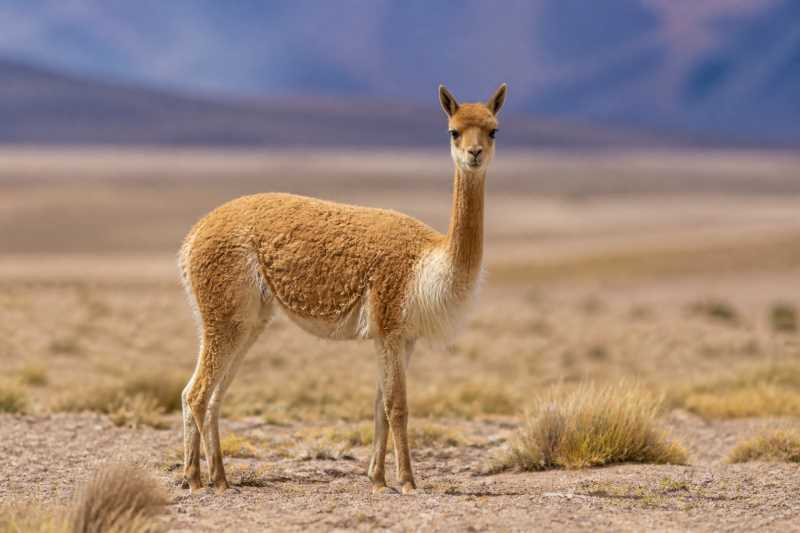
Vicuñas are the smallest members of the camelid family, standing at about 80 to 100 centimeters at the shoulder and weighing between 35 to 50 kilograms. Their slender bodies are covered with a dense, soft fleece that is highly prized for its warmth and softness. The wool is a light cinnamon color with white underparts, creating a striking contrast. Vicuñas have large, dark eyes and long, slender legs adapted for swift movement across rugged terrain. Their small heads are adorned with pointed ears, and a graceful neck enhances their elegant appearance.
Range and Habitat
Vicuñas inhabit the high-altitude regions of the Andes, ranging from southern Peru through Bolivia, northwestern Argentina, and northern Chile. They are typically found at elevations between 3,200 and 4,800 meters, where they graze on the sparse grasses of the puna and altiplano ecosystems. These habitats are characterized by harsh conditions, including extreme temperature fluctuations, strong winds, and limited water sources. Vicuñas have adapted to these conditions with physiological traits that enable efficient oxygen use and water conservation.
Behavior and Diet
Vicuñas are social animals that live in family groups consisting of a dominant male, several females, and their offspring. These groups graze together during the day and rest at night. Vicuñas communicate through a series of vocalizations and body language cues, which help maintain group cohesion and signal danger.
Their diet primarily consists of grasses and other low-lying vegetation found in their high-altitude habitats. Vicuñas are selective feeders, preferring nutrient-rich plants that provide the energy needed to survive in their challenging environment. Their specialized digestive systems allow them to extract maximum nutrients from their food, which is essential for their survival in nutrient-poor regions.
Identification Tips (Field Recognition Cues)
To identify a vicuña in the field, look for these key characteristics:
- Size and Build: Smaller and more delicate than llamas and alpacas.
- Coloration: Light cinnamon-colored wool with white underparts.
- Group Behavior: Often seen in small family groups.
- Habitat: High-altitude Andean regions.
- Movement: Graceful and fast, adapted for rocky terrains.
Conservation Status (with Threats and Protections)
The vicuña is currently classified as a species of "Least Concern" by the International Union for Conservation of Nature (IUCN), thanks to successful conservation efforts. However, they were once considered endangered, primarily due to poaching for their valuable wool. Today, threats include habitat loss from agricultural expansion and climate change.
Conservation measures have been implemented, such as sustainable shearing programs and protected areas, which have significantly improved their populations. These programs ensure that vicuñas can be shorn without harm, providing economic benefits to local communities while conserving the species.
Frequently Asked Questions
What is the main use of vicuña wool?
Vicuña wool is one of the finest natural fibers in the world, highly valued for its softness, warmth, and rarity. It is used to make luxury garments and textiles.
How do vicuñas survive in high-altitude environments?
Vicuñas have adapted to high-altitude living with efficient oxygen utilization and water conservation. Their hemoglobin has a high oxygen affinity, crucial for survival at elevations over 4,000 meters.
Are vicuñas domesticated like alpacas and llamas?
No, vicuñas are not domesticated. They remain wild animals and are protected by law to prevent poaching and exploitation.
How can vicuña populations be protected?
Conservation efforts include sustainable shearing practices, habitat protection, and community engagement to prevent poaching and ensure the species’ long-term survival.
What is the difference between a vicuña and an alpaca?
Vicuñas are smaller, have finer wool, and are wild, whereas alpacas are domesticated, breed for wool production, and have a more robust build.
Related posts