Sowerby’s Beaked Whale (Mesoplodon bidens)
Introduction
Sowerby’s Beaked Whale, scientifically known as Mesoplodon bidens, is a lesser-known marine mammal belonging to the family Ziphiidae. Discovered in the early 19th century by marine biologist James Sowerby, this elusive species is recognized for its deep-diving capabilities and distinctive beak-like jaw structure. Despite its relatively recent discovery, much about its behavior and ecology remains shrouded in mystery due to its preference for deep offshore waters, making it a fascinating subject for marine researchers and enthusiasts alike.
Physical Description
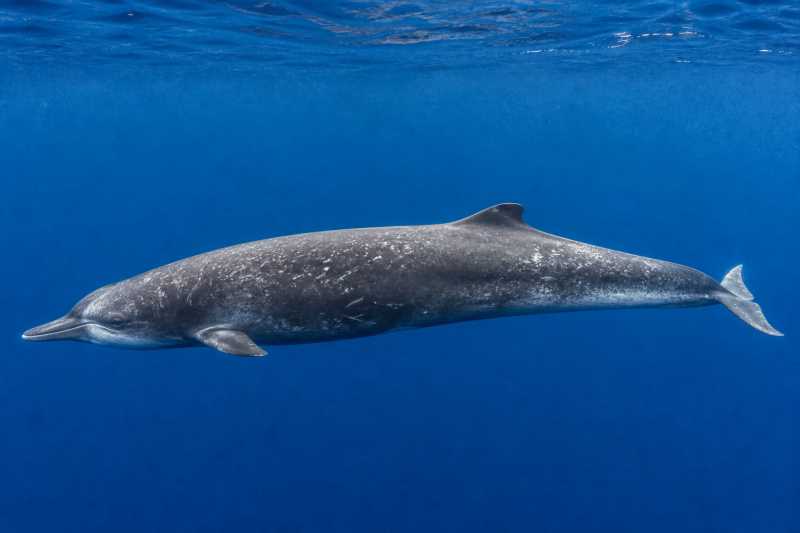
Sowerby’s Beaked Whale is characterized by its sleek, spindle-shaped body, typical of members of the beaked whale family. Adults generally reach lengths of 4.5 to 5.5 meters (approximately 15 to 18 feet) and weigh between 1,000 and 1,300 kilograms (around 2,200 to 2,900 pounds). The whale’s coloration is predominantly a dark bluish-gray on the dorsal side, fading to lighter shades on the ventral side.
One of the most distinctive features of M. bidens is its elongated beak, which is more pronounced than in many other cetaceans. This feature is complemented by a slightly bulbous forehead, known as the "melon," which is used for echolocation. The species also possesses a pair of small, triangular pectoral fins and a dorsal fin located approximately two-thirds down the back.
Male Sowerby’s Beaked Whales can be distinguished by two prominent teeth that protrude from the lower jaw, a characteristic feature used in intraspecies competition and display. These teeth are not present in females, which contributes to sexual dimorphism within the species.
Range and Habitat
Sowerby’s Beaked Whale is primarily found in the North Atlantic Ocean, with a range extending from the eastern coasts of North America to the waters of Western Europe. Their habitat includes deep, offshore waters where they are known to inhabit depths ranging from 200 meters to over 1,000 meters.
Preferring temperate and subarctic regions, they are often observed in the North Atlantic’s eastern and western margins, including the waters off the British Isles, Scandinavia, and occasionally as far south as the Azores. The species is also known to frequent areas characterized by steep underwater topography, such as continental slopes and underwater canyons, which provide ideal conditions for their deep-diving foraging habits.
Behavior and Diet
Sowerby’s Beaked Whales are deep-diving cetaceans, capable of reaching depths exceeding 1,000 meters in pursuit of prey. Their diet primarily consists of deep-sea squid, fish, and crustaceans, which they locate using sophisticated echolocation abilities. These whales are known for their extended dive times, often remaining submerged for up to an hour.
Socially, Sowerby’s Beaked Whales are typically encountered in small, cohesive groups, suggesting a complex social structure. Groups generally consist of 3 to 10 individuals, although solitary sightings have also been recorded. Little is known about their breeding habits due to the challenges of studying these elusive creatures in their natural habitat.
Identification Tips
Identifying Sowerby’s Beaked Whale in the field can be challenging due to their elusive nature and preference for deep waters. However, several key features can aid in their recognition:
- Beak Shape: The elongated, narrow beak is a distinctive trait.
- Body Size and Shape: Look for a spindle-shaped body with a small, triangular dorsal fin positioned far back from the head.
- Coloration: Note the dark bluish-gray coloration that fades to a lighter belly.
- Teeth in Males: If visible, the protruding teeth in males are a distinguishing feature.
- Surfacing Behavior: Sowerby’s Beaked Whales often surface with minimal splash and exhibit a characteristic rolling motion.
Conservation Status
As of the latest assessments, Sowerby’s Beaked Whale is listed as "Data Deficient" by the International Union for Conservation of Nature (IUCN). This classification underscores the lack of comprehensive data on their population trends and threats.
Threats
The primary threats facing M. bidens include:
- Bycatch: Incidental capture in fishing gear poses a significant risk.
- Noise Pollution: Increased underwater noise from shipping and naval activities can disrupt echolocation and communication.
- Climate Change: Shifts in ocean temperatures and prey availability may impact their habitat and foraging success.
Protections
Sowerby’s Beaked Whale is protected under various international agreements, including the Convention on International Trade in Endangered Species of Wild Fauna and Flora (CITES), which regulates the trade of marine species to prevent exploitation.
Frequently Asked Questions
What is the primary diet of Sowerby’s Beaked Whale?
Sowerby’s Beaked Whale primarily feeds on deep-sea squid, fish, and crustaceans. They utilize echolocation to locate their prey during deep dives.
How deep can Sowerby’s Beaked Whale dive?
These whales are capable of diving to depths exceeding 1,000 meters (over 3,280 feet) in pursuit of prey, remaining submerged for up to an hour.
Where can Sowerby’s Beaked Whales be found?
They inhabit the North Atlantic Ocean, ranging from the eastern coast of North America to Western Europe, often frequenting areas with steep underwater topography.
Are Sowerby’s Beaked Whales endangered?
Currently, they are classified as "Data Deficient" by the IUCN, meaning there is insufficient data to determine their conservation status accurately.
How can you identify a Sowerby’s Beaked Whale?
Key identification features include a narrow beak, spindle-shaped body, small triangular dorsal fin, and, in males, protruding teeth.
Related posts