Introduction
The Red Slender Loris (Loris tardigradus) is a unique and captivating primate that has captured the interest of scientists and animal enthusiasts alike. Native to the lush forests of Sri Lanka, this nocturnal mammal is renowned for its distinct features and intriguing behaviors. As a member of the Lorisidae family, the Red Slender Loris plays an essential role in its ecosystem. This article delves deep into the various aspects of this fascinating species, offering insights into its physical characteristics, habitat, behavior, and conservation status.
Physical Description
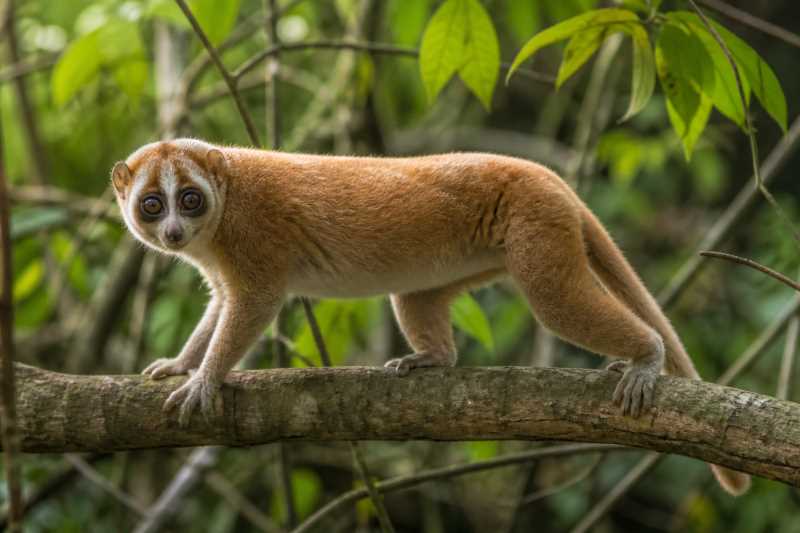
The Red Slender Loris is a small, arboreal primate, characterized by its slender body and long limbs. This species typically measures between 17 to 26 centimeters in length, with a weight ranging from 85 to 160 grams. Its most striking feature is its large, forward-facing eyes, which are perfectly adapted for nocturnal vision, allowing it to hunt efficiently in the dark. The loris’s coat is short and dense, varying in color from reddish-brown to gray, which provides excellent camouflage among the forest canopy. Additionally, its face is marked by a distinct white stripe running from the forehead to the nose, bordered by dark rings around the eyes, enhancing its characteristic appearance.
Range and Habitat
The Red Slender Loris is endemic to Sri Lanka, predominantly inhabiting the island’s wet and dry zones. Its range extends across several forested areas, including lowland rainforests, montane forests, and even scrublands. This adaptability to various habitats is crucial for its survival, as it allows the loris to exploit a range of resources. However, it prefers dense, mature forests with a rich understory, which provide ample food and shelter. The complex forest structure also aids in protection from predators and serves as a conduit for movement and communication within its territory.
Behavior and Diet
As a nocturnal and arboreal creature, the Red Slender Loris spends most of its active life in trees. It is a solitary animal, although it occasionally forms loose social groups. Communication with conspecifics is achieved through a combination of vocalizations, scent marking, and tactile interactions. The diet of the Red Slender Loris is primarily insectivorous, consisting mainly of insects and other invertebrates. However, it also consumes fruits, leaves, and small vertebrates, which supplement its nutritional intake. Its slow and deliberate movement is an adaptation that aids in stealthy hunting, allowing it to capture prey with precision.
Identification Tips (field recognition cues)
Identifying the Red Slender Loris in the wild requires careful observation due to its elusive nature and preference for nocturnal activity. Here are some key identification tips:
- Large Eyes: Look for the large, reflective eyes that shine in the dark, a hallmark of night vision adaptation.
- Distinct Coloration: Note the reddish-brown to gray coat and the white facial stripe with dark eye rings.
- Slender Build: Observe the slim body and long limbs, which are disproportionally elongated compared to its small size.
- Slow Movements: Spot its unique, measured movements along tree branches, as it rarely makes rapid or sudden motions.
Conservation Status (with threats and protections)
The Red Slender Loris is currently classified as "Near Threatened" on the IUCN Red List due to habitat loss and fragmentation. Deforestation, driven by agriculture, urbanization, and logging, poses the greatest threat to its survival. Additionally, hunting and capturing for the illegal pet trade further exacerbate its decline. Conservation efforts are underway to protect and restore its habitat, including reforestation projects and the establishment of protected areas. Community-based conservation initiatives aim to raise awareness and engage local populations in preserving these unique primates. Legal protections under Sri Lankan law also exist to curb illegal trade and hunting activities.
Frequently Asked Questions
What adaptations help the Red Slender Loris survive in its environment?
The Red Slender Loris possesses several adaptations that aid in its survival, such as its large eyes for enhanced nocturnal vision, a keen sense of smell, and a flexible spine for navigating tree branches. Its slow movements help it avoid detection by predators and increase hunting success.
How do Red Slender Lorises communicate?
Red Slender Lorises communicate through vocalizations, such as whistles and clicks, as well as scent markings and physical contact. These methods facilitate social interactions, territory marking, and mating behaviors.
Are Red Slender Lorises endangered?
While not yet classified as endangered, the Red Slender Loris is listed as "Near Threatened" due to habitat destruction and hunting pressures. Conservation efforts are critical to ensuring their continued survival.
What is the primary diet of the Red Slender Loris?
The Red Slender Loris primarily feeds on insects and other invertebrates. It also consumes fruits, leaves, and occasionally small vertebrates, which provide additional nutrients.
How can I help in the conservation of the Red Slender Loris?
Supporting conservation organizations, promoting sustainable forest management, and advocating for stronger wildlife protection laws can all contribute to the conservation of the Red Slender Loris and its habitat.
Related posts