Introduction
The Mainland Clouded Leopard (Neofelis nebulosa) is one of the most enigmatic and elusive big cats in the world. Named for the cloud-like patterns on its coat, this feline is a relic of the ancient forests it inhabits. Found primarily in Southeast Asia, the Mainland Clouded Leopard is not only known for its striking appearance but also for its essential role in the ecosystem as a top predator. This article delves into the various aspects of this fascinating species, from its physical description to its conservation status, providing a comprehensive overview for wildlife enthusiasts and researchers alike.
Physical Description
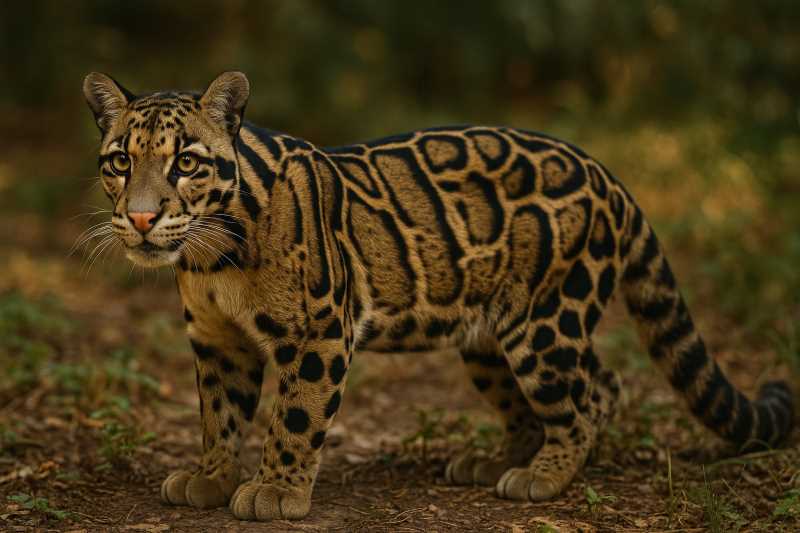
Mainland Clouded Leopards are medium-sized feline predators. They are characterized by their distinctive coat, which features large, irregular cloud-like spots bordered in black on a tawny or grayish background. This unique pattern is not just beautiful but serves as camouflage in their forested environments.
These leopards possess a sturdy build, with a body length ranging from 70 to 105 cm (28 to 41 inches) and a tail almost as long as the body, measuring between 61 to 91 cm (24 to 36 inches). Their weight varies between 15 to 23 kg (33 to 50 pounds), making them relatively small compared to other big cats. Clouded leopards have short, powerful legs, which aid in climbing, and large paws equipped with sharp retractable claws.
One of the most striking features of the Mainland Clouded Leopard is its elongated canine teeth, which are proportionately the longest of any living feline. These teeth resemble those of the prehistoric saber-toothed cats, and it’s hypothesized that they are adapted for puncturing and holding onto prey.
Range and Habitat
The Mainland Clouded Leopard inhabits the dense tropical and subtropical forests of Southeast Asia. Its range extends from the foothills of the Himalayas in Nepal and India, through Bhutan, Myanmar, Thailand, the Malay Peninsula, and into parts of Vietnam, Laos, and Cambodia.
These cats are arboreal and terrestrial, spending a significant amount of time in trees, which provide safety from larger predators and a vantage point for hunting. The dense forests they inhabit are crucial for their survival, offering ample cover and a variety of prey species.
Deforestation and habitat fragmentation pose significant threats to their habitat. As forests are cleared for agriculture and human settlement, the clouded leopards’ territory is diminished, leading to increased competition for resources and greater vulnerability to poaching and human-wildlife conflict.
Behavior and Diet
Mainland Clouded Leopards are solitary and nocturnal, primarily active during the night and at dawn and dusk. Their arboreal skills are exceptional; they can climb down trees headfirst, hang upside down beneath branches, and leap from tree to tree with ease.
Their diet consists mainly of arboreal and terrestrial mammals. They prey on a variety of animals, including deer, monkeys, squirrels, birds, and pigs. Occasionally, they might also hunt smaller animals such as porcupines and slow lorises. Their powerful jaws and teeth are used to deliver a crushing bite to the neck of their prey, ensuring a quick kill.
Identification Tips (Field Recognition Cues)
Identifying a Mainland Clouded Leopard in the wild can be challenging due to its elusive nature and the dense habitats it prefers. However, some key identification cues can assist observers:
- Coat Pattern: Look for the distinctive cloud-like spots on a tawny or grayish background.
- Size and Build: Note the medium size, robust build, and relatively short legs.
- Tail: The tail is long and thick, often used for balance while navigating through trees.
- Behavior: Observe their arboreal behavior, such as climbing and resting in trees.
Conservation Status (With Threats and Protections)
The Mainland Clouded Leopard is classified as Vulnerable on the IUCN Red List. The primary threats to their survival include habitat loss due to deforestation, poaching for their beautiful pelts and bones, and illegal wildlife trade.
Conservation efforts are underway to protect these magnificent cats. Several countries within their range have established protected areas and national parks to conserve their habitats. Organizations are also working on anti-poaching measures and raising awareness about the species.
Collaboration between governments, non-governmental organizations, and local communities is essential to ensure the survival of the Mainland Clouded Leopard. Continued research is crucial to better understand their ecology and to implement effective conservation strategies.
Frequently Asked Questions
1. What is the primary habitat of the Mainland Clouded Leopard?
Mainland Clouded Leopards primarily inhabit dense tropical and subtropical forests in Southeast Asia. They rely on these forests for cover, hunting, and safety from larger predators. The dense canopy offers them a perfect environment to utilize their exceptional climbing skills.
2. How do Mainland Clouded Leopards hunt?
These leopards are adept hunters, utilizing both arboreal and terrestrial strategies. They rely on stealth and the element of surprise, often ambushing prey from trees or dense underbrush. Their powerful jaws and elongated canine teeth make them efficient predators, capable of delivering a fatal bite to their prey.
3. Are Mainland Clouded Leopards endangered?
Yes, Mainland Clouded Leopards are classified as Vulnerable. The major threats to their survival include habitat destruction, poaching, and illegal wildlife trade. Conservation efforts are focused on habitat protection, anti-poaching measures, and raising awareness about the species.
4. Can Mainland Clouded Leopards be kept as pets?
No, Mainland Clouded Leopards are wild animals and should not be kept as pets. They have specific ecological needs that cannot be met in a domestic setting. Furthermore, keeping them as pets is illegal in many countries due to their protected status.
5. How can I help in the conservation of Mainland Clouded Leopards?
You can contribute to their conservation by supporting organizations dedicated to wildlife protection, spreading awareness about the threats they face, and advocating for sustainable practices that protect their habitats. Additionally, visiting responsibly managed wildlife reserves can help fund conservation efforts.
Related posts