Introduction
Illiger’s Saddle-back Tamarin (Saguinus illigeri) represents an enchanting species within the primate family, known for its distinctive markings and dynamic social behavior. Native to the dense rainforests of the Amazon basin, this species contributes significantly to the ecological diversity and biological richness of its habitat. The tamarin’s role in seed dispersion and as part of the food chain underscores its ecological importance, while its unique characteristics have made it a subject of interest among researchers and wildlife enthusiasts alike.
Physical Description
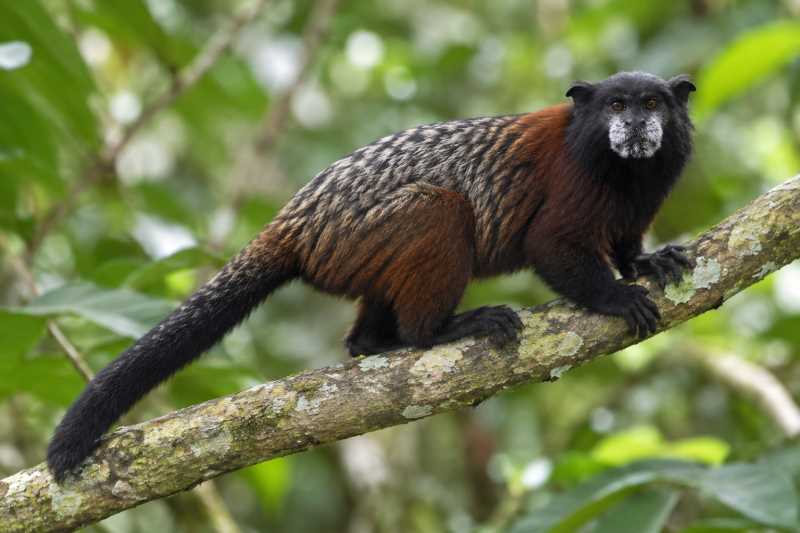
Illiger’s Saddle-back Tamarin is a small primate, characterized by its diminutive size and striking coloration. Adults typically weigh between 300 to 450 grams and measure around 20 to 30 centimeters in body length, with a tail that extends an additional 25 to 35 centimeters. The species is named for the saddle-like patch of reddish-brown fur that adorns its back, contrasting with its predominantly black and gray body. Its face is framed by a short, white mustache, and it possesses sharp, claw-like nails, which are adaptations for its arboreal lifestyle.
The tamarin’s dense fur serves as insulation against the humid and often cool rainforest climate. Its large, expressive eyes are well-suited for the low-light conditions of its forest environment, aiding in foraging and predator awareness.
Range and Habitat
Illiger’s Saddle-back Tamarin is endemic to the western Amazon rainforest, with a range that primarily encompasses parts of Peru and Brazil. This species thrives in diverse forest habitats, including primary rainforests, secondary growth forests, and occasionally in forest edges and floodplains.
The tamarin’s preference for dense canopies provides both a rich source of food and protection from predators. These habitats are characterized by high biodiversity, with a complex structure of trees, shrubs, and vines that support the tamarin’s arboreal lifestyle. Despite this adaptability, the tamarin’s habitat is increasingly threatened by deforestation and environmental changes.
Behavior and Diet
Illiger’s Saddle-back Tamarin exhibits complex social behavior, living in groups typically consisting of 2 to 15 individuals. These groups have a hierarchical structure often led by a dominant breeding pair. Communication within the group is maintained through a variety of vocalizations, body postures, and facial expressions.
The tamarin is primarily diurnal, spending its days foraging for food. Its diet is omnivorous, consisting of fruits, insects, small vertebrates, and occasionally nectar. The species plays a crucial role in seed dispersal, as it consumes fruits and excretes seeds, facilitating plant reproduction.
Identification Tips
Identifying Illiger’s Saddle-back Tamarin in the field requires attention to several distinct features:
- Coloration: Look for the reddish-brown "saddle" on its back, contrasting with darker fur on the body.
- Size: Note the small stature, comparable to a small squirrel.
- Tail: A long, non-prehensile tail often held erect while moving through the trees.
- Facial Features: A white mustache and expressive eyes are distinctive identifiers.
- Behavior: Observe the social interactions and vocalizations within groups, often observed in the canopy.
Conservation Status
Currently, Illiger’s Saddle-back Tamarin is listed as a species of Least Concern by the IUCN. However, ongoing threats could alter this status if not addressed. The primary threats include habitat destruction due to logging, agriculture, and urban expansion.
Despite these threats, some conservation efforts have been implemented. Protected areas within its range have been established, and local conservation projects aim to reduce habitat destruction and promote sustainable land use practices.
Continued research and monitoring are vital to ensure this species does not become endangered. Conservationists advocate for increased awareness and protection of its natural habitat to prevent further population decline.
Frequently Asked Questions
Q1: What is the lifespan of Illiger’s Saddle-back Tamarin in the wild? A: In the wild, Illiger’s Saddle-back Tamarin typically lives for about 10 to 12 years. In captivity, with optimal care, they may live slightly longer, up to 15 years.
Q2: How does Illiger’s Saddle-back Tamarin contribute to its ecosystem? A: This tamarin plays a crucial role in seed dispersal, aiding forest regeneration. It also contributes to the food chain as both predator and prey, maintaining ecological balance.
Q3: What are the main threats to Illiger’s Saddle-back Tamarin? A: The primary threats include habitat destruction due to deforestation, illegal wildlife trade, and competition with other species due to habitat fragmentation.
Q4: What adaptations help Illiger’s Saddle-back Tamarin survive in the rainforest? A: Adaptations such as sharp claws for climbing, a varied diet, and social behaviors for protection enhance its survival in the dense rainforest environment.
Q5: Are there any specific conservation programs in place for this species? A: Yes, several local and international conservation programs focus on habitat protection and sustainable land use practices to preserve the tamarin’s natural environment.
Related posts