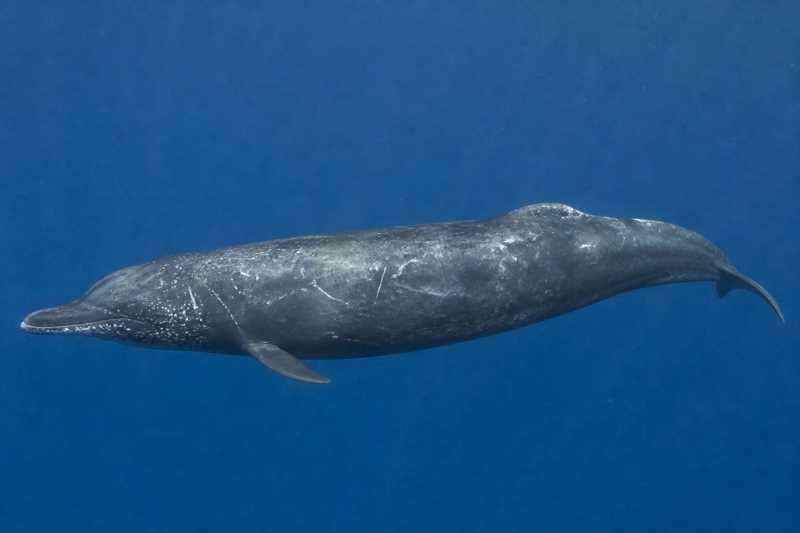
Gervais’s Beaked Whale (Mesoplodon europaeus)
Introduction
Gervais’s Beaked Whale, scientifically known as Mesoplodon europaeus, is one of the lesser-known members of the beaked whale family, Ziphiidae. This elusive species is primarily found in the warm temperate and tropical waters of the Atlantic Ocean. First described by French naturalist Paul Gervais in 1855, these whales are characterized by their deep-diving abilities and unique physical features. Despite their elusive nature, marine biologists have made significant strides in understanding their ecology, behavior, and conservation needs.
Physical Description
Gervais’s Beaked Whale possesses a streamlined body adapted for efficient swimming and deep-sea diving. Adults typically range from 4.5 to 5.2 meters in length and weigh between 1,000 to 1,200 kilograms. The species exhibits sexual dimorphism, with males being slightly larger than females.
The whale’s skin is generally dark gray to bluish-black, with lighter patches on the belly. Males display distinctive scarring, likely from intraspecific competition or interactions with other marine life. These scars are particularly prominent around the head and back.
One of the most notable features of Gervais’s Beaked Whale is its beak, which is long and slender, giving the whale its name. The dorsal fin is small and positioned towards the rear of the body, while the flippers are short and rounded.
Range and Habitat
Gervais’s Beaked Whale is found primarily in the warm waters of the Atlantic Ocean. Their range extends from the southeastern coast of the United States and the Gulf of Mexico to the Caribbean Sea and as far south as Brazil. Occasional sightings have been reported in the eastern Atlantic, near the Azores and Canary Islands.
These whales prefer deep pelagic waters, often inhabiting areas beyond the continental shelf. They are typically found in regions with depths ranging from 200 meters to over 1,000 meters. Their affinity for deep waters is closely tied to their deep-diving behavior, which is essential for foraging.
Behavior and Diet
Gervais’s Beaked Whales are deep divers, capable of reaching depths of over 1,000 meters in search of food. They are known to dive for up to 90 minutes, though most dives last around 20 to 30 minutes. Their diet primarily consists of squid and deep-sea fish, which they locate using echolocation.
These whales are generally solitary or found in small groups, often consisting of a mother and her calf or small pods of up to five individuals. They are elusive and spend little time at the surface, making them challenging to study.
Communication among Gervais’s Beaked Whales is believed to involve a series of clicks and whistles, common in toothed whales. These vocalizations are essential for navigation and locating prey in the dark depths of the ocean.
Identification Tips (field recognition cues)
Identifying Gervais’s Beaked Whale in the field can be challenging due to their elusive nature and similarity to other beaked whale species. However, there are several key features to look for:
- Beak: Long and slender, more pronounced in males.
- Body Color: Dark gray to bluish-black with lighter patches on the belly.
- Dorsal Fin: Small and positioned far back on the body.
- Scarring: Males have prominent scars, particularly around the head.
- Surfacing Behavior: They surface briefly and tend to avoid boats.
Conservation Status (with threats and protections)
The International Union for Conservation of Nature (IUCN) currently lists Gervais’s Beaked Whale as "Data Deficient," meaning there is insufficient information to assess their population status accurately. However, several threats have been identified that may impact their survival:
- Bycatch: Accidental capture in fishing gear poses a significant threat to beaked whales.
- Ocean Noise: Increased noise pollution from shipping and military activities can disrupt their echolocation and communication.
- Pollution: Chemical pollutants and plastic debris in the ocean can have harmful effects.
- Climate Change: Changes in ocean temperatures and currents may affect their prey availability.
There are several international agreements and regulations aimed at protecting marine mammals, including Gervais’s Beaked Whale. These include the Marine Mammal Protection Act (MMPA) in the United States and the Convention on International Trade in Endangered Species (CITES).
Frequently Asked Questions
- What is the best time of year to see Gervais’s Beaked Whale?
Gervais’s Beaked Whales are most likely to be seen during the warmer months when they are more active near the surface. However, sightings are rare due to their elusive nature.
- How deep can Gervais’s Beaked Whale dive?
Gervais’s Beaked Whales are capable of diving to depths exceeding 1,000 meters. They typically dive for 20 to 30 minutes but can stay submerged for up to 90 minutes.
- What do Gervais’s Beaked Whales eat?
Their diet mainly consists of squid and deep-sea fish. They use echolocation to locate prey in the dark depths of the ocean.
- Are Gervais’s Beaked Whales social animals?
They are generally solitary or found in small groups, often consisting of a mother and her calf or small pods of up to five individuals.
- How can I help protect Gervais’s Beaked Whale?
You can contribute to their conservation by supporting organizations focused on marine conservation, advocating for reduced ocean noise, and reducing plastic waste.
Related posts