Introduction
Demidoff’s Dwarf Galago, scientifically known as Galagoides demidoff, is a small primate species that resides in the forests of Africa. This nocturnal creature is renowned for its agility and distinctive vocalizations. As one of the smallest members of the Galagidae family, Demidoff’s Dwarf Galago has captured the interest of primatologists and wildlife enthusiasts alike.
The species was named after the Russian aristocrat and explorer, Anatole Demidoff, who contributed to its discovery. These fascinating creatures play an important role in their ecosystem, serving as both predator and prey within their habitat. Understanding the characteristics and behaviors of Demidoff’s Dwarf Galago is crucial for their conservation and the protection of their natural environments.
Physical Description
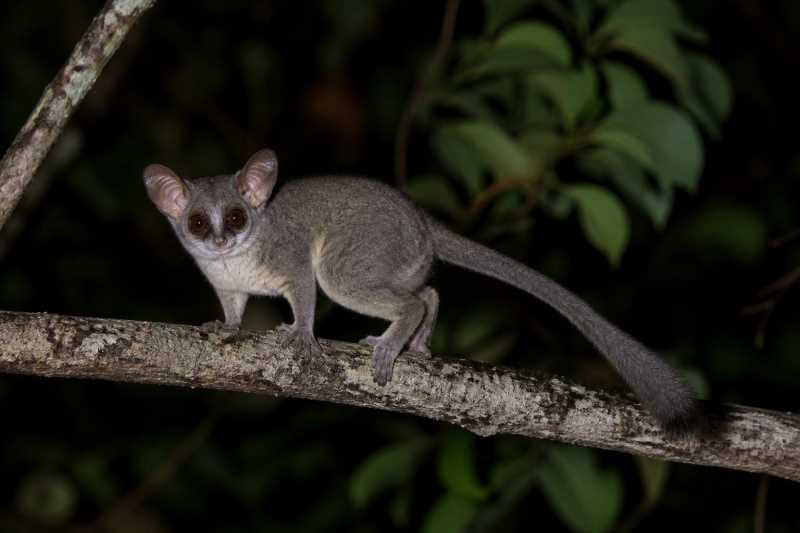
Demidoff’s Dwarf Galago is one of the smallest primates, with a body length ranging from 8 to 13 centimeters (3 to 5 inches) and a tail that extends up to 17 centimeters (6.7 inches). The tail is often longer than the body, aiding in balance and navigation through the treetops.
Weighing between 50 to 100 grams (1.8 to 3.5 ounces), this diminutive galago is covered in soft, dense fur that varies in color from gray-brown to reddish-brown. This fur not only provides warmth during cooler nights but also serves as camouflage against predators.
Their large, forward-facing eyes are a notable feature, providing excellent night vision crucial for their nocturnal lifestyle. The eyes are surrounded by dark rings, accentuating their alert appearance. Their ears are large and independently mobile, allowing them to detect even the faintest sounds in their environment.
Range and Habitat
Demidoff’s Dwarf Galago is predominantly found in the tropical and subtropical forests of West and Central Africa. Their range extends across countries such as Sierra Leone, Nigeria, Cameroon, Gabon, and the Democratic Republic of the Congo.
These primates are highly adaptable and can inhabit a variety of forest types, including primary and secondary forests, swamp forests, and even areas of human cultivation, provided there is sufficient tree cover. They prefer dense vegetation that offers ample foraging opportunities and protection from predators.
The galago’s arboreal lifestyle requires a habitat with an abundance of trees and shrubs, which they utilize for feeding, shelter, and navigating through the forest canopy.
Behavior and Diet
Demidoff’s Dwarf Galagos are primarily nocturnal, spending most of the night foraging for food and interacting with others in their social group. They are highly agile, using their powerful hind limbs to leap between branches and cover large distances in search of sustenance.
Their diet consists mainly of insects and other small invertebrates, supplemented by fruit, tree gum, and occasionally small vertebrates. The ability to exploit multiple food sources allows them to thrive in a variety of environments.
Socially, these galagos live in small family groups or solitary territories. Communication amongst them involves a complex system of vocalizations, olfactory signals, and body language. These methods are vital for maintaining social bonds and coordinating activities such as foraging and territory defense.
Identification Tips (Field Recognition Cues)
Identifying Demidoff’s Dwarf Galago in the field requires keen observation skills and familiarity with their distinctive features:
- Size and Shape: Look for a small primate with a body length of 8 to 13 cm and a tail that is often longer than the body.
- Eye Color and Shape: Notice the large, round eyes that reflect light at night, an adaptation for nocturnal vision.
- Ear Movement: Their large, mobile ears are constantly in motion, detecting sounds in the dense foliage.
- Vocalizations: Listen for their characteristic calls, which include a range of clicks, whistles, and chirps, often used for communication within their group.
- Fur Color: Observe the soft, dense, gray-brown to reddish-brown fur that aids in camouflage.
Conservation Status (With Threats and Protections)
Currently, Demidoff’s Dwarf Galago is classified as Least Concern by the International Union for Conservation of Nature (IUCN). However, like many forest-dwelling species, they face threats from habitat destruction due to logging, agriculture, and urban expansion.
Bushmeat hunting and the pet trade also pose significant risks to their populations. Although not currently endangered, continued habitat loss and exploitation could threaten their numbers in the future.
Conservation efforts focus on habitat preservation and the establishment of protected areas. Awareness and education campaigns aim to reduce hunting and promote sustainable land-use practices that benefit both local communities and wildlife.
Frequently Asked Questions
How do Demidoff’s Dwarf Galagos communicate? Demidoff’s Dwarf Galagos communicate through a variety of vocalizations, including clicks and whistles, as well as olfactory signals and body language. These methods help maintain social bonds and coordinate activities within their group.
What is the primary diet of Demidoff’s Dwarf Galago? Their diet mainly consists of insects and small invertebrates, but they also consume fruits, tree gum, and occasionally small vertebrates. This varied diet allows them to adapt to different environments.
Where can Demidoff’s Dwarf Galago be found? They are primarily found in the tropical and subtropical forests of West and Central Africa, including countries like Sierra Leone, Nigeria, and the Democratic Republic of the Congo.
What are the main threats to Demidoff’s Dwarf Galago? The main threats include habitat destruction due to logging and agriculture, as well as hunting for bushmeat and the pet trade. Conservation efforts focus on habitat preservation and sustainable practices.
How can one identify Demidoff’s Dwarf Galago in the wild? Identifying them involves noting their small size, large reflective eyes, mobile ears, distinctive vocalizations, and gray-brown to reddish-brown fur.
Related posts