Introduction
The Long-finned Pilot Whale (Globicephala melas) is a remarkable marine mammal recognized for its distinctive long pectoral fins and sociable behavior. These whales are members of the oceanic dolphin family and are known for their deep-sea excursions and complex social structures. Understanding their ecological role and conserving their populations is crucial as they face numerous environmental threats.
Physical Description
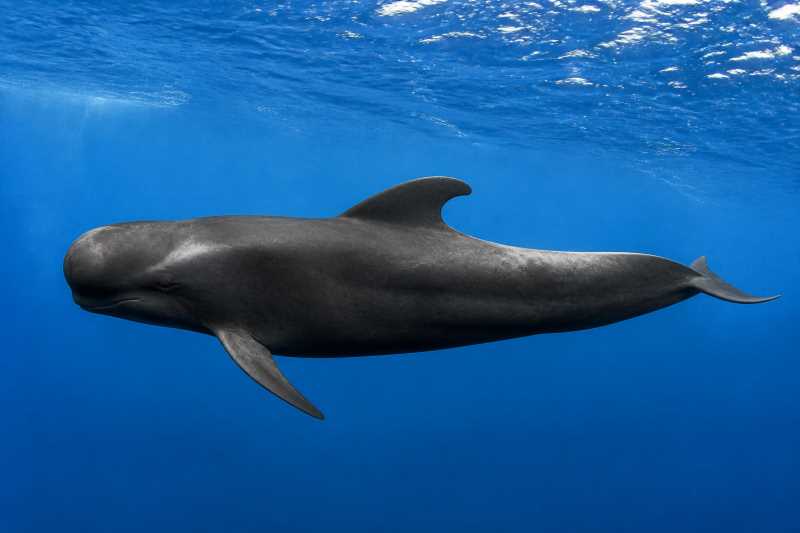
Long-finned Pilot Whales are medium-sized cetaceans, typically measuring between 6 to 7.5 meters in length and weighing up to 2,300 kilograms. They possess a robust, bulbous head with no beak, and their most distinctive feature is their elongated pectoral fins, which can be as long as 1.8 meters. Their coloration is generally dark gray to black, with a lighter patch behind each eye and a dorsal fin that is curved and set far forward on the back.
Range and Habitat
Globicephala melas are found in both the North Atlantic and Southern Hemisphere, preferring temperate and subpolar waters. They inhabit deep offshore waters but are also known to approach coastal areas, especially in pursuit of prey. Known for their seasonal migrations, these whales often travel in large pods, sometimes numbering hundreds of individuals.
Behavior and Diet
Long-finned Pilot Whales are highly social animals, living in matriarchal pods. These pods are characterized by strong social bonds, and members often engage in synchronized swimming and cooperative hunting. Their diet primarily consists of squid, but they also consume fish and other cephalopods. Foraging mainly occurs at night when their prey is closer to the surface.
Identification Tips (Field Recognition Cues)
To identify Long-finned Pilot Whales in the field, observers should look for their distinctive long pectoral fins and black coloration. They are often seen swimming in tight-knit groups and can be identified by their curved dorsal fin and bulbous head. They are sometimes confused with Short-finned Pilot Whales, but the length of the pectoral fins and geographic location can help in distinguishing between the two.
Conservation Status (With Threats and Protections)
The conservation status of Long-finned Pilot Whales is currently listed as "Least Concern" by the IUCN, but they face several threats including bycatch in fishing gear, climate change, and pollution. Conservation efforts are focused on reducing bycatch and protecting their natural habitat from industrial impacts. International agreements such as the Marine Mammal Protection Act in the United States also play a role in their conservation.
Frequently Asked Questions
What do Long-finned Pilot Whales eat? Long-finned Pilot Whales primarily feed on squid, but they also consume fish and other cephalopods, mainly during night-time foraging.
How can you tell Long-finned Pilot Whales apart from Short-finned Pilot Whales? The key difference lies in the length of the pectoral fins—Long-finned Pilot Whales have notably longer fins. Geographic location also helps, as their ranges do not typically overlap.
Are Long-finned Pilot Whales endangered? Currently, they are listed as "Least Concern," but they face threats such as bycatch and habitat degradation, which require ongoing conservation efforts.
Where can Long-finned Pilot Whales be found? They inhabit the North Atlantic and Southern Hemisphere, preferring temperate and subpolar waters, often found in deep offshore areas.
What is the social structure of Long-finned Pilot Whales? They live in matriarchal pods with strong social bonds, exhibiting behaviors such as synchronized swimming and cooperative hunting.
Related posts